

How to Read a Supplier Price Increase Letter
A supplier price increase letter annotated line by line: what a complete notice states, the gaps to question, and which of seven replies each calls for.
Contents
A supplier price increase letter is written to be accepted, not examined. It names a percentage, an effective date and a reason in one sentence, and leaves the rest to the attached price list. If you buy for a distributor, wholesaler or manufacturer, the letter on your desk probably changes more than the headline says, and the reply you send should depend on what it leaves out.
This guide takes one example manufacturer price increase letter to a distributor, annotates it line by line, shows how to work out what it really changes, and maps each gap to the reply it calls for. The full method for testing whether an increase is justified sits in the guide on how to respond to a supplier price increase. This page is about the document itself.
In Short
- Read the letter for what it changes besides the list price: discount, surcharges, carriage thresholds, minimum orders and the date basis.
- Convert everything into one number: the change in your net, invoiced price per unit. That is often well above the headline.
- A complete notice states scope, item-level changes, effective date and its basis, treatment of acknowledged orders, the cost drivers with shares and evidence, other terms and validity.
- Every missing element becomes a numbered question in your reply.
- What the letter shows decides which of seven replies to send, from asking for the breakdown to declining.
- Log three dates on day one: the notice date, the effective date and your own reply-by date.
The Letter, Annotated
Below is an example letter from a power tool manufacturer to its UK distributors. It is typical in structure: short, polite, and built around an average.
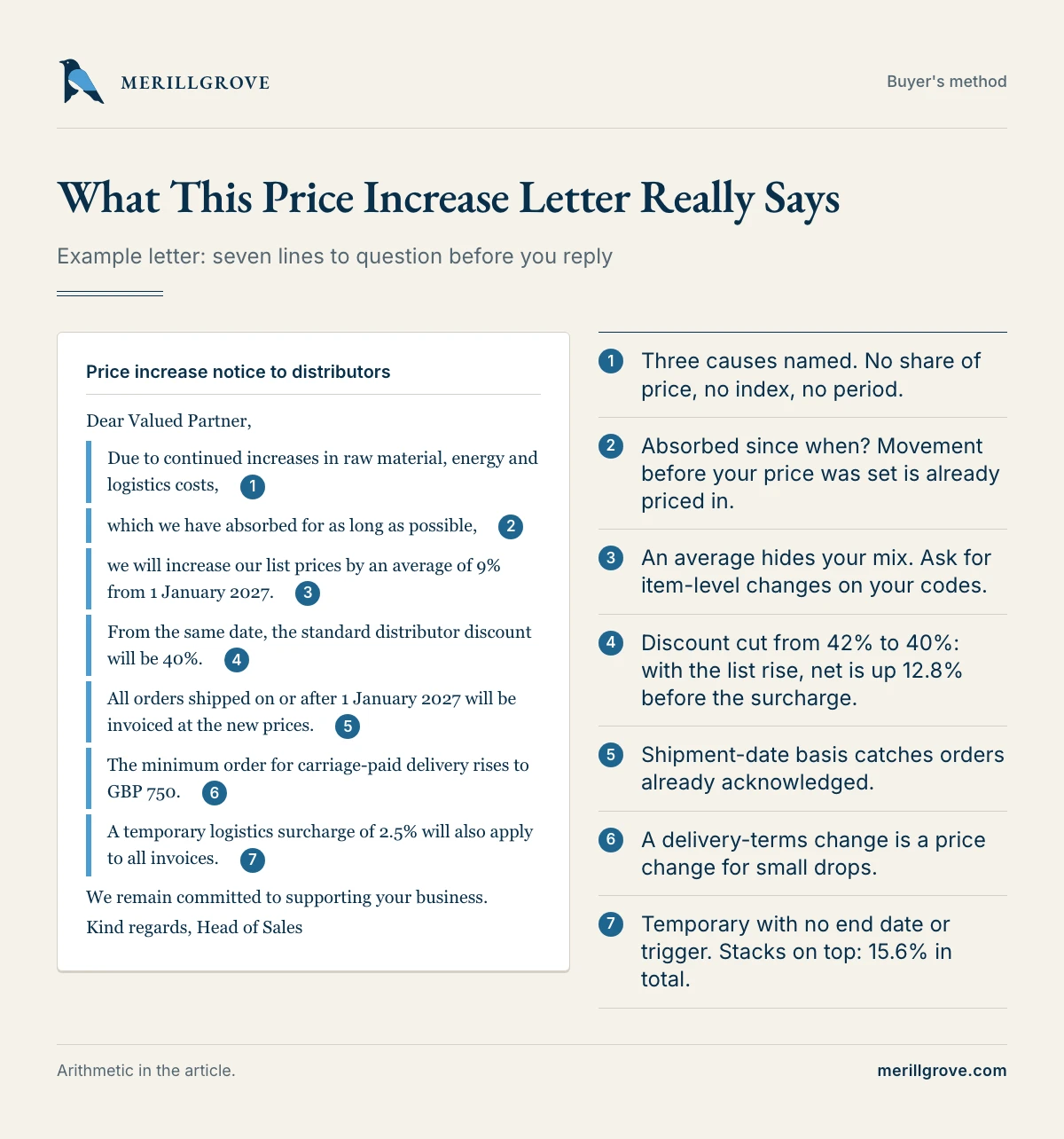 *A manufacturer price increase letter to distributors, with the gaps a buyer should question.*
Taking the notes in order:
1. "Raw material, energy and logistics costs." Three cost drivers are named. None has a share of the price, a measured movement, a period or an index. You cannot test a reason that has no numbers attached, so this line generates your first questions. Economy-wide figures do not settle it either way: the ONS reported UK input producer prices up 6.1% and output prices up 3.7% in the year to August 2026. Those are averages across all of industry. They neither prove nor disprove 9% on your product.
2. "Absorbed for as long as possible." This is tone, not evidence. It implies the increase covers several periods of cost movement. Ask from which date the costs are being measured. Your current price was set on a known date; movement before that date was already priced in.
3. "An average of 9%." An average across a price list hides the spread. Some lines may rise 4%, others 15%. Your exposure depends on your mix, not the catalogue's. Ask for the item-level change on the codes you buy, or compare the old and new lists yourself.
4. "The standard distributor discount will be 40%." This is the most expensive line in the letter, and it is not in the headline. A cut from 42% to 40% raises your net price on its own. The arithmetic is below.
5. "All orders shipped on or after 1 January." The letter uses the shipment date, not the order date. Orders you placed and had acknowledged in November, due to ship in January, would be invoiced at the new price. Ask for acknowledged orders to be supplied at the price on the acknowledgement.
6. "Carriage-paid threshold rises to £750." A change to delivery terms is a price change for any branch that orders in smaller drops. Count how many of last year's orders fell below the new threshold.
7. "A temporary logistics surcharge of 2.5%." Temporary with no end date, no trigger and no index is permanent until someone challenges it. It also stacks on top of the list increase. Ask what freight measure it tracks and what reading would remove it.
What the letter does not say matters as much: there is no statement of how long the new prices will be held, and no mention of whether minimum order quantities, payment terms or lead times are changing.
What a Manufacturer Price Increase Letter Really Changes
Put every change into one number: what you will pay per unit, net, on the invoice. For a distributor, list price is not your price.
A distributor buys a cordless drill kit with a list price of £60.00 at a 42% discount. Net price: £60.00 x 0.58 = £34.80.
After the letter:
| Step | Calculation | Net per unit |
|---|---|---|
| Current net price | £60.00 x (1 - 0.42) | £34.80 |
| List up 9% | £60.00 x 1.09 = £65.40 | |
| Discount cut to 40% | £65.40 x 0.60 | £39.24 |
| Surcharge 2.5% on invoice | £39.24 x 1.025 | £40.22 |
| Change in net price | £40.22 - £34.80 = £5.42 | +15.6% |
The letter says 9%. The invoice rises 15.6% (£5.42 / £34.80). Unit prices are rounded to the penny, as they would be invoiced. At 3,000 units a year, a 9% rise on net would take the price to £37.93 (£34.80 x 1.09), £3.13 a unit, or £9,390. The real change costs £5.42 a unit, or £16,260: £6,870 more than the headline suggests, before any carriage charges on small orders.
This conversion is the first thing to do with any vendor price increase letter. "Your letter says 9%; our invoices will rise 15.6%; please explain the other 6.6 points" is a specific question the supplier's sales manager has to answer.
What a Complete Price Increase Notice Contains
A legitimate notice can be short and still complete. Use this as the standard to read against. Anything missing becomes a question in your reply.
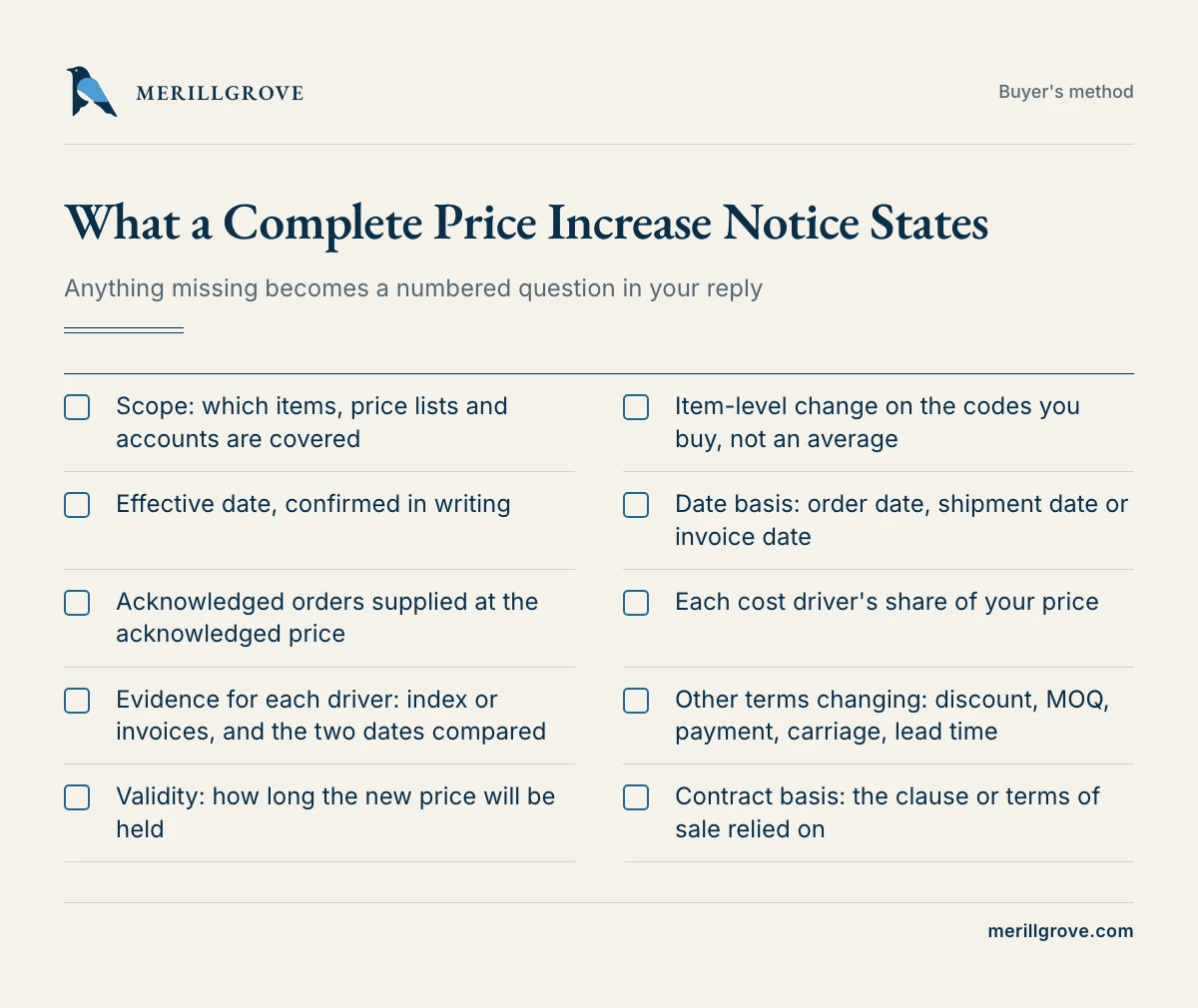 *What a complete price increase notice states. Missing elements become numbered questions in your reply.*
| Element | Why it matters | If it is missing, ask |
|---|---|---|
| Scope | Which items, lists and customers are covered | "Which item codes on our account are affected?" |
| Item-level change | Averages hide your mix | "Please send old and new net prices for our codes" |
| Effective date | Sets your deadline | "Please confirm the date in writing" |
| Date basis | Order, shipment and invoice dates differ | "Does the new price apply by order, shipment or invoice date?" |
| Acknowledged orders | Protects orders already placed | "Please confirm acknowledged orders ship at the acknowledged price" |
| Cost drivers and shares | A 20% rise on 10% of the price is 2 points | "What share of our price does each cited cost make up?" |
| Evidence and period | Lets you test the claim | "Which index or invoices, and between which dates?" |
| Other terms | Discount, MOQ, payment, carriage, lead time | "Is anything else changing at the same time?" |
| Validity | Tells you when the next notice comes | "How long will the new price be held?" |
| Contract basis | Notice periods and fixed-price periods | "Which clause or terms of sale does this rely on?" |
The last row needs care. Whether a supplier can change price at all, and on how much notice, depends on your agreement, the supplier's terms of sale and what you have accepted in practice. Read your own contract before you rely on it, and see what a reasonable notice period is. This is commercial guidance, not legal advice.
Which Reply the Letter Calls for
What you find in the letter points to one of seven replies. Most first replies combine two: a request for missing information and a position on the price.
| What the letter shows | Reply to send |
|---|---|
| No breakdown, and the real change is well above what you can see in your costs | Request the cost breakdown and evidence |
| A breakdown that supports part of the increase, and you have alternatives or time | Counter with evidence |
| An increase supported to within about a point | Accept, with validity, a review date and unchanged terms |
| A partly supported increase from a supplier you cannot easily replace | Propose a phased increase |
| A price dominated by materials or energy that will keep moving | Propose an index-linked mechanism for next time |
| A largely unsupported increase and credible alternatives | Hold the current price while you test the market |
| A fixed-price period still running, or a notice shorter than your agreement requires | Decline and keep the current price |
The choice also depends on your leverage, which the letter cannot tell you. For the decision itself, including the override rules, see choosing between accept, counter, phase and decline. For the paragraphs to use, see the sample wording for each of the seven replies. If the breakdown is the first thing you need, here is how to ask the supplier for a cost breakdown without souring the call.
The First 48 Hours After the Letter Arrives
- Log three dates. The notice date, the effective date, and your reply-by date, which should leave the supplier at least ten working days to respond before the effective date.
- List your open orders. Every acknowledged order that ships after the effective date, with its quantity and acknowledged price.
- Pull 12 months of history. Units and spend by item code. It sizes the increase in money and tells the supplier you know your volume.
- Run the net-price conversion for your top items by spend, including discount, surcharge and any carriage changes.
- Find your agreement. Note any fixed-price period, notice period or price review clause.
- Send a holding acknowledgement. One line: you have received the notice, you are reviewing it, and you expect acknowledged orders to ship at the acknowledged price. It stops silence being read as acceptance in the supplier's mind, and it costs nothing.
The same reading applies to a vendor price increase letter for services or software: replace discount with tier, licence count or bundle, and surcharge with any new fee. The question is always what the invoice will say.
Want This Checked for You?
Send the notice, the quotes or the supplier details. We tell you what to question first, and the fee is agreed before any work starts.
More on Price Increases
 Price IncreasesHow to Ask a Supplier for a Price Reduction When Freight FallsFreight is in your CIF or DDP price and rates have dropped. Size the cut with freight share x lane movement, check the lag, then send the cost-down letter.
 Price IncreasesTariff Surcharges on Supplier Invoices: Who Should Pay?A tariff surcharge on a supplier invoice: who carries US duty under each Incoterm, five checks on the surcharge, and a worked example. Not customs advice.
 Price IncreasesHow to Pass a Supplier Price Increase to Customers Without Losing ThemHow much of a supplier price increase to pass on: cash margin vs percentage margin, break-even volume, timing, and a customer notice that holds.