

How to Negotiate a Price Increase: Accept, Counter, Phase or Decline
Accept, counter, phase or decline? Check the override rules, score your leverage out of 14, read the gap grid, then price each answer over 12 months.
Contents
You have tested the supplier's notice and you know the gap: the increase requested minus the increase the evidence supports. The next decision is which answer to give, and it is where most buyers fall back on instinct, usually splitting the difference. This guide gives a decision order you can defend to your finance director: check the override rules, score your leverage, read the grid, then price each answer over 12 months before you send anything.
If you have not yet calculated the gap, the method is in how to respond to a supplier price increase.
In Short
- Decide in a fixed order: override rules, then the gap against your leverage, then the money.
- Six override rules beat the grid, including a running fixed-price period (decline) and thin stock cover on critical supply (do not hold or decline).
- Score leverage on seven factors, 0 to 2 each. 0 to 5 is low, 6 to 9 medium, 10 to 14 high.
- The grid gives four main answers: accept with conditions, counter with evidence, phase, or hold and test the market. Decline is reserved for the overrides.
- Price every answer over 12 months. Splitting the difference is rarely the cheapest answer you could defend.
- Whatever the answer, add conditions: validity, a review date, acknowledged orders at the acknowledged price.
Step 1: Check the Override Rules First
Some facts decide the answer before leverage matters. Work down the ladder; stop at the first yes.
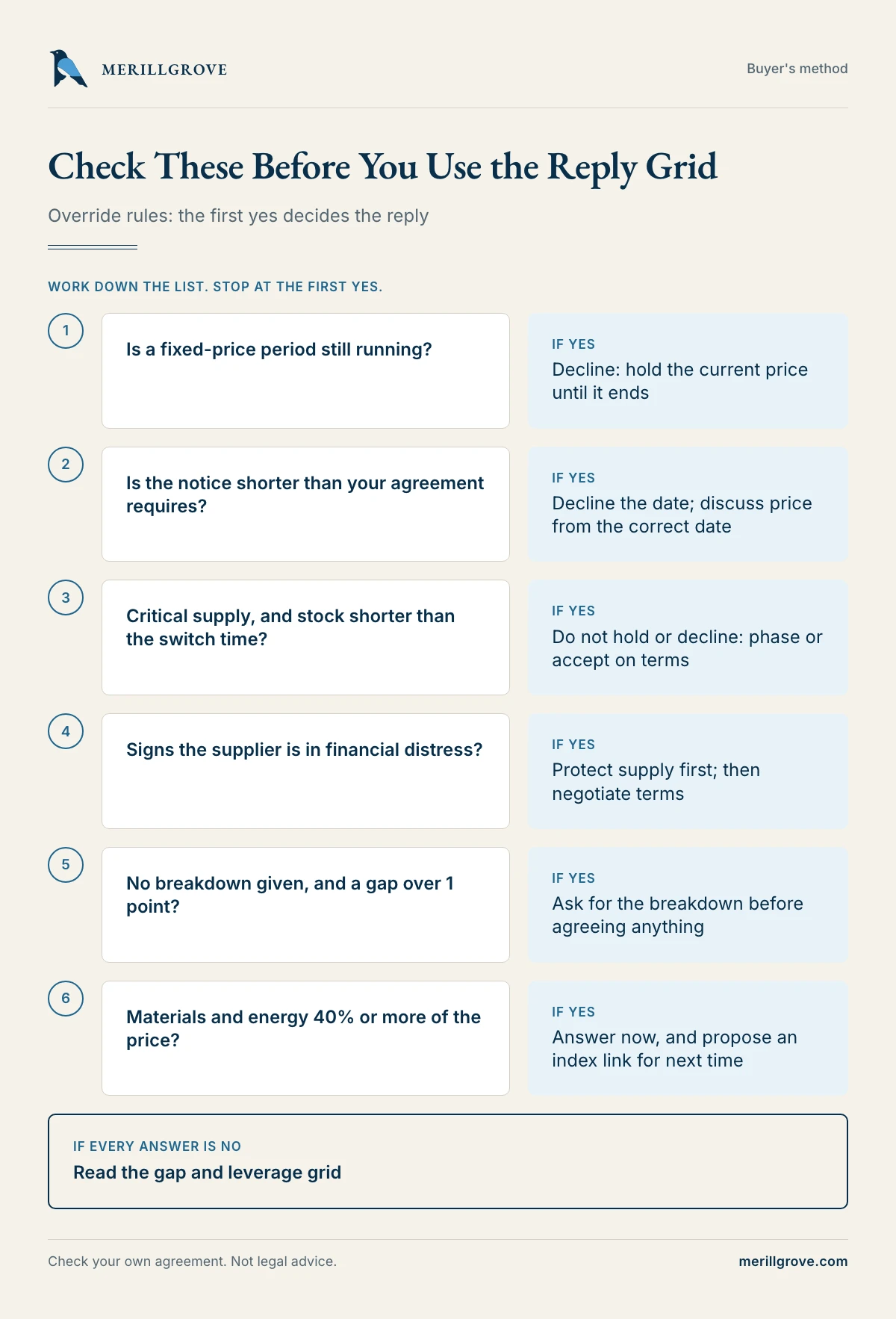 *Override rules come first. If none applies, use the gap and leverage grid.*
- Is a fixed-price period still running? Decline and hold the current price until it ends. Offer to review from that date with evidence.
- Is the notice shorter than your agreement requires? Decline the effective date, not necessarily the price. Discuss the price from the correct date.
- Is supply critical and your stock cover shorter than the time to qualify an alternative? Do not hold or decline. Phase, or accept with conditions, and start qualifying an alternative now.
- Is the supplier showing signs of financial distress? Protect supply first. An increase may be what keeps your source open. See supplier insolvency warning signs.
- Has the supplier given no breakdown, with a gap over a point? Ask for the breakdown before agreeing anything. You can send a counter in the same letter.
- Are materials and energy 40% or more of the price? Whatever you answer now, propose an index-linked mechanism for the next change.
Rules 1 and 2 depend on your agreement. Read the clause yourself; this is commercial guidance, not legal advice.
Step 2: Measure the Gap Three Ways
Express the gap in percentage points, per unit and per year. Points tell you which row of the grid you are in. Money tells you how much effort the negotiation deserves. A 4-point gap on GBP 8,000 of annual spend is GBP 320; on GBP 800,000 it is GBP 32,000.
Step 3: Score Your Leverage
Leverage is how credibly you could move the business, and how soon. Score each factor honestly; the supplier's sales manager will.
| Factor | 0 | 1 | 2 |
|---|---|---|---|
| Credible alternatives | None qualified or quotable | One, needing work | Two or more ready to quote |
| Switching cost and time | Over 6 months or heavy tooling | 2 to 6 months | Under 2 months, little cost |
| Your importance to the supplier | Small account | Mid-sized account | A top account |
| Contract terms | None help you | Review or evidence clause | Fixed price or notice protection |
| Timing and stock cover | Effective date close, low stock | Some cover | Cover beyond the switch time |
| Market conditions | Supplier capacity tight | Mixed | Supplier needs volume |
| Supplier's recent performance | Good | Some issues | Late or quality failures on record |
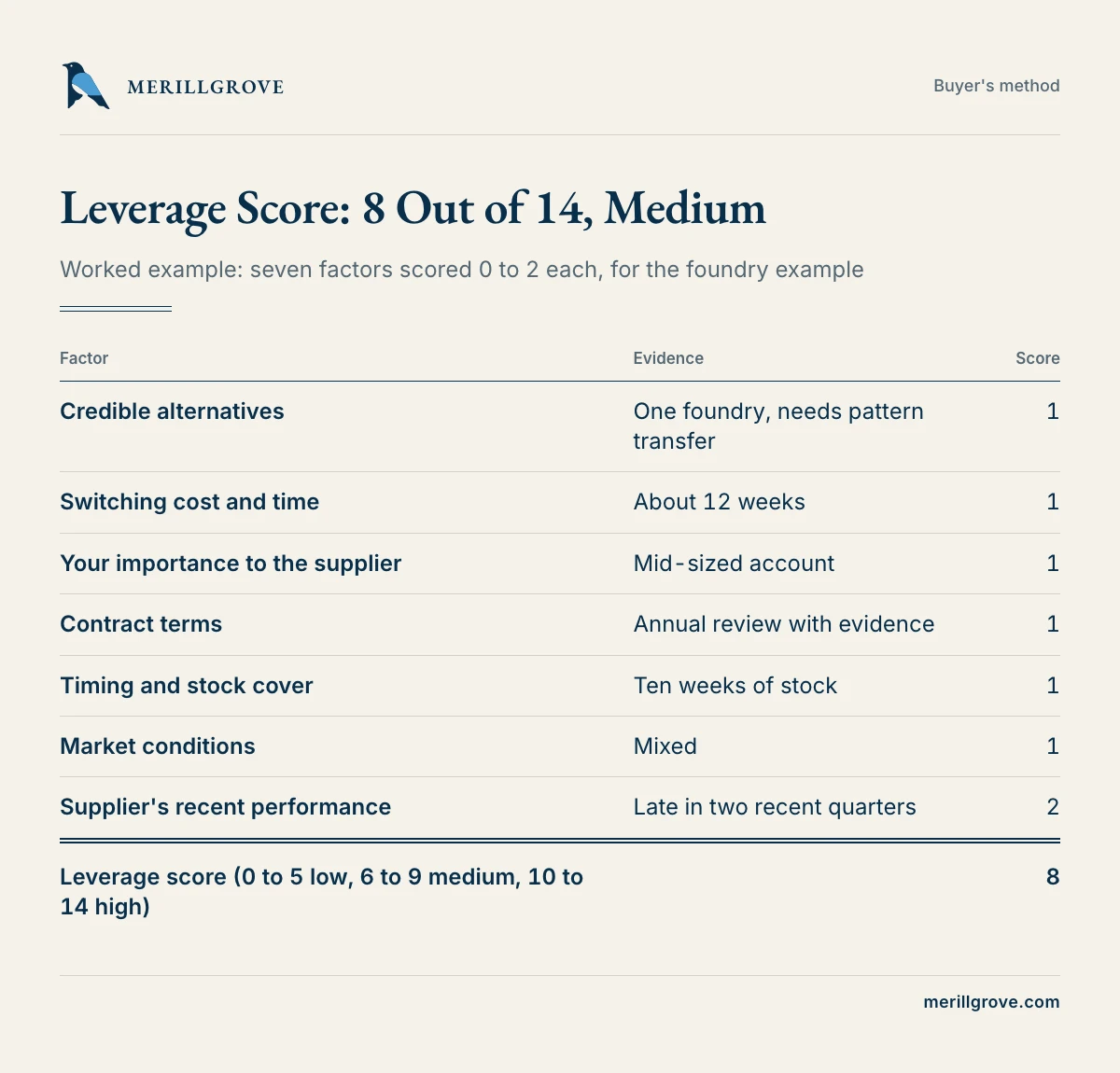 *The leverage score for the foundry example below: 8 out of 14, medium.*
Total: 0 to 5 is low, 6 to 9 medium, 10 to 14 high. These bands are a judgement, not a law; adjust if one factor dominates. Switching cost deserves real numbers, not a guess: see the real cost of switching suppliers.
Step 4: Read the Grid
| Gap | Low leverage | Medium leverage | High leverage |
|---|---|---|---|
| 1 point or less | Accept with conditions | Accept with conditions | Accept, and ask for terms in return |
| Over 1, up to 3 points | Phase the increase | Counter with evidence | Counter with evidence |
| Over 3 points | Ask for the breakdown, then counter | Counter with evidence | Hold the price and test the market |
The logic behind each answer:
- Accept with conditions when arguing costs more than the gap. The conditions (validity, review date, unchanged terms) are the negotiation.
- Counter with evidence when you can show your figures and the supplier has reason to engage with them. Your number is the justified price, not a midpoint.
- Phase when part of the increase is real but you cannot push hard. You give time; the supplier gets the money in steps, with the second step tied to a named index.
- Hold and test the market only when you can actually run the test, with stock to cover it.
- Decline sits outside the grid. It is the answer to rules 1 and 2, or to a supplier that will not engage at all.
Step 5: Price Each Answer Over 12 Months
Before sending, put each realistic answer into money over the next year. It shows what the negotiation is worth, and it stops the reflex to split the difference.
Worked Example: A UK Foundry Asks for 14%
A UK pump manufacturer buys grey iron castings from a foundry at GBP 18.50 each, 9,600 a year (800 a month). The price was agreed in October 2025. The foundry gives 90 days' notice of 14% from 1 January 2027, to GBP 21.09 (18.50 x 1.14), citing metal and energy. It sends a one-page breakdown on request.
The buyer's test, with energy movement checked against the DESNZ industrial energy price statistics:
| Cost driver | Share | Movement | Points |
|---|---|---|---|
| Metal | 35% | 6.0% | 2.10 |
| Energy | 15% | 22.0% | 3.30 |
| Labour | 25% | 4.5% | 1.13 |
| Consumables | 8% | 5.0% | 0.40 |
| Freight | 4% | 3.0% | 0.12 |
| Overheads | 7% | 3.0% | 0.21 |
| Margin | 6% | held as cash | 0.00 |
| Justified | 100% | 7.26 |
Justified price: GBP 18.50 x 1.0726 = GBP 19.84. Gap: 14.0 minus 7.26 is 6.7 points, GBP 1.25 a casting, GBP 12,000 a year.
Leverage: alternatives 1 (one foundry, needing pattern transfer), switching 1 (about 12 weeks), importance 1, contract 1 (annual review with evidence), timing 1 (ten weeks of stock), market 1, performance 2 (late deliveries in two recent quarters). Total 8: medium.
Overrides: no fixed price; notice meets the agreement; supply is critical and ten weeks of stock is less than the 12-week switch, so rule 3 rules out holding or declining; metal and energy are 50% of the price, so rule 6 adds an index proposal. Grid: over 3 points, medium leverage: counter with evidence.
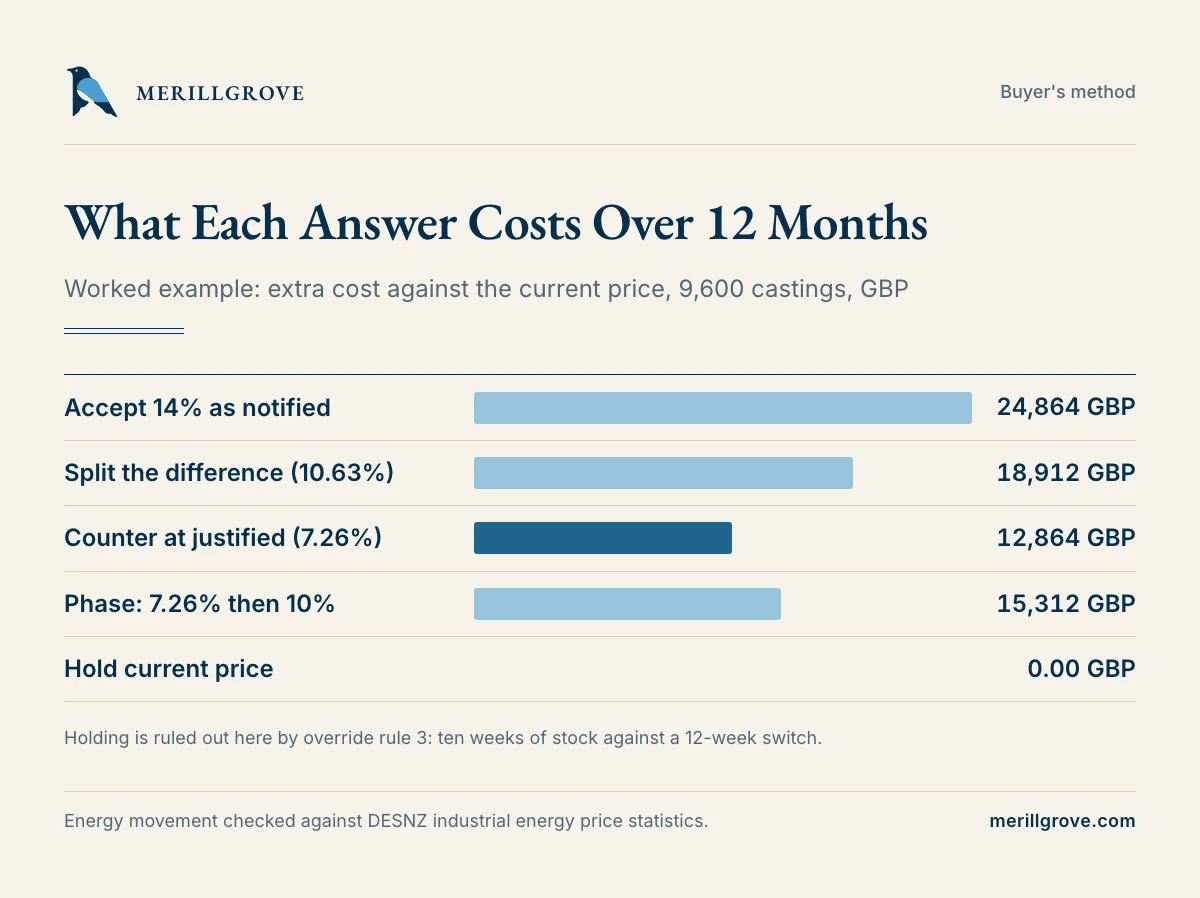 *Extra cost over 12 months against the current price, 9,600 castings.*
| Answer | Price | Extra cost over 12 months |
|---|---|---|
| Accept as notified | GBP 21.09 | 2.59 x 9,600 = GBP 24,864 |
| Split the difference (10.63%) | GBP 20.47 | 1.97 x 9,600 = GBP 18,912 |
| Counter at justified | GBP 19.84 | 1.34 x 9,600 = GBP 12,864 |
| Phase: justified for 6 months, then 10% | GBP 19.84, then 20.35 | 1.34 x 4,800 + 1.85 x 4,800 = GBP 15,312 |
| Hold the current price | GBP 18.50 | Nil in price, but ruled out by rule 3 |
Splitting the difference (halfway between 14% and 7.26%) costs GBP 6,048 more than the counter, for a number the buyer cannot explain. The buyer sends the counter at GBP 19.84 with a 12-month hold and a proposal to link the metal and energy shares to named indices from the next review. It keeps the phased schedule as its fallback: that gives the foundry more money later, costs GBP 2,448 more than the counter and still GBP 3,600 less than splitting the difference. If energy later falls 10% from the base reading, the mechanism moves the price down 1.5% (15% x 10%).
The wording for the counter, the phase and the index proposal is in sample wording for each reply.
Three Shorter Cases
| Situation | Gap | Leverage | Answer |
|---|---|---|---|
| A distributor's carton supplier asks 5%; the breakdown supports 4.4% | 0.6 points | Low (score 4) | Accept with conditions: 12-month validity, review date, unchanged MOQ |
| A sole-source electronic controller rises 15%; evidence supports about 8% | 7 points | Low (score 3) | Breakdown request, then phase; see price increase from a sole supplier |
| A fastener supplier asks 9% on standard parts; evidence supports 3% | 6 points | High (score 11) | Hold the price for six weeks and run an RFQ |
After You Answer
Expect a reply that disputes a share or a movement. Move only on evidence: if the supplier shows a different steel share with invoices, re-run the sum and adjust. Do not move on repetition. If the supplier wants the money sooner, trade timing for validity or volume, not the percentage. Confirm whatever is agreed in writing the same day.
Want This Checked for You?
Send the notice, the quotes or the supplier details. We tell you what to question first, and the fee is agreed before any work starts.
More on Price Increases
 Price IncreasesHow to Ask a Supplier for a Price Reduction When Freight FallsFreight is in your CIF or DDP price and rates have dropped. Size the cut with freight share x lane movement, check the lag, then send the cost-down letter.
 Price IncreasesTariff Surcharges on Supplier Invoices: Who Should Pay?A tariff surcharge on a supplier invoice: who carries US duty under each Incoterm, five checks on the surcharge, and a worked example. Not customs advice.
 Price IncreasesHow to Pass a Supplier Price Increase to Customers Without Losing ThemHow much of a supplier price increase to pass on: cash margin vs percentage margin, break-even volume, timing, and a customer notice that holds.