

Tariff Surcharges on Supplier Invoices: Who Should Pay?
A tariff surcharge on a supplier invoice: who carries US duty under each Incoterm, five checks on the surcharge, and a worked example. Not customs advice.
Contents
A "tariff surcharge" has appeared on a supplier invoice. It may come from an overseas factory, from a supplier that ships to you duty paid, or from a US distributor that imports the goods and resells them. The surcharge means something different in each case.
Whether a tariff surcharge on a supplier invoice has a basis starts with one question: who is the importer of record, and so who actually pays US duty? Your Incoterm usually answers that. This guide sets out who carries duty under each trade term, five checks on any tariff surcharge, and two worked examples. It is commercial guidance, not legal or customs advice. Merillgrove does not classify goods or advise on duty rates; confirm rates and classification with your licensed customs broker.
In Short
- US duty is owed by the importer of record. Under federal regulations it is a personal debt of the importer to the United States.
- Under every Incoterms rule except DDP, the buyer normally imports. A foreign supplier on FOB, CIF or DAP terms pays no US duty, so a "tariff surcharge" from them is a price increase and should be tested as one.
- Under DDP, the seller imports and pays. A surcharge can reflect a real duty change, but it should be calculated on the customs value, not on the DDP price.
- A US distributor's tariff surcharge is a price increase driven by its import costs. Test it on the imported content and the duty on its customs value, not on your price.
- Surcharges introduced for IEEPA tariffs have lost their basis. IEEPA refunds go to the importer of record, which may be your vendor, not you.
- Ask for the tariff, the HTS line, the rate, the date and the value the rate was applied to.
Who Pays US Duty: The Importer of Record
Duty and the liability to pay it attach on importation, and federal regulations describe that liability as a personal debt due from the importer to the United States (19 CFR 141.1). Paying a broker does not discharge it if the broker does not pay. Whoever files the entry as importer of record carries the duty.
The Incoterms rules allocate import clearance and import duties. In practice, under EXW, FCA, FAS, FOB, CPT, CIP, CFR, CIF, DAP and DPU, the buyer (or the buyer's broker) clears the goods into the US and pays duty. Under DDP, the seller does, usually through an agent acting as a nonresident importer of record. Check the entry documents on your own shipments rather than assuming.
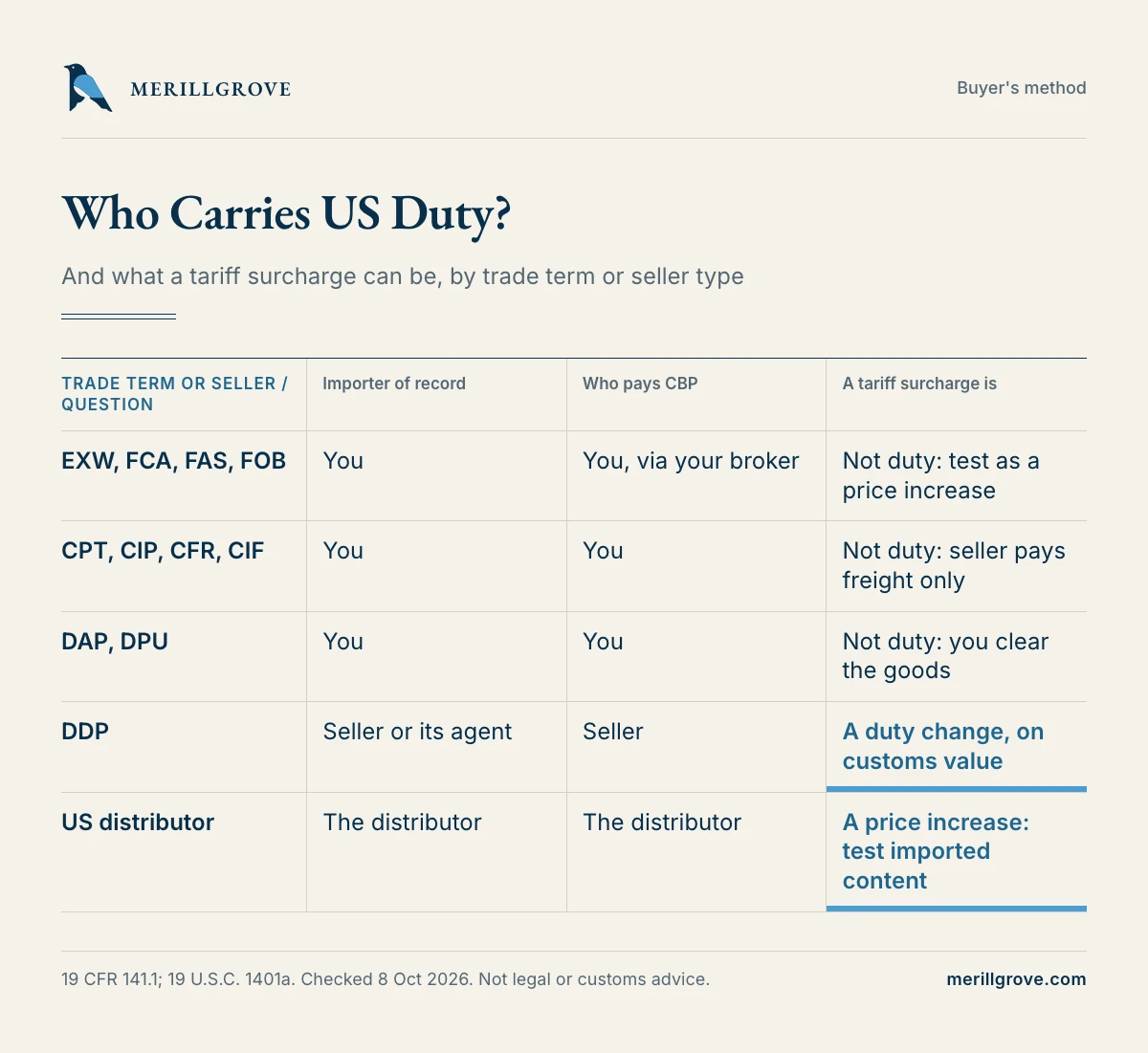 *Who is the importer, who pays CBP, and what a surcharge can legitimately be.*
| Trade term or seller | Importer of record | Who pays CBP | What a "tariff surcharge" can be |
|---|---|---|---|
| EXW, FCA, FAS, FOB (foreign supplier) | You | You, via your broker | Not duty. A price increase to test on its merits |
| CPT, CIP, CFR, CIF | You | You | Not duty. The seller pays main freight, not duty |
| DAP, DPU | You | You | Not duty. Delivered to your door, cleared by you |
| DDP | Seller or its agent | Seller | A duty change, if the contract allows it; on customs value |
| US distributor or domestic vendor | The distributor | The distributor | A price increase driven by its import costs |
If you are choosing between delivered terms for future orders, see DDP vs DAP.
Five Checks on Any Tariff Surcharge
- Who was the importer of record on these goods? If it was you, the supplier paid no US duty on them. If it was a DDP supplier or a distributor, ask them to confirm it.
- Which tariff, at what rate, from what date? Ask for the authority (for example Section 301 or Section 232), the HTS line and the rate applied, and check the effective date against your orders. Your broker can confirm the rate for the line. To estimate it yourself first, see estimate import duty before you buy.
- Applied to what value? US duty is charged on customs value. For most imports that is the transaction value: the price paid when the goods were sold for export to the US, excluding international freight and insurance, and excluding transport and duties after import (19 U.S.C. 1401a). It is not the DDP price and it is not a distributor's resale price.
- Only the change, only on imported content. If your price already included duty at the old rate, only the increase counts. If part of what you buy is made in the US, the surcharge should apply only to the imported part.
- What makes it end? Rates change, exclusions expire or are extended, refunds are paid. A surcharge should name the tariff it follows and fall away when that tariff does.
Tariff Status at a Glance (Last Checked: 8 October 2026)
- IEEPA tariffs. The Supreme Court decided Learning Resources, Inc. v. Trump on 20 February 2026; the Court's summary states that IEEPA does not authorise the President to impose tariffs. CBP is refunding IEEPA duties, with interest, through its CAPE process. Refunds are paid to the importer of record, or to a party it designates on CBP Form 4811, generally 60 to 90 days after CBP accepts the declaration.
- Section 301, forced labour. USTR's notice imposes an additional 10% or 12.5% on products of 60 economies, for goods entered on or after 12:01 a.m. Eastern on 24 July 2026, with an exception for goods already in transit. Articles subject to Section 232 tariffs are among the exemptions. The rate for your product depends on origin and line.
- Section 301, China exclusions. USTR extended 178 exclusions until 10 November 2026. See Section 301 exclusions ending 10 November 2026.
These positions change. Re-check them, and your broker's view of your lines, before you rely on them.
Surcharges Added for IEEPA Tariffs
Many surcharges were introduced in 2025, citing tariffs imposed under IEEPA. Those tariffs no longer stand, so a surcharge built on them has lost its basis. Ask for it to be removed from the date the vendor stopped paying IEEPA duty on its entries.
There is a second question. If your vendor was the importer of record and passed the duty to you through a surcharge, CBP's refund goes to the vendor, not to you. Whether any of it should come back to you is a commercial question first, and possibly a legal one; the documents that decide it are the surcharge notices and your terms. Ask in writing. The detail is in IEEPA tariff refunds and supplier pricing.
Worked Example 1: A US Distributor's 15% Surcharge
The 12.5% rate is an example only, not a statement of any product's rate.
A US hardware retailer buys a line of hand tools from a US distributor at USD 20.00 a unit, about 40,000 units a year. The distributor imports them. It adds a 15% tariff surcharge, USD 3.00 a unit, citing new Section 301 tariffs.
The retailer asks for the basis and gets two facts: the distributor's entered value is about USD 9.00 a unit, and its broker has confirmed an additional 12.5% applies to the line.
- Duty increase per unit: 9.00 x 12.5% = USD 1.125.
- As a share of the retailer's price: 1.125 / 20.00 = 5.6%.
- If the distributor keeps its 30% gross margin on the extra cost: 1.125 / (1 less 0.30) = USD 1.61, or 8.0% of the price.
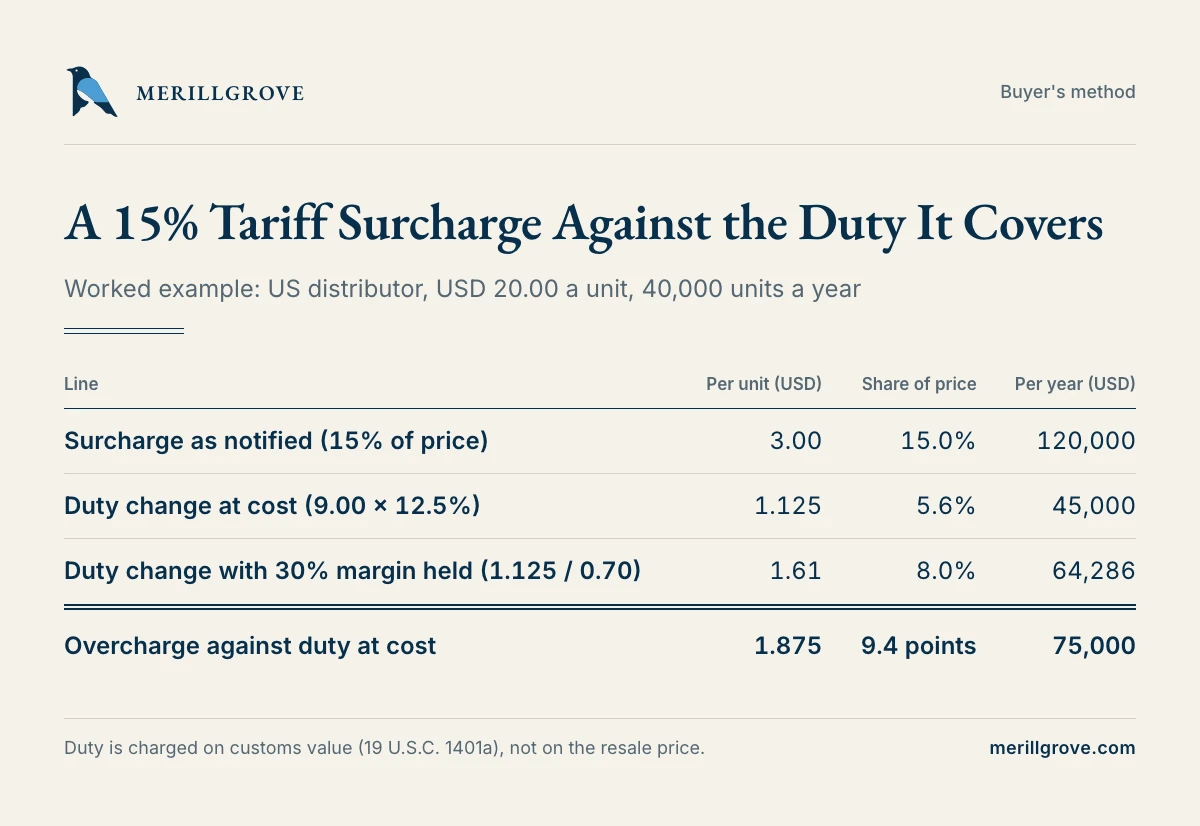 *Surcharge as notified, against the duty change at cost and with margin held.*
Over a year: the surcharge as notified costs 40,000 x 3.00 = USD 120,000. The duty change at cost is 40,000 x 1.125 = USD 45,000. With the distributor's margin held, about USD 64,286.
The retailer counters at USD 1.13 a unit, as a separate line tied to the named tariff and rate, falling away if the rate changes or an exclusion applies. Its fallback is USD 1.61 if the distributor insists on its percentage margin. It also asks whether any 2025 surcharge on the same line was IEEPA-related, and if so what is happening to the refund.
Worked Example 2: A DDP Supplier's Surcharge
An Asian supplier ships to a US importer on DDP terms at USD 50.00 a unit, quoted before 24 July 2026. After the new Section 301 rate takes effect it asks for 12.5% more, USD 6.25 a unit.
The DDP price includes ocean freight, insurance, US clearance and inland delivery as well as the goods. Suppose the goods were sold for export at USD 38.00, the transaction value. The duty change is 38.00 x 12.5% = USD 4.75, not 6.25. Whether the supplier can pass on even that depends on what the DDP contract says about duty changes. Ask for the entry lines showing the rate and value declared.
Test any residual increase for other costs with how to respond to a supplier price increase. A surcharge that bundles steel and tariffs needs both tests: see check a steel surcharge against the index.
What to Ask for
In one written reply, ask for: confirmation of the importer of record; the tariff authority, HTS line, rate, effective date and value used; the surcharge recalculated on customs value and imported content only; a mechanism that names the tariff, follows its rate and ends with it; and, for any IEEPA-era surcharge, its removal date and the vendor's position on refunds.
Tools for the Reply
Sources (checked 8 October 2026): 19 CFR 141.1, https://www.ecfr.gov/current/title-19/chapter-I/part-141/subpart-A/section-141.1; 19 U.S.C. 1401a, https://www.law.cornell.edu/uscode/text/19/1401a; Supreme Court of the United States, Opinions of the Court (Learning Resources, Inc. v. Trump, 24-1287), https://www.supremecourt.gov/opinions/slipopinion/25; CBP, IEEPA duty refunds, https://www.cbp.gov/trade/programs-administration/trade-remedies/ieepa-duty-refunds; Federal Register, Notice of Actions in Section 301 Investigations (2026-15181), https://www.federalregister.gov/documents/2026/07/28/2026-15181/notice-of-actions-in-section-301-investigations-of-acts-policies-and-practices-of-various-economies; USTR fact sheet, https://ustr.gov/about/policy-offices/press-office/fact-sheets/2026/july/fact-sheet-ustr-section-301-action-response-failure-60-economies-ban-imports-produced-forced-labor; USTR, China Section 301 exclusions extended, https://ustr.gov/about/policy-offices/press-office/press-releases/2025/november/ustr-extends-exclusions-china-section-301-tariffs-related-forced-technology-transfer-investigation; ITA, Know Your Incoterms, https://www.trade.gov/know-your-incoterms. Incoterms is a trademark of the International Chamber of Commerce. Last checked: 8 October 2026. This is commercial guidance, not legal or customs advice.
Want This Checked for You?
Send the notice, the quotes or the supplier details. We tell you what to question first, and the fee is agreed before any work starts.
More on Price Increases
 Price IncreasesHow to Ask a Supplier for a Price Reduction When Freight FallsFreight is in your CIF or DDP price and rates have dropped. Size the cut with freight share x lane movement, check the lag, then send the cost-down letter.
 Price IncreasesHow to Pass a Supplier Price Increase to Customers Without Losing ThemHow much of a supplier price increase to pass on: cash margin vs percentage margin, break-even volume, timing, and a customer notice that holds.Price IncreasesHow to Check a Supplier's Steel SurchargeHow to check a supplier steel surcharge: steel weight x base price x index movement, with a worked US example on BLS steel indices and UK and AU sources.