

DDP vs DAP: Who Pays the Duty?
DDP vs DAP for buyers: who pays duty and import VAT, who is the importer of record, a floor test for DDP quotes that look too cheap, and 9 checks to run.
Contents
A supplier has offered you two delivered prices, DAP and DDP, or only DDP, and the DDP number looks attractive: one price to your door, duty included, nothing to clear. The difference between DDP vs DAP is not delivery. Both deliver to your named place. The difference is who clears the goods through your customs, who pays the duty and import tax, and in whose name all of that is done. This guide sets out who does what, a floor test for DDP prices, a worked example for a US e-commerce brand, and the checks to run before you accept a DDP quote.
In Short
- DAP: the seller delivers to your named place, ready to unload. You clear the import, pay duty and import tax, and unload.
- DDP: the seller also clears the import and pays duty and import tax. You still unload.
- Under DDP the seller, or someone it appoints, normally acts as importer. In the US the importer of record is responsible for the entry and all duties, taxes and fees.
- A DDP price should not be lower than the DAP-equivalent price plus duty, entry fees and clearance. If it is, ask why before you pay.
- DDP shifts tariff-change risk to the seller, which is why sellers price it in or attach conditions.
- For most buyers who can use a customs broker, DAP keeps the customs relationship in your hands for a small extra effort.
DDP vs DAP: Who Does What
Under both Incoterms® 2020 rules the seller carries the goods and the transit risk to your named place, and you unload. (If you want the seller to unload, that is DPU, a different rule.)
| DAP (named place) | DDP (named place) | |
|---|---|---|
| Freight, insurance, delivery to the named place | Seller | Seller |
| Import clearance and importer of record | You | Seller, or its appointee |
| Duty, tariffs, entry fees | You | Seller |
| Import VAT or GST | You | Seller |
| Risk of a duty rate change before entry | You | Seller |
| Customs exams, holds, storage at destination | You | Seller in principle; agree it in writing |
| Unloading at your premises | You | You |
Merillgrove's summary of the general allocation under Incoterms 2020, not ICC text. The rules do not change duty rates or customs procedures; they decide who deals with them. Your contract governs.
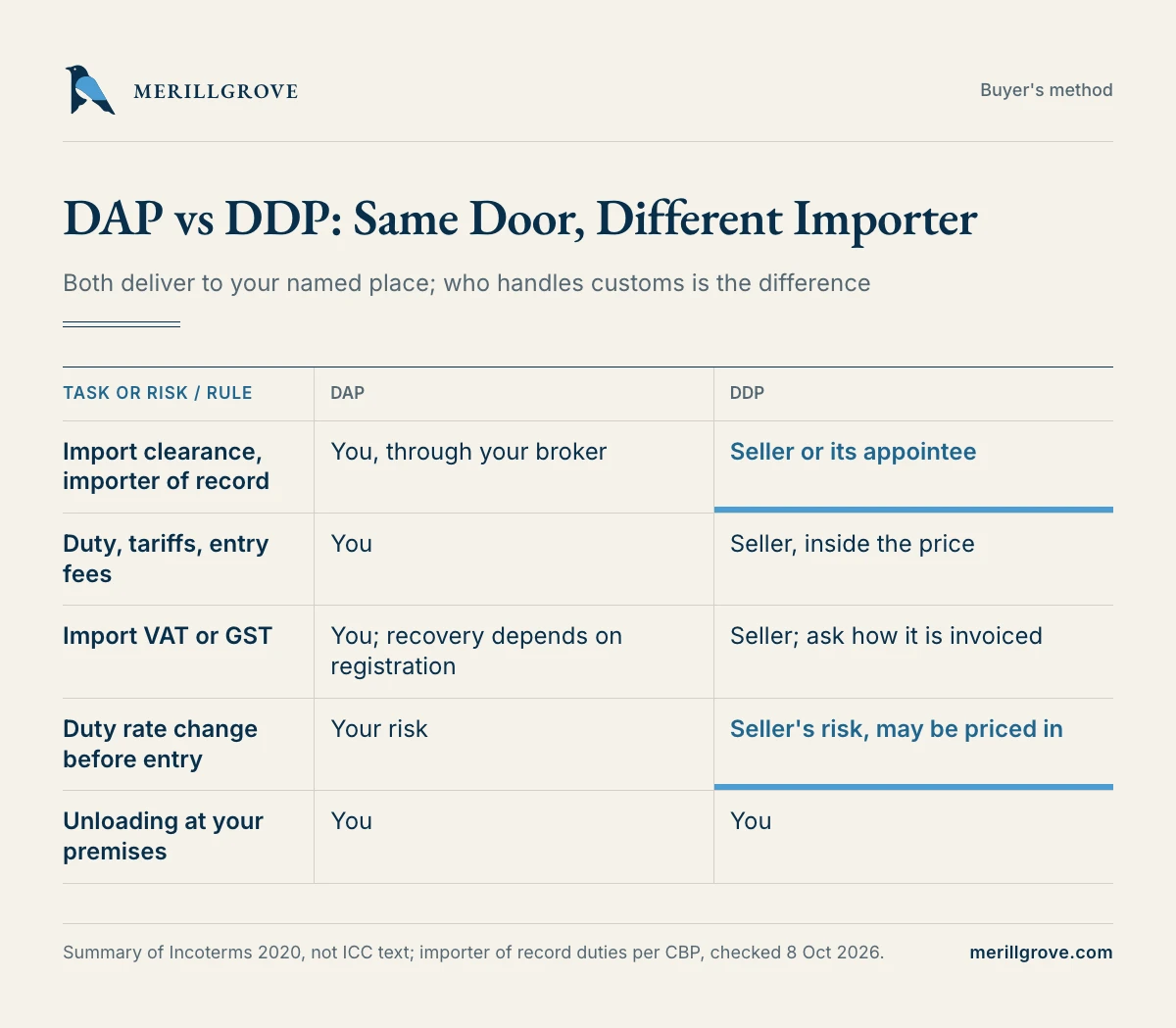 *The delivery point is the same. The customs relationship is not.*
Who Pays Duty, and Who Is the Importer, by Country
Last checked: 8 October 2026.
- United States. The importer of record is ultimately responsible for the correctness of the entry and for all applicable duties, taxes and fees, even when a licensed broker files it, and bears the cost of any CBP examination. Under DDP that is the seller or its appointee; under DAP it is you.
- United Kingdom. You need a GB EORI number to import into Great Britain. Import VAT belongs to whoever imports: a VAT-registered importer can use postponed VAT accounting or reclaim using the C79 certificate. If the supplier arranges the import on your behalf, HMRC says you must agree with the supplier how import VAT is accounted for, keep a written record and give the supplier your EORI. Under true DDP, ask how the seller will charge VAT to you, and whether you will hold a document that lets you recover it.
- Australia. The importer pays GST at the same time and in the same way as customs duty, at 10% of the value of the taxable importation. Under DDP, ask who the importer is and how GST will appear on the seller's invoice.
This is commercial guidance, not customs or tax advice. A licensed customs broker can confirm the position for your goods; Merillgrove does not classify goods or give customs advice.
Worked Example: A US E-Commerce Brand, Two DDP Quotes
A US e-commerce brand needs 2,000 units delivered to its warehouse. Supplier A quotes USD 9.10 a unit DAP and USD 10.05 DDP. Supplier B quotes DDP only, at USD 9.20.
Supplier A, DAP route. The DAP invoice of USD 18,200.00 shows international freight and insurance (USD 1,400.00) and US port charges and delivery (USD 1,050.00) separately. US transaction value excludes international transport and insurance, and post-importation transport when shown separately, so the dutiable value here is 18,200.00 minus 2,450.00 = USD 15,750.00; your broker confirms the treatment. Duty is assumed at 7.5% for the example; your broker confirms the real rate, including any additional duties.
- Duty: 15,750.00 × 7.5% = 1,181.25
- MPF: 15,750.00 × 0.3464% = 54.56
- HMF: 15,750.00 × 0.125% = 19.69
- Brokerage and ISF: 275.00
DAP route total: 18,200.00 + 1,530.50 = USD 19,730.50, or 9.87 a unit. Supplier A's DDP price is 2,000 × 10.05 = USD 20,100.00, or USD 369.50 more (18 cents a unit, 1.9%). For that, A takes on the entry, the duty and the risk of a rate change before entry. A reasonable trade, once you have checked who A's importer is.
Supplier B, the floor test. Ask B for its FOB price too. It quotes USD 7.95. Build the DDP floor from it, using the same transport costs as A: goods 15,900.00, international freight and insurance 1,400.00, US port charges and delivery 1,050.00, duty 15,900.00 × 7.5% = 1,192.50, MPF 55.08, HMF 19.88, brokerage 275.00. Floor: USD 19,892.46, or 9.95 a unit.
B's DDP price is USD 18,400.00, which is USD 1,492.46 below the floor, more than the whole duty and fee bill of USD 1,267.46. Either B is absorbing the cost, or the value, classification or importer on the entry is not what you would expect. The test does not tell you which. It tells you to ask before you pay.
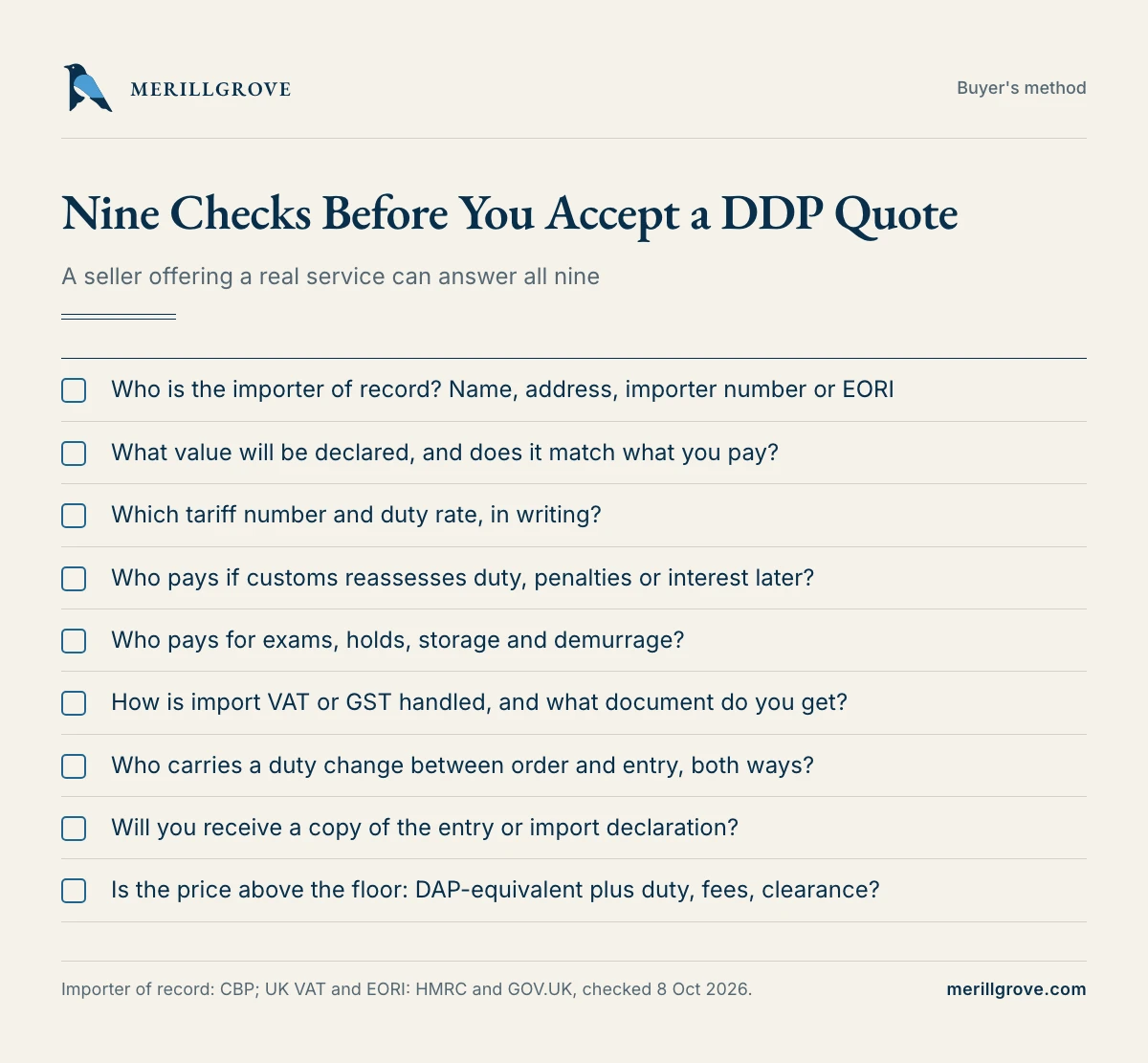 *Nine questions to answer before accepting a DDP price.*
Is This DDP Quote Too Good to Be True? Nine Checks
- Who is the importer of record? Company name, address and, in the US, its importer number; in the UK, its EORI.
- What value will be declared? It should be the price you pay, less any separately shown international freight and insurance where your country allows.
- Which tariff number and duty rate? Ask for both in writing, and check the rate in the official tariff.
- Who pays if customs reassesses? Duty, penalties and interest after entry, in writing.
- Who pays for exams, holds, storage and demurrage?
- How is import VAT or GST handled? Who pays it, and what document you receive.
- Who carries a duty change between order and entry, in both directions?
- Will you receive the entry documents? A copy of the entry summary or import declaration.
- Does the price pass the floor test?
A seller that answers all nine is offering a real service. A seller that cannot answer the first two is asking you to trust a customs position you cannot see, and in your own country it may be your goods that are held.
DAP or DDP: When Each Makes Sense
Choose DAP when you can appoint a customs broker, want to control the value and classification declared, and want the import documents in your own name. It is the default for most repeat importers.
Choose DDP for a first small order, or where you cannot act as importer, and only from a seller that passes the nine checks. Review the choice once volumes grow.
To compare a DDP quote with FOB or FCA offers from other suppliers, see how to compare quotes on different Incoterms rules; to choose which basis to request, see EXW vs FOB vs DDP. For a duty figure before you commit, see how to estimate import duty before you buy. The wider method sits in compare supplier quotes on one basis and landed cost vs unit price.
Want This Checked for You?
Send the notice, the quotes or the supplier details. We tell you what to question first, and the fee is agreed before any work starts.