

How to Ask a Supplier for a Price Reduction When Freight Falls
Freight is in your CIF or DDP price and rates have dropped. Size the cut with freight share x lane movement, check the lag, then send the cost-down letter.
Contents
You buy on a delivered price, CIF or DDP, and container rates on your lane have dropped. Your supplier has not mentioned it. If the price went up when freight rose, it is fair to ask for a price reduction now that freight has fallen, but only for the part of the price that is freight, and only once you know the supplier's own freight cost has actually moved.
This guide shows how to size the request, when not to send one, and how to word the letter. The arithmetic is the same one buyers use to test an increase, run in the other direction. If your case for a lower price is a competing quote rather than a cost that has fallen, the wording is different: see asking for a reduction with a competing quote.
In Short
- Check the Incoterm first. On EXW, FCA, FAS or FOB, freight is not in the supplier's price, so there is nothing to ask the supplier for.
- Estimate the ocean freight inside each unit: the container rate the price was built on, divided by units per container.
- Only the main ocean leg moves with a freight index. Origin charges, insurance, destination charges and duty do not.
- Justified reduction = freight share of the price x movement in the lane rate since the price was set.
- Check the lag. A supplier on a contract rate will not see the spot fall until the contract resets.
- Ask for an FOB price alongside the delivered price. CIF minus FOB shows the freight the supplier is charging you.
- If share x movement is under about 1% of the price, park it for the next price review rather than sending a standalone request.
Step 1: Confirm Freight Is in the Price
Under the Incoterms 2020 rules, the seller arranges and pays the main carriage under CPT, CIP, CFR, CIF, DAP, DPU and DDP. Under EXW, FCA, FAS and FOB, the buyer does. If you buy FOB, a fall in freight shows up in your forwarder's invoice, not your supplier's, and the conversation belongs with your forwarder.
If freight is in the price, find out how it got there. Was the delivered price quoted from scratch, or built as an FOB price plus a freight add-on? If it was built as FOB plus freight, asking for the add-on is the quickest route to the number you need. The trade-offs between the two terms are set out in FOB vs CIF for buyers.
Step 2: Check Your Lane, Not the Headline
Container indices publish a composite and individual lanes, and the lanes do not move together. The Drewry World Container Index assessment for Thursday 1 October 2026 shows the split clearly:
| Lane (USD per 40ft) | Reading, 1 Oct 2026 | Weekly change |
|---|---|---|
| WCI composite | 4,434 | down 1% |
| Shanghai to Rotterdam | 3,399 | down 2% |
| Shanghai to Genoa | 3,702 | down 3% |
| Shanghai to Los Angeles | 7,835 | stable |
| Shanghai to New York | 10,428 | up 1% |
Drewry also reported that Asia to Europe rates had fallen for 12 consecutive weeks. A UK or European importer from China has a case worth testing this autumn. A US importer on the transpacific has a weaker signal: those lanes were flat or rising that week, so the case depends entirely on where the lane stood when the price was set. If it is not clearly lower now, agree the mechanism instead, so that the price follows when the lane turns.
For Australian lanes, which are not among the WCI's eight East-West routes, the best evidence is your own: quotes from your forwarder for the same port pair now and when the price was set. That is good evidence on any lane, because it is the rate you could actually buy. The Freightos Baltic Index publishes further lane indices (FBX11 is China/East Asia to Northern Europe) and is another reference. Record the date of every reading you use; these are weekly spot assessments.
Step 3: Work Out the Freight Inside Each Unit
Freight per unit is the container rate divided by the units in a container. The share is freight per unit divided by the unit price.
A UK homeware importer buys a 60 litre polypropylene storage box at USD 12.40 CIF Felixstowe. A 40ft high cube holds 2,600 boxes. The price was agreed when the supplier's ocean freight was USD 5,200 a container. The importer's forwarder now quotes USD 3,640 for the same port pair.
| Line in the CIF price | Per unit (USD) | Moves with the lane rate? |
|---|---|---|
| Ocean freight at agreement (5,200 / 2,600) | 2.00 | Yes |
| Origin terminal and documents | 0.12 | No |
| Insurance | 0.03 | No |
| Goods, packing, margin (residual) | 10.25 | No |
| CIF price | 12.40 |
The calculation:
- Freight share: 2.00 / 12.40 = 16.1% of the price.
- Lane movement: 3,640 / 5,200 - 1 = -30.0%.
- Justified change: 16.1% x -30.0% = -4.8%, which is 2.00 x 30.0% = USD 0.60 a unit.
- Requested price: 12.40 - 0.60 = USD 11.80.
- At 20 containers a year (52,000 units), that is 52,000 x 0.60 = USD 31,200.
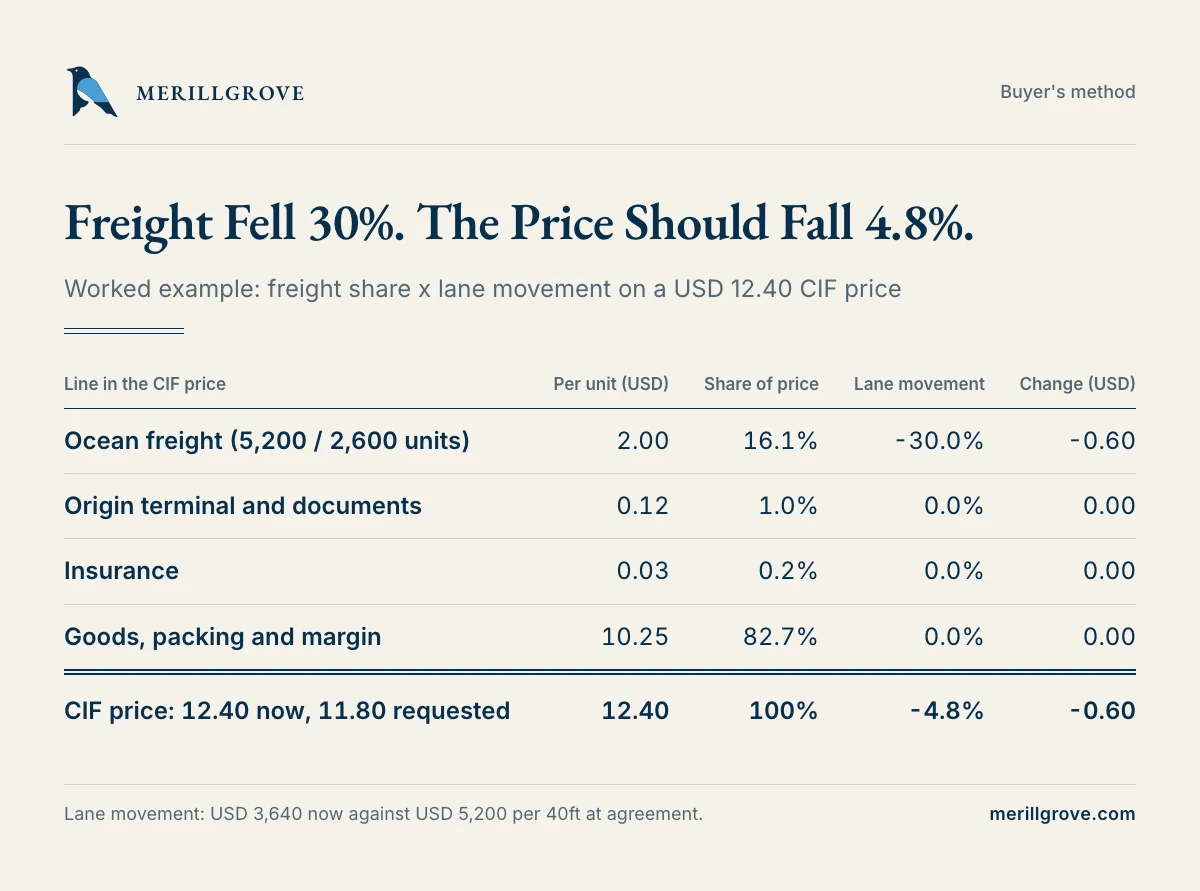 *Only the ocean leg moves with the lane: USD 0.60 off a USD 12.40 CIF price.*
Notice what the request does not include. The headline freight fall was 30%, but the justified price reduction is 4.8%. Asking for more invites the supplier to dismiss the whole letter; asking for exactly this is hard to refuse.
On DDP or DAP prices the same rule applies with more lines that do not move: destination terminal charges, delivery and duty all sit in the price and none of them follows the ocean rate. See DDP vs DAP for how those prices are built.
Step 4: Check the Lag Before You Ask
The supplier may not be paying today's spot rate. Ask, or work out:
- Contract or spot. Many shippers book on contract rates fixed for a quarter or a year. If the supplier's contract runs to 31 December, its cost falls from the first booking after that, and your request should say so.
- Base period. Measure from the rate when your price was set, not from the peak. If your price was agreed after rates had already fallen, part of the fall is already in it.
- Surcharges. Fuel and other carrier surcharges move separately from base rates. Ask whether the supplier's quote included them.
Step 5: Use the CIF Minus FOB Test
The strongest single piece of evidence is the supplier's own FOB price for the same goods. CIF minus FOB is the freight and insurance the supplier is charging you. Compare it with your forwarder's quote for the same lane.
In the example above, CIF minus FOB would be about USD 2.03 a unit (ocean freight plus insurance at the old rate; origin terminal charges sit inside an FOB price too). If your forwarder can move the goods for USD 1.40 plus insurance, you have two options: ask for the delivered price to come down, or switch to FOB and book the freight yourself. Having the second option is what makes the first one work.
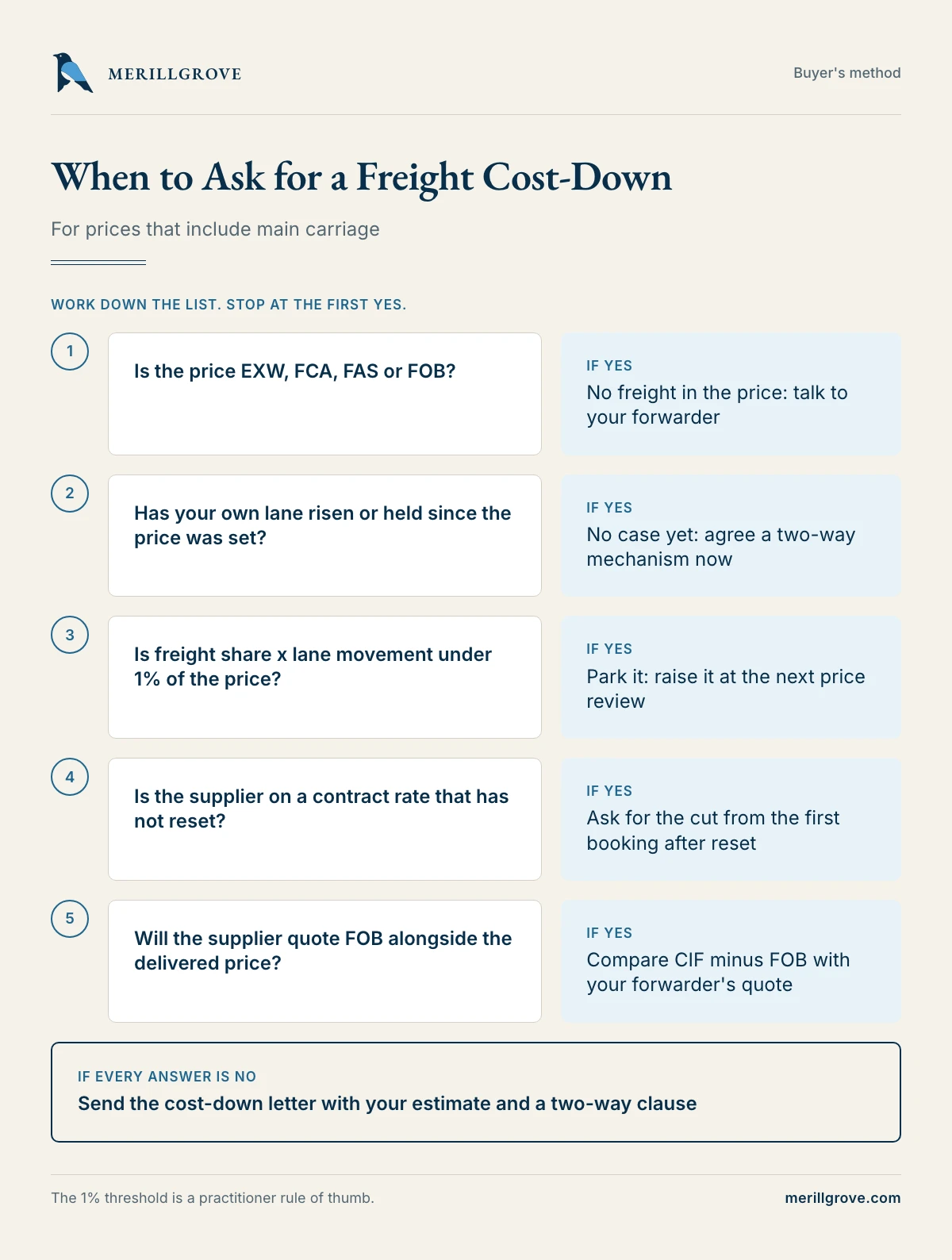 *A decision ladder for a freight-inclusive price.*
Step 6: Ask the Supplier for the Price Reduction in Writing
Write first, then talk. Keep it short and put the arithmetic in a table the supplier can check.
Subject: Freight element of our CIF price for [item code]
Dear [name],
Our current CIF Felixstowe price of USD 12.40 was agreed on [date], when ocean freight from [port] was around USD 5,200 per 40ft. Our forwarder's current quote for the same lane is USD 3,640, a fall of 30%.
On 2,600 units per container, freight was USD 2.00 a unit. A 30% fall brings it to USD 1.40. We are asking for the CIF price to reduce by that USD 0.60, to USD 11.80, from the first booking after [date]. Every other part of the price stays as agreed.
If your freight is booked on a contract rate, please tell us when it resets and we will agree the date from then. It would also help to have your FOB price for the same item, so that we can both see the freight element directly.
For future changes, we would like to agree a simple freight adjustment based on [named lane index or forwarder quotes], reviewed quarterly, that moves the price up or down by the same rule.
Could you reply by [date]?
The last paragraph matters as much as the request. A one-off reduction solves this quarter; a two-way index-linked price adjustment clause solves the next rise and fall as well. If your supplier raised the price citing freight in the past, point to it: you are asking for the same logic in reverse. Check any clause against your own contract; this is commercial guidance, not legal advice.
What a Reasonable Supplier Will Say
Expect one of three answers. "Yes, from the next booking" is the answer you are aiming for, and clear arithmetic makes it easy to give. "Our contract rate has not changed" is fair if true: agree the reset date in writing. "Other costs have gone up" is the reply to watch. That may be true, but it is a separate claim and needs its own evidence; test it with the method in how to respond to a supplier price increase. Energy claims run on the same share x movement arithmetic: here is how to test an energy surcharge.
Tools for the Arithmetic and the Reply
Sources (checked 8 October 2026): Drewry, World Container Index assessed by Drewry (assessment for 1 October 2026), https://www.drewry.co.uk/supply-chain-advisors/supply-chain-expertise/world-container-index-assessed-by-drewry; Freightos, Freightos Baltic Index, https://www.freightos.com/enterprise/terminal/freightos-baltic-index-global-container-pricing-index/; International Chamber of Commerce, Incoterms 2020, https://iccwbo.org/business-solutions/incoterms-rules/incoterms-2020/. Incoterms is a trademark of the International Chamber of Commerce.
Want This Checked for You?
Send the notice, the quotes or the supplier details. We tell you what to question first, and the fee is agreed before any work starts.
More on Price Increases
 Price IncreasesTariff Surcharges on Supplier Invoices: Who Should Pay?A tariff surcharge on a supplier invoice: who carries US duty under each Incoterm, five checks on the surcharge, and a worked example. Not customs advice.
 Price IncreasesHow to Pass a Supplier Price Increase to Customers Without Losing ThemHow much of a supplier price increase to pass on: cash margin vs percentage margin, break-even volume, timing, and a customer notice that holds.
 Price IncreasesHow to Check a Supplier's Steel SurchargeHow to check a supplier steel surcharge: steel weight x base price x index movement, with a worked US example on BLS steel indices and UK and AU sources.