

Supplier Energy Surcharge: How to Test the Claim
Test a supplier energy surcharge: kWh per unit x the move in energy prices since your price was set. UK and EU index readings, worked examples, a reply.
Contents
A supplier has added an energy surcharge, or raised its price and named energy as the reason. You need to know whether the number holds up before you accept it. The test is the same one buyers use for any cost driver: how much energy goes into each unit, and how much the price of that energy has moved since your price was set. This guide applies it with real UK and EU energy price readings, two worked examples and a list of what to ask the supplier.
Energy is a real cost for coaters, heat treaters, moulders, foundries, glass and ceramics makers. It is also the easiest cost to name in a notice, because everyone remembers when energy prices spiked.
In Short
- An energy surcharge is justified by energy intensity (kWh per unit) times the change in price per kWh since your price was set. Nothing else.
- Convert that into a share: energy cost per unit divided by the unit price. For most products it is a single-digit percentage.
- Run the reverse test: requested surcharge divided by energy share gives the rise in energy prices the request implies. If that number is implausible, so is the request.
- Use the right index: the supplier's country, fuel, size band and base period. Published UK and EU readings moved in different directions over the year to mid-2026.
- Ask for kWh per unit, contract dates and rates. A supplier on a fixed contract has not seen the market move yet, in either direction.
- If you accept a surcharge, agree how it moves down and when it ends.
How to Test a Supplier Energy Surcharge: Energy Intensity X Price Movement
Justified change per unit = kWh per unit x change in price per kWh, for each fuel.
As a percentage of the price, it is the energy share of the price times the movement in energy prices. Two numbers, then:
- Energy intensity. Electricity and gas per unit or per kilogram. A supplier that wants an energy surcharge should be able to tell you. If it will not, estimate from the process: oven or furnace rating and line speed, moulding cycle time and machine power, kiln load and firing curve.
- Price movement. The change in the supplier's price per kWh between when your price was set and now. Use the supplier's own contract rates if it shares them; a published index for its country, fuel and size band if not.
Then run the reverse test: requested surcharge / energy share = the rise in energy prices the request implies. If energy is 10% of the price, a 7% surcharge implies energy prices up by 7 / 10 = 70%. Check that against the index before anything else.
What to Ask the Supplier for
An energy surcharge justification should come with evidence. Ask for it in your first reply, before you agree anything.
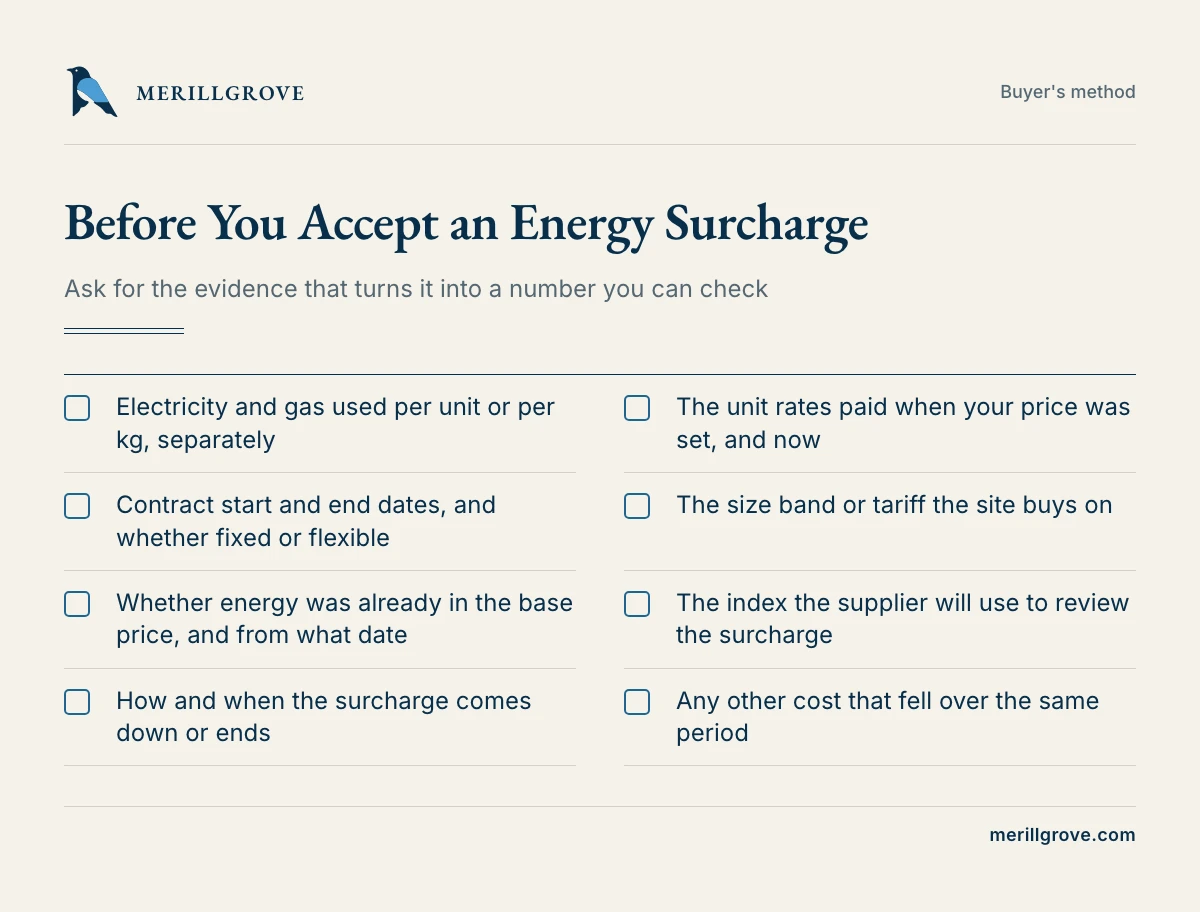 *The questions that turn an energy surcharge into a number you can check.*
If the supplier refuses to give any breakdown, the guide on how to ask the supplier for a cost breakdown covers what to do next. Your own estimate, stated clearly, is a fair basis for a counter.
Which Index to Use
UK. The Department for Energy Security and Net Zero publishes average prices of fuels purchased by manufacturing industry, in pence per kWh, quarterly, by size band (QEP Table 3.1.2). The prices exclude the Climate Change Levy and come from a survey of some 600 manufacturing sites; the latest average is provisional.
| DESNZ Table 3.1.2, p/kWh | Apr to Jun 2024 | Apr to Jun 2025 | Apr to Jun 2026 | 2025 to 2026 |
|---|---|---|---|---|
| Electricity, small users | 27.05 | 27.02 | 26.15 | -3.2% |
| Electricity, medium users | 22.33 | 20.40 | 22.64 | +11.0% |
| Electricity, all users (average) | 17.77 | 16.69 | 17.36 | +4.0% |
| Gas, all users (average) | 3.69 | 3.62 | 3.85 | +6.3% |
Two lessons are in that table. The size band matters: over the same year, electricity fell 3.2% for small users and rose 11.0% for medium ones. And the base period matters: measured from April to June 2024 instead, average electricity is 2.3% lower now, not higher, while gas is 4.3% higher.
EU. Eurostat publishes half-yearly prices for non-household electricity (nrg_pc_205) and gas (nrg_pc_203) by country and consumption band, with an option excluding taxes and levies.
| Eurostat, EUR/kWh, excluding taxes and levies | 2025 first half | 2026 first half | Change |
|---|---|---|---|
| Germany, electricity, 2,000 to 19,999 MWh a year | 0.1598 | 0.1382 | -13.5% |
| France, electricity, same band | 0.1164 | 0.1064 | -8.6% |
| Italy, electricity, same band | 0.1661 | 0.1659 | -0.1% |
| Germany, gas, 10,000 to 99,999 GJ a year | 0.0563 | 0.0529 | -6.0% |
Australia. The ABS reported that Input to Manufacturing prices rose 0.9% in the June quarter 2026, driven by higher energy prices after the closure of the Strait of Hormuz, and that output prices for domestic gas extraction rose 6.7% through the year to June 2026 (index 244.6 to 260.9). That is a producer price, not the tariff your supplier pays, so treat it as a direction, not a measure. For Australian electricity, rely on the supplier's own contract evidence.
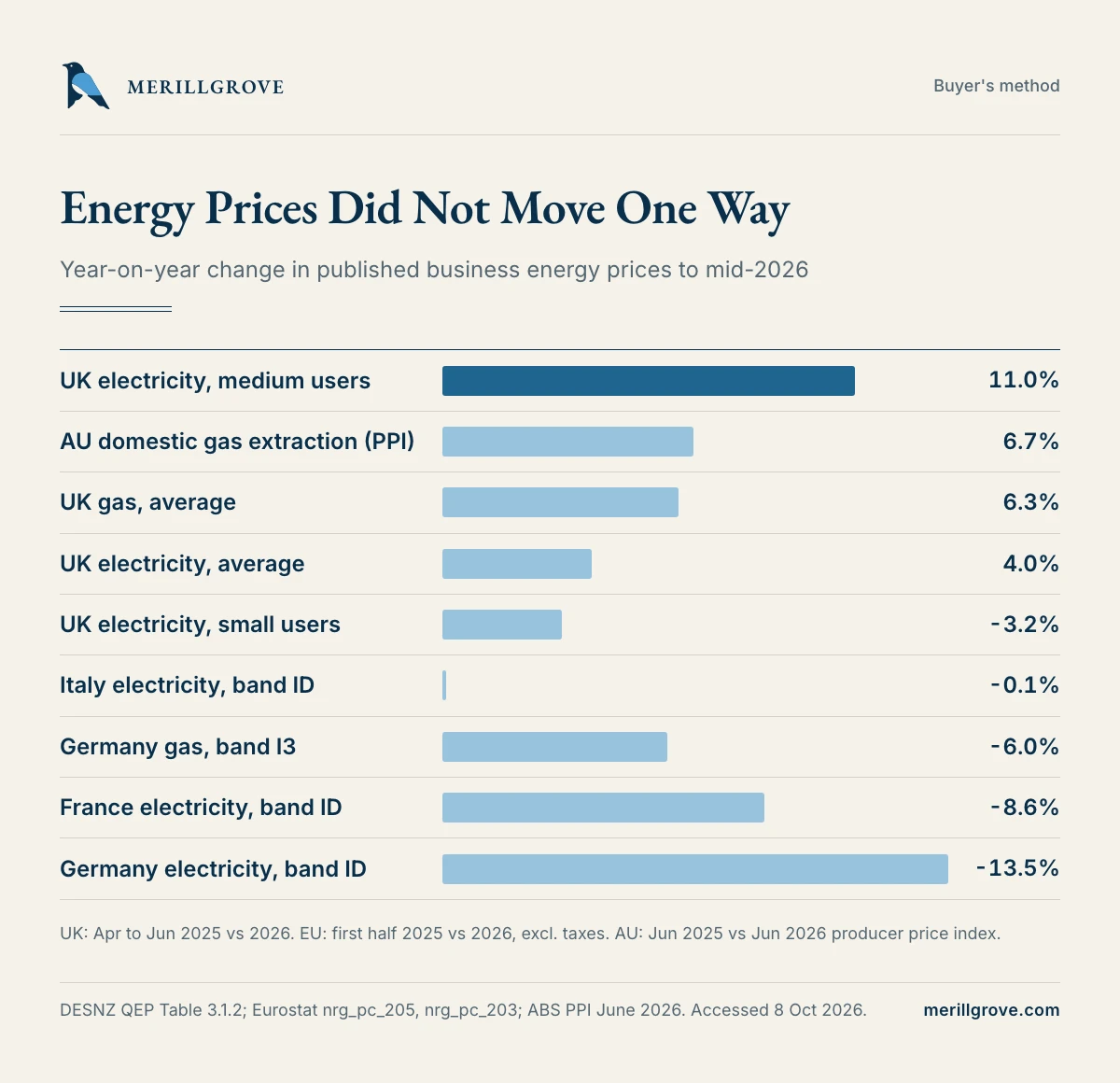 *Published energy price movements, year on year. Sources: DESNZ QEP Table 3.1.2; Eurostat nrg_pc_205 and nrg_pc_203; ABS PPI. Accessed 8 October 2026.*
For a wider map of free indices by country, see which public price index to use.
Worked Example 1 (UK): A Coating Subcontractor's 7% Surcharge
Energy prices are real DESNZ readings.
A UK buyer sends steel brackets to a Midlands powder coating subcontractor at GBP 3.20 a part, 120,000 parts a year. The price was set in mid-2025. The coater gives notice of a 7% energy surcharge from 1 November 2026, citing rising energy costs.
From the oven rating and line speed, the buyer estimates 1.1 kWh of electricity and 2.4 kWh of gas per part. Using the DESNZ all-user averages:
| Apr to Jun 2025 | Apr to Jun 2026 | |
|---|---|---|
| Electricity: 1.1 kWh x price | 1.1 x 16.69 = 18.36p | 1.1 x 17.36 = 19.10p |
| Gas: 2.4 kWh x price | 2.4 x 3.62 = 8.69p | 2.4 x 3.85 = 9.24p |
| Energy cost per part | 27.05p | 28.34p |
- Energy share of the price: 27.05 / 320 = 8.5%.
- Energy cost movement: 28.34 / 27.05 - 1 = +4.8%.
- Justified change: 28.34 - 27.05 = 1.29p a part, which is 1.29 / 320 = 0.4% of the price. About GBP 1,550 a year.
- Requested: 7% x 320p = 22.4p a part, GBP 26,880 a year.
- Reverse test: 7 / 8.45 = an 83% rise in energy prices. The published rise was 4.8%.
Sensitivity: if the coater sits in the medium electricity band (20.40p to 22.64p), the electricity rise is 1.1 x 2.24 = 2.46p, plus 0.55p for gas, about 3.0p a part. Still under 1% of the price.
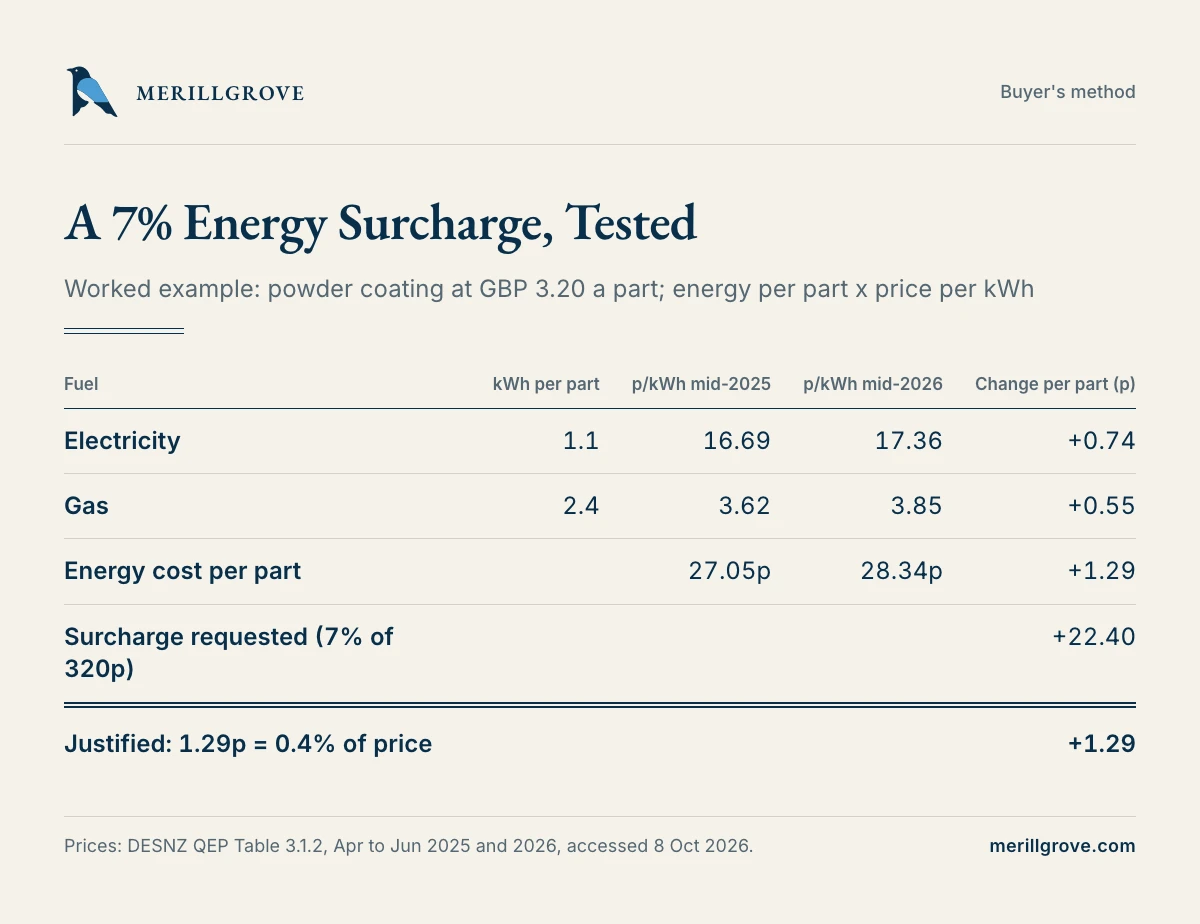 *Energy per part x price per kWh, mid-2025 to mid-2026, against the 7% requested.*
The reply: accept a change of about 1% at most, pending the coater's actual kWh and contract rates, and propose an energy adjustment based on the DESNZ table, reviewed quarterly, that moves both ways.
Worked Example 2 (EU): A German Supplier's Surcharge, Invoiced in Euros
Energy prices are real Eurostat readings.
An Australian equipment maker buys machined aluminium housings from a German supplier at EUR 42.00 each, price set in early 2025. In October 2026 the supplier announces a 4% energy surcharge from January 2027. The buyer estimates electricity at 9% of the price and gas at 3%.
- Electricity, Germany, band 2,000 to 19,999 MWh: -13.5% from the first half of 2025 to the first half of 2026.
- Gas, Germany, band I3: -6.0%.
- Index-based change: 9% x -13.5% + 3% x -6.0% = -1.22% - 0.18% = -1.4%, about EUR 0.59 a unit lower.
- Requested: +4%, EUR 1.68 a unit higher.
The published prices point down. The supplier's position may still be different: if it fixed a contract when prices were higher, its cost has not followed the market yet. That is a timing question, so ask when its current contract started and when it ends. If it renews in 2027 at today's levels, its energy cost should fall, and so should the surcharge. Because the invoice is in euros, the exchange rate is the buyer's own exposure here, not part of this test; see exchange rate price increase for that side.
If You Accept a Surcharge, Agree How It Ends
A surcharge that only moves up is a price increase with a different name. If the evidence supports one, write down:
- the kWh per unit (fixed, unless the process changes);
- the named index, country, fuel and band, and the base reading;
- a review frequency and a band within which nothing changes;
- movement in both directions, and an end date or a rule for folding the surcharge into the base price.
The wording is covered in the index-linked price adjustment clause, and the wider method of building a price from its cost drivers in should-cost analysis. Check any clause against your own contract; this is commercial guidance, not legal advice.
Tools for the Test and the Reply
Sources (checked 8 October 2026): DESNZ, Prices of fuels purchased by manufacturing industry (QEP Table 3.1.2), https://www.gov.uk/government/statistical-data-sets/prices-of-fuels-purchased-by-manufacturing-industry; DESNZ, Industrial energy price statistics, https://www.gov.uk/government/collections/industrial-energy-prices; Eurostat, Electricity prices for non-household consumers (nrg_pc_205), https://ec.europa.eu/eurostat/api/dissemination/statistics/1.0/data/nrg_pc_205?geo=DE&geo=FR&geo=IT&geo=EU27_2020&nrg_cons=MWH2000-19999&tax=X_TAX¤cy=EUR&unit=KWH&lang=EN&sinceTimePeriod=2024-S1; Eurostat, Gas prices for non-household consumers (nrg_pc_203), https://ec.europa.eu/eurostat/api/dissemination/statistics/1.0/data/nrg_pc_203?geo=DE&geo=IT&geo=EU27_2020&nrg_cons=GJ10000-99999&tax=X_TAX¤cy=EUR&unit=KWH&lang=EN&sinceTimePeriod=2024-S1; ABS, Producer Price Indexes, Australia, June 2026, https://www.abs.gov.au/statistics/economy/price-indexes-and-inflation/producer-price-indexes-australia/latest-release.
Want This Checked for You?
Send the notice, the quotes or the supplier details. We tell you what to question first, and the fee is agreed before any work starts.
More on Cost Analysis
 Cost AnalysisExchange Rate Price Increase: When Does a Currency Move Justify One?A supplier cites the exchange rate. Test it: invoice currency, cost currency share, movement since your price was set. Three worked examples, US, UK, AU.
 Cost AnalysisPackaging Price Increase: How to Check a Box Supplier's NoticeA corrugated box supplier wants 11%. Check the board grade, the board share and the public indices before you agree. Worked example with BLS and ONS data.