
Exchange Rate Price Increase: When Does a Currency Move Justify One?
A supplier cites the exchange rate. Test it: invoice currency, cost currency share, movement since your price was set. Three worked examples, US, UK, AU.
Contents
A supplier has asked for more money and the reason given is the exchange rate. Sometimes that is fair: a supplier with costs in one currency, invoicing you in another, really can lose margin when its home currency strengthens. Often it is not: the invoice is in the supplier's own currency, the costs are in dollars anyway, or the currency moved in your favour. This guide gives a four-question test for an exchange rate price increase from a supplier, with real currency movements for the last year and three worked examples from the US, UK and Australia.
In Short
- Start with the invoice currency. If the supplier invoices in the same currency its costs are in, it has no exchange rate case.
- Only the share of the supplier's costs that sits in another currency can move with the exchange rate. Estimate it.
- Measure the movement from when your current price was set, using one published source at both ends.
- Justified change = share of cost in the other currency x change in what that currency costs in the invoice currency.
- Test both directions. Over the year to September 2026, several common currency pairs moved in the buyer's favour.
- Your own exposure (paying in a currency that is not yours) is your risk to manage, not the supplier's argument.
- Agree a two-way FX clause so the next move is handled by rule.
How to Test an Exchange Rate Price Increase from a Supplier
Four questions settle most claims.
1. What currency is the invoice in? This decides who already carries the risk. A Chinese supplier invoicing you in yuan has passed the exchange rate risk to you; a currency move cannot hurt its margin on yuan costs. A supplier invoicing in US dollars or in your currency carries the risk on any costs it pays in another currency.
2. What share of the supplier's costs sits in another currency? Typical splits: labour, local components, overheads and margin in the supplier's home currency; globally traded inputs (chips, metals, resins) often bought in US dollars. If the inputs are bought in the invoice currency, that share has no exchange rate exposure at all. Use the supplier's breakdown if you have it; otherwise estimate the shares, as in a cost breakdown analysis.
3. How has that currency moved against the invoice currency since your price was set? Use one source for both readings (a central bank rate is fine) and the same averaging basis: a monthly average at each end is fairer than two single days.
4. Is the result big enough to act on? Small movements are normal and should sit inside the price. Agree a threshold for next time.
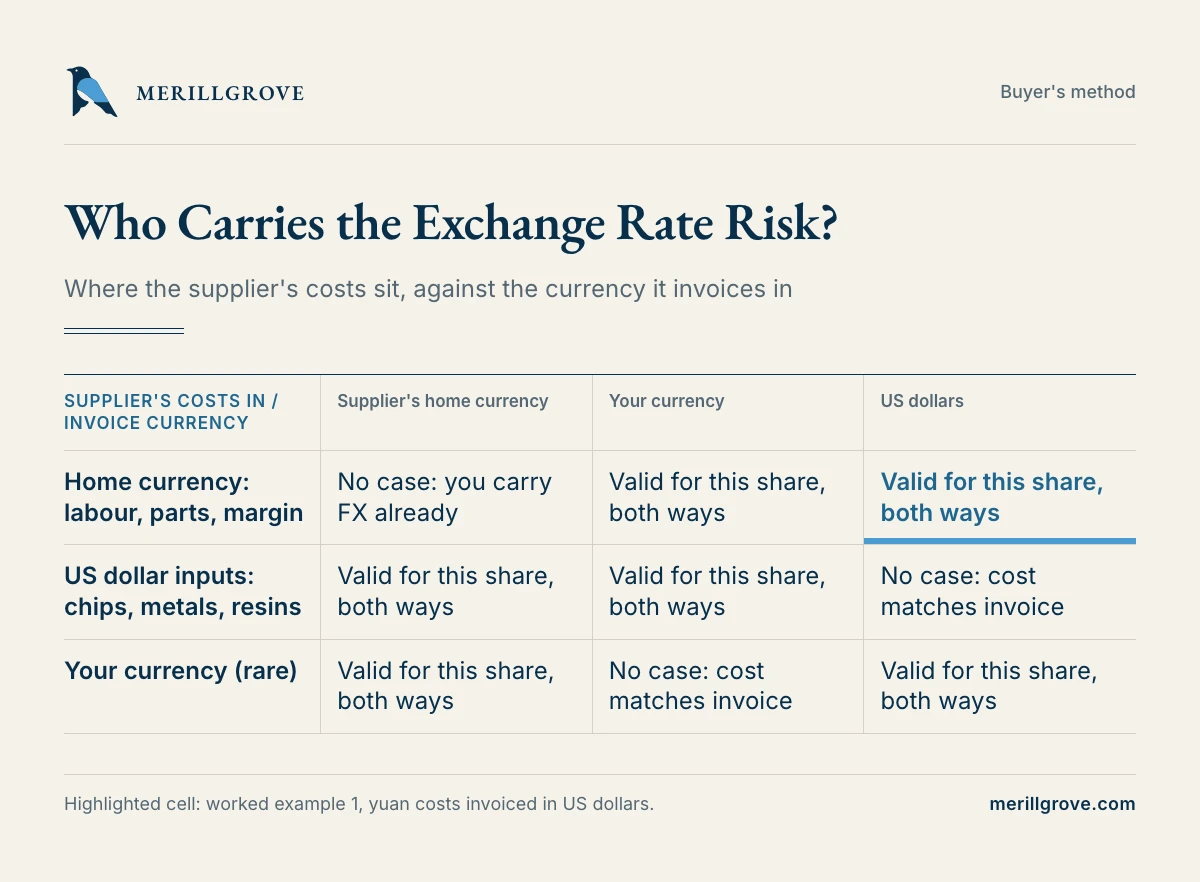 *Whether the supplier has a case depends on where its costs sit and what currency it invoices in.*
What the Currencies Did: September 2025 to September 2026
The table shows how much more or less one unit of each cost currency cost in each invoice currency, comparing the September 2026 monthly average with September 2025. The rates are ECB monthly average reference rates against the euro; the cross rates are computed from them.
| Supplier's cost currency | Invoice currency | Sep 2025 | Sep 2026 | Change in cost |
|---|---|---|---|---|
| Chinese yuan | US dollar | 7.1245 yuan per USD | 6.7090 | +6.2% |
| Chinese yuan | Pound sterling | 9.6193 yuan per GBP | 9.0012 | +6.9% |
| US dollar | Pound sterling | 1.3502 USD per GBP | 1.3417 | +0.6% |
| Euro | Pound sterling | 0.8689 GBP per EUR | 0.8581 | -1.2% |
| Chinese yuan | Australian dollar | 4.6972 yuan per AUD | 4.7781 | -1.7% |
| US dollar | Australian dollar | 0.6593 USD per AUD | 0.7122 | -7.4% |
How to read a line: in September 2025 one US dollar bought 7.1245 yuan; in September 2026 it bought 6.7090. A cost of 100 yuan therefore cost USD 14.04 and then USD 14.91, an increase of 7.1245 / 6.7090 - 1 = 6.2%.
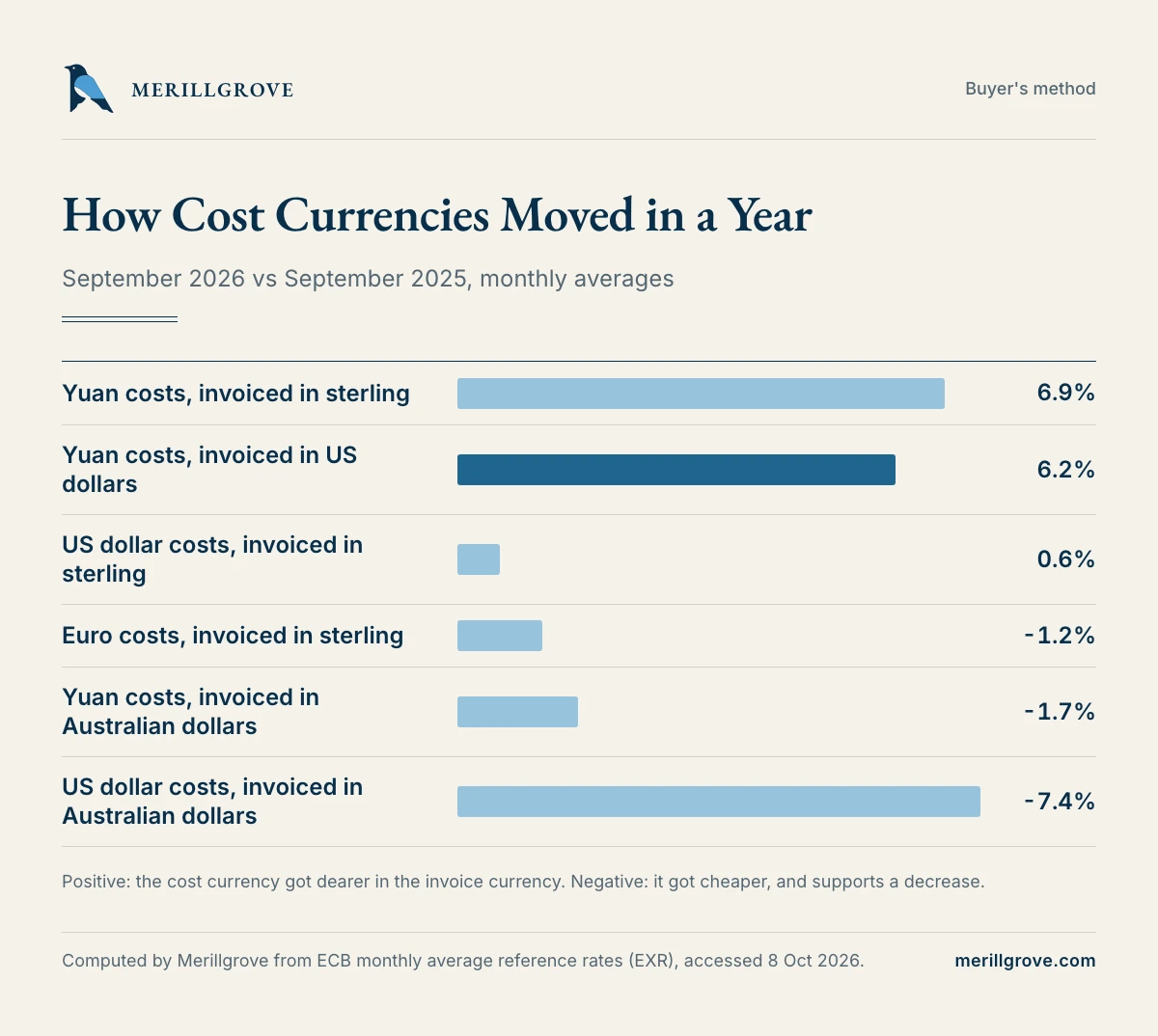 *Change in what one unit of the cost currency cost in the invoice currency. Computed from ECB monthly average reference rates, accessed 8 October 2026.*
Spot rates move around the averages. The Federal Reserve's H.10 release gives 0.6953 US dollars per Australian dollar on 2 October 2026, well below the September average of 0.7122. That is why the averaging period belongs in any agreement.
Worked Example 1 (US): A Chinese Supplier Invoicing in US Dollars
Exchange rates are real ECB readings.
A US lighting distributor buys LED panels at USD 18.60 FOB Shenzhen. The price was set in September 2025. In October 2026 the factory asks for 8%, citing the stronger yuan.
The buyer estimates that 55% of the price is yuan cost (assembly labour, local metalwork, overheads and the factory's margin) and 45% is LED chips and drivers bought in US dollars.
- Yuan share: 55%. Movement in the dollar cost of yuan: +6.2%.
- Justified increase: 0.55 x 6.19% = 3.4%. Price 18.60 x 1.034 = USD 19.23.
- Requested: 18.60 x 1.08 = USD 20.09.
- Gap: 20.09 - 19.23 = USD 0.86 a unit; at 30,000 units a year, about USD 25,800.
This claim is partly real, and dismissing it would be a mistake. The counter is 3.4%, with a clause that moves the yuan share both ways from now on.
Worked Example 2 (UK): An EU Supplier Invoicing in Sterling
Exchange rates are real ECB readings.
A UK hospitality supplier buys ceramic tableware from a Portuguese factory, invoiced in pounds. The factory gives notice of 5% for "exchange rate movements". The buyer estimates 80% of the price is euro cost.
- If the price was set in September 2025: the pound cost of a euro moved 0.8581 / 0.8689 - 1 = -1.2%. Justified change: 0.80 x -1.2% = -1.0%. The exchange rate supports a small decrease.
- If the price was last set in January 2025, when the average was 0.8391 pounds per euro: the movement is 0.8581 / 0.8391 - 1 = +2.3%. Justified change: 0.80 x 2.3% = +1.8%.
Same supplier, same notice, opposite answers. The base date is the first thing to agree. Neither base supports 5%.
Worked Example 3 (AU): A Local Distributor Citing a Weak Australian Dollar
Exchange rates are real ECB readings.
A Melbourne café group buys equipment and consumables from a local distributor, invoiced in Australian dollars. The distributor gives notice of 6%, citing "the weak Australian dollar". About 60% of its price is goods it imports and pays for in US dollars.
- The Australian dollar cost of one US dollar moved 0.6593 / 0.7122 - 1 = -7.4% between the September averages.
- Justified change on the import share: 0.60 x -7.43% = -4.5%.
- Using the latest ECB daily rates instead (7 October 2026: 1.1177 USD and 1.6079 AUD per euro, so 0.6951 USD per AUD), the movement is -5.2% and the justified change is 0.60 x -5.15% = -3.1%.
On either basis, the exchange rate points down, not up. The ABS made the same point in its June quarter 2026 producer price release: appreciation of the Australian dollar early in the quarter put downward pressure on prices of imported inputs. The distributor may have real increases elsewhere, but they need their own evidence; ask for the basis using the method in how to respond to a supplier price increase.
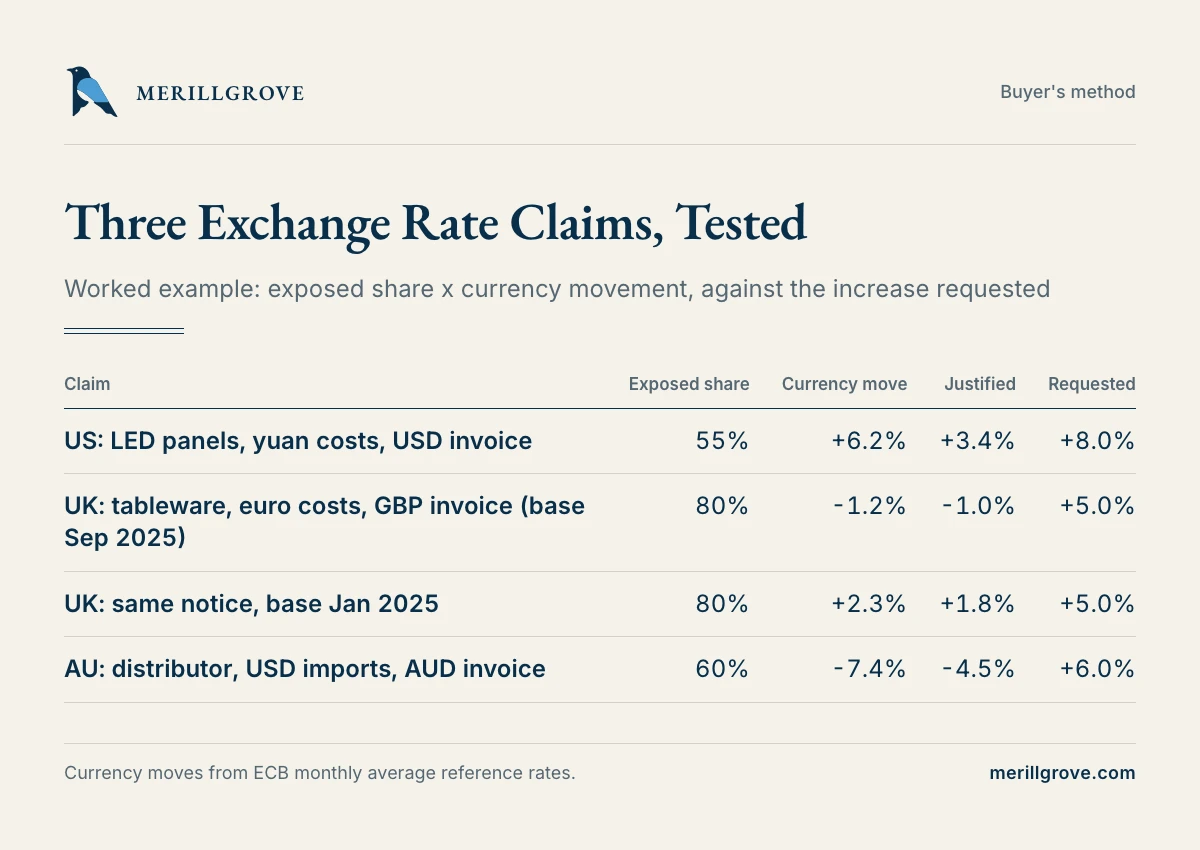 *Exposed share x currency movement against the increase requested.*
Your Own Exposure Is a Separate Question
If you pay suppliers in a currency that is not yours, the movement between your currency and the invoice currency is your risk. A UK buyer paying US dollar invoices saw the pound cost of a dollar rise 0.6% over the year to September 2026; an Australian buyer paying dollar invoices saw it fall 7.4%. Neither is a reason for the supplier's price to change. Manage it through when you buy currency and, if the amounts justify it, hedging with your bank. The guide to quote currency and validity covers how to set this up at the quote stage.
Agree an FX Clause for Next Time
The best time to agree how currency moves are handled is when nobody knows which way the next one will go. A workable clause names:
- the invoice currency and the share of the price exposed to each other currency;
- the reference rate source (ECB, Federal Reserve H.10, Bank of England or Reserve Bank of Australia) and the averaging period, for example the monthly average;
- the base rate, fixed at the date the price was set;
- a band within which nothing changes, for example 3% either way;
- the adjustment outside the band: exposed share x movement;
- movement in both directions, a review frequency and the notice for any change.
Currency is one driver among several; the same share x movement logic underpins should-cost analysis and a supplier's energy surcharge. For the wording of a two-way mechanism, see the index-linked price adjustment clause. Check any clause against your own contract; this is commercial guidance, not legal advice.
Run the Numbers
The free justified increase quick calculator, with the 12 checks before you accept a price increase, runs share x movement for each driver in one sheet; check 08 covers matching the currency over the same period: download the free checklist and calculator.
Sources (checked 8 October 2026): European Central Bank, reference exchange rates, monthly averages, https://data-api.ecb.europa.eu/service/data/EXR/M.USD+GBP+AUD+CNY.EUR.SP00.A?format=csvdata&startPeriod=2025-01&endPeriod=2026-09; European Central Bank, euro foreign exchange reference rates, https://www.ecb.europa.eu/stats/eurofxref/eurofxref-daily.xml; Federal Reserve, H.10 Foreign Exchange Rates, https://www.federalreserve.gov/releases/h10/current/; Australian Bureau of Statistics, Producer Price Indexes, Australia, June 2026, https://www.abs.gov.au/statistics/economy/price-indexes-and-inflation/producer-price-indexes-australia/latest-release; Bank of England Database, https://www.bankofengland.co.uk/boeapps/database/; Reserve Bank of Australia, exchange rates, https://www.rba.gov.au/statistics/frequency/exchange-rates.html.
Want This Checked for You?
Send the notice, the quotes or the supplier details. We tell you what to question first, and the fee is agreed before any work starts.
More on Cost Analysis
 Cost AnalysisPackaging Price Increase: How to Check a Box Supplier's NoticeA corrugated box supplier wants 11%. Check the board grade, the board share and the public indices before you agree. Worked example with BLS and ONS data.Cost AnalysisSupplier Energy Surcharge: How to Test the ClaimTest a supplier energy surcharge: kWh per unit x the move in energy prices since your price was set. UK and EU index readings, worked examples, a reply.