

Packaging Price Increase: How to Check a Box Supplier's Notice
A corrugated box supplier wants 11%. Check the board grade, the board share and the public indices before you agree. Worked example with BLS and ONS data.
Contents
A packaging price increase notice usually cites one thing: board. "Containerboard costs have risen", a percentage, an effective date. If you buy corrugated boxes or printed cartons, the useful question is not whether board went up. It is how much of your box price is board, which board, over which months, and whether the box market as a whole moved as far as your supplier wants to.
This guide gives you a five-step board grade index check, then works it through on a US example using live Bureau of Labor Statistics data to August 2026, with the UK and Australian equivalents. The general method for any supplier increase sits in how to respond to a supplier price increase; this page is the packaging-specific version.
In Short
- Confirm the board specification first. An increase that arrives with a lighter or different grade is two changes, not one.
- Estimate the board share of each box. It differs by size and print: a flat percentage across sizes over-recovers on small, heavily printed boxes.
- Apply a paperboard index for the months since your price was set, not from the supplier's chosen low point.
- Sense-check against the box makers' own selling-price index. It tells you what the market is bearing, not what is justified.
- In the US example below, a cost build supports about 3.9% and the box market moved 7.8%, against an 11% notice.
- Agree a review against a named index that moves both ways, so the next notice is a calculation, not a negotiation.
Step 1: Check the Board Grade Has Not Changed
Before any index, pull the current specification and the last invoice, and put them next to the notice and the new price list. For corrugated, check the flute (single wall or double wall, and the flute profile), the liner and medium (kraft or recycled), the strength rating your spec uses (edge crush test, bursting strength or box compression), the print (colours and coverage) and the box dimensions.
Three things to look for:
- A quiet downgrade. The same price list code with a lower strength rating or a lighter liner. That is a cost reduction for the supplier landing on the same day as a price rise.
- A grade the index does not track. Public producer price indices cover paperboard mills or corrugated products as a whole. If your box uses a specialist white-top liner or a coated board, the public index is a proxy and you should say so in your workings.
- A different reference. Many box contracts move with a trade-press containerboard price assessment. Those are licensed, so ask the supplier which assessment it uses and for the two readings it relied on, rather than guessing.
Step 2: Estimate the Board Share of Each Box
The board share is the number that matters most. If board is 55% of your box price and board rose 4.6%, board supports about 2.5% on the box, not 4.6%.
Suppliers rarely state the share, so build it. For a regular slotted carton, the blank is roughly twice the length plus twice the width plus a glue flap, by the height plus the width. Blank area times quantity gives board consumption, and a precise question for the supplier: "what board cost per square metre (or per thousand square feet) does your current price assume?"
Board share is lower on small, heavily printed or die-cut boxes (more conversion, print and set-up per unit) and higher on large plain shippers. A single percentage applied across a range of sizes was not built box by box. Ask for the increase per item, or apply your own shares by item.
Estimate the rest (conversion labour, starch, inks and adhesives, energy, delivery, overheads, margin) as shares too, adding up to 100%. Our guide on how to ask the supplier for a cost breakdown has wording for the request.
Step 3: Apply the Board Index for the Right Period
Take two readings: the month your current price was set, and the latest month. Movement is the latest divided by the base, minus one.
| Market | Board or input index | Finished box index | Frequency |
|---|---|---|---|
| US | BLS PPI Paperboard mills (PCU322130322130) | BLS PPI Corrugated and solid fiber box manufacturing (PCU322211322211) | Monthly |
| UK | ONS PPI output, C1712 Paper and paperboard | ONS PPI output, C1721 Corrugated paper and paperboard and containers (EVVQ) | Monthly |
| AU | ABS PPI output, pulp, paper and converted paper product manufacturing (Table 12) | Same group (no separate box index) | Quarterly |
Two cautions. BLS revises indexes for up to four months after first publication, so record the date you read each value. And measure from when your price was agreed, not from whichever month gives the largest movement. Our map of free public price indices covers the series in more detail.
Step 4: Build the Justified Increase
Multiply each cost's share by its movement and add the results. Hold the supplier's margin as cash per box unless you have agreed otherwise. Energy deserves its own line if the notice leans on it; the method for testing an energy surcharge applies here unchanged.
Step 5: Sense-Check Against the Box Makers' Selling Prices
The finished box index measures what box makers are charging across the market. It is not a cost index: it moves with demand, capacity and margin as well as board. Use it as a ceiling check. If a notice is well above both your cost build and the market's selling-price movement, you have a strong case. If the notice is close to the market movement, you are arguing about margin, and your leverage decides the outcome.
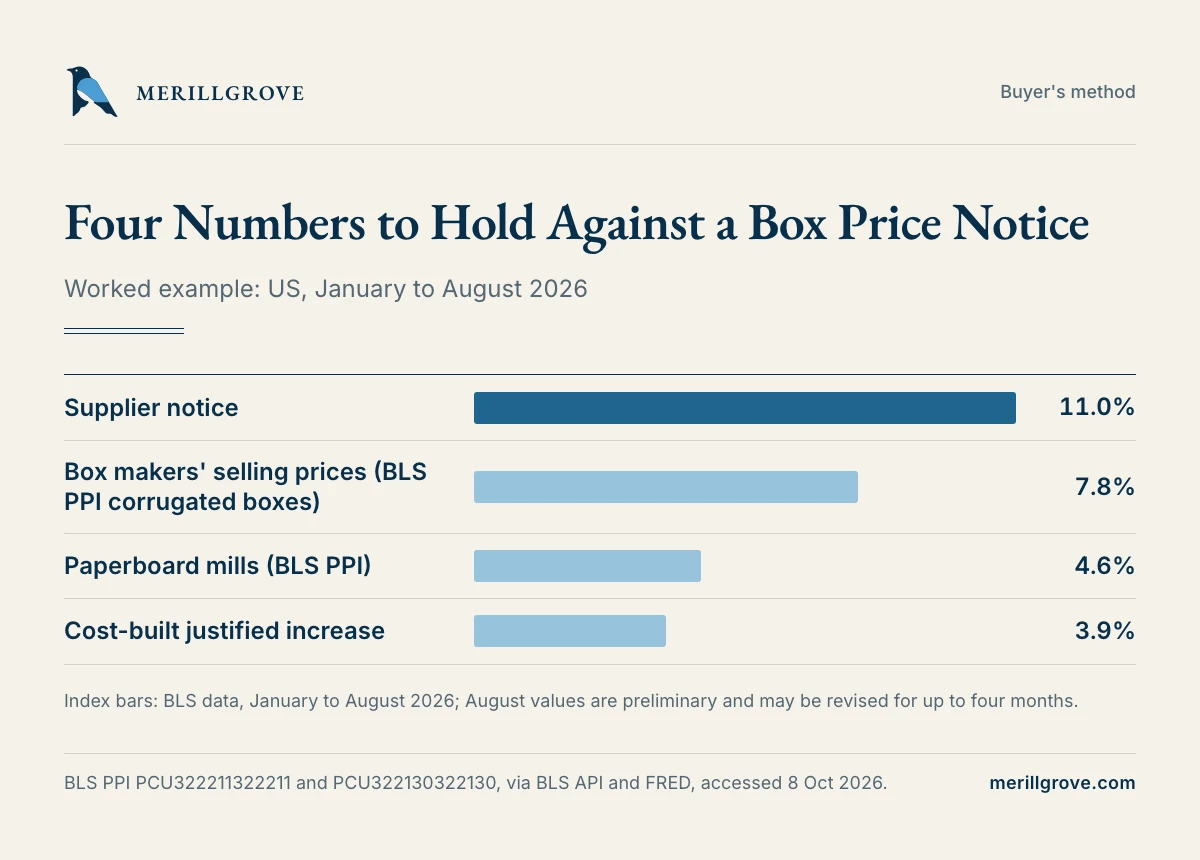 *Four numbers to hold against a box price notice, January to August 2026. The two index bars are BLS data; the notice and cost build are examples.*
Worked Example: A US Brand and an 11% Box Notice
A US consumer goods brand buys printed single-wall regular slotted cartons in three sizes, 360,000 boxes a year at a weighted average of USD 0.85 a box (USD 306,000 a year). The price was set in January 2026. In mid-September its box supplier gives notice of 11% from 1 November 2026, citing containerboard, energy and labour.
Step 1. Same price list codes. The buyer asks the supplier to confirm in writing that board grade, flute, strength rating and print are unchanged.
Step 2. The buyer estimates shares: containerboard 55%, starch, inks and adhesives 5%, conversion labour 14%, energy 5%, delivery 6%, overheads 9%, margin 6%. Total 100%.
Step 3. BLS Paperboard mills: 393.979 in January 2026, 412.186 in August 2026 (preliminary). Movement: 412.186 / 393.979 minus 1 = 4.6%. Other lines use the buyer's stated assumptions, open to challenge: labour 3.5%, energy 6.0%, starch and inks 2.0%, delivery 3.0%, overheads 3.0%.
Step 4.
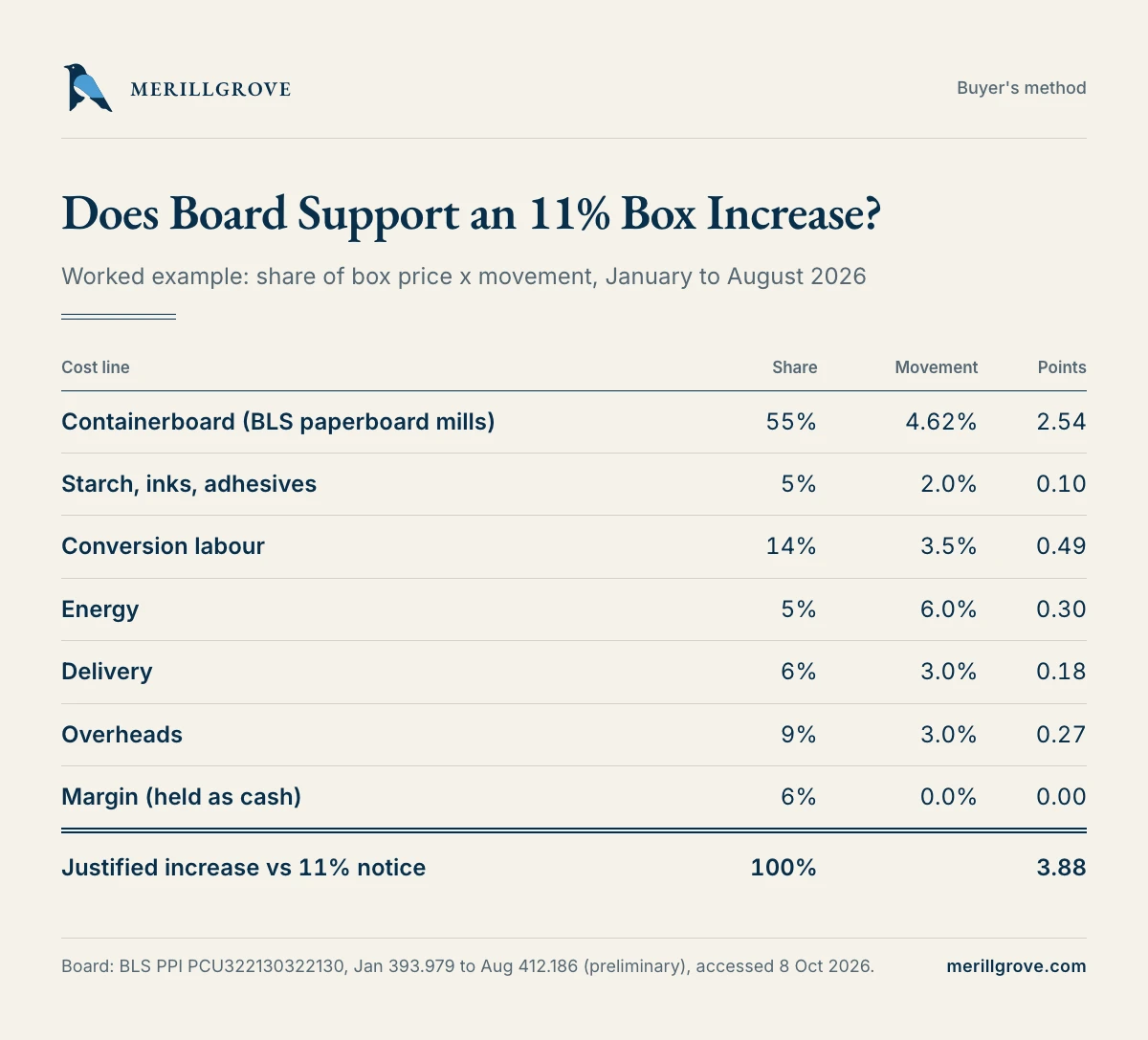 *Board grade index check: share times movement per cost line.*
| Cost line | Share | Movement | Points |
|---|---|---|---|
| Containerboard | 55% | 4.62% | 2.54 |
| Starch, inks, adhesives | 5% | 2.0% | 0.10 |
| Conversion labour | 14% | 3.5% | 0.49 |
| Energy | 5% | 6.0% | 0.30 |
| Delivery | 6% | 3.0% | 0.18 |
| Overheads | 9% | 3.0% | 0.27 |
| Margin (held as cash) | 6% | 0.0% | 0.00 |
| Justified increase | 100% | 3.88 |
About 3.9%, or USD 0.883 a box. If the board share were 65% rather than 55%, board would add 3.00 points instead of 2.54 and the total would be about 4.3%. The notice is well outside that range either way.
Step 5. BLS Corrugated and solid fiber box manufacturing: 465.078 in January 2026, 501.441 in August 2026 (preliminary), up 7.8%. Almost all of it came after April (463.660 in April, up 8.1% to August). The market is moving, faster than board alone explains, so the supplier has room to argue. But 11% is above both the cost build and the market movement.
The numbers over a year at 360,000 boxes:
- As notified, 11%: USD 0.9435 a box, an extra USD 33,660.
- Market movement, 7.8%: USD 0.9163, an extra USD 23,868.
- Cost build, 3.9%: USD 0.8831, an extra USD 11,934.
The reply. Confirm the grade is unchanged, show the table, and counter at 4% from 1 November (USD 0.884 a box, an extra USD 12,240 a year), with a review in February 2027 against the same paperboard index applied to the 55% board share, moving in either direction. Ask which containerboard reference the supplier uses and for its readings. Offer what costs you little: a 12-month forecast by size and a longer validity on the new price. If the supplier settles between 4% and 7.8%, you know what you are paying for: margin and market tightness, not board.
The Same Check in the UK and Australia
A UK buyer runs Step 5 on the ONS output index for corrugated paper, paperboard and containers sold in the UK (EVVQ). It read 131.6 in January 2026 and 138.1 in August 2026: up 4.9%. Watch the base month. Measured from March 2026 (131.1), the same index shows 5.3%; measured over the year from August 2025 (134.4), only 2.8%. A notice that quotes "board up over 5%" may be measuring from the low point, so ask which months it used.
An Australian buyer has only a quarterly series: the ABS output index for pulp, paper and converted paper product manufacturing, in Table 12 of the Producer Price Indexes release. It covers more than boxes, so treat it as a sense check and lean harder on the supplier's own board reference and readings.
When to Accept
Not every packaging notice is padded. The same BLS data shows plastics packaging film and sheet up 15.6% from January to August 2026 (182.153 to 210.609, preliminary). A film supplier asking for 8% with a high resin share may be asking for less than its costs moved. Run the same five steps; if the justified figure is at or above the request, accept, and spend your effort on a review mechanism rather than the number.
Protect the Next Notice
Packaging is a good candidate for an index-linked price adjustment mechanism: a named board index, the board share fixed in the agreement, base readings, a quarterly review, a threshold below which nothing changes, and movement in both directions. Check any such clause against your own contract; this is commercial guidance, not legal advice.
Want This Checked for You?
Send the notice, the quotes or the supplier details. We tell you what to question first, and the fee is agreed before any work starts.
More on Cost Analysis
 Cost AnalysisExchange Rate Price Increase: When Does a Currency Move Justify One?A supplier cites the exchange rate. Test it: invoice currency, cost currency share, movement since your price was set. Three worked examples, US, UK, AU.
 Cost AnalysisSupplier Energy Surcharge: How to Test the ClaimTest a supplier energy surcharge: kWh per unit x the move in energy prices since your price was set. UK and EU index readings, worked examples, a reply.