

How to Ask a Supplier for a Cost Breakdown
What to ask for, wording by leverage level, answers to the five usual refusals, and how to estimate the breakdown yourself when the supplier says no.
Contents
A supplier has asked for more money and given you a reason without numbers. You need the evidence behind the increase, and you need it without turning a routine notice into a dispute. This guide covers what to put in a supplier cost breakdown request, how to word it for your level of leverage, how to answer the usual refusals, and how to build the breakdown yourself when the supplier will not.
The wider method, from reading the notice to choosing a reply, is in how to respond to a supplier price increase. This page covers one step in it: getting the numbers from the supplier. Reading the notice itself comes before it; a full bottom-up estimate from the drawing comes after it, if the numbers never arrive.
In Short
- Ask for shares, not margins. "What share of our price is each cost you cite?" can be answered without exposing a margin; "send us your costings" cannot.
- Three levels of request: shares only; shares plus evidence; full open book. Match the level to your leverage and spend.
- Ask in writing, give at least ten working days, and set the date before the effective date.
- Most refusals are about confidentiality or effort. Both have answers.
- If the supplier still says no, estimate the split yourself, apply public indices, and send your figures with an invitation to correct them. A refusal does not leave you without evidence.
What You Need, and What You Do Not
To test a price increase you need three things per cost driver: its share of your current price, how much it has moved, and the evidence and period for that movement. With those you can calculate share times movement and see what the evidence supports.
You do not need the supplier's margin, the names of its suppliers, its overhead allocation or its accounts. Asking for them makes the request feel like an audit, and the answer becomes a refusal. Ask for the least that lets you test the claim.
That gives three levels of request:
| Level | You ask for | Fits when |
|---|---|---|
| 1. Shares | Percentage share of price for each cost cited, and the change applied | Low leverage, small spend, or a first request |
| 2. Shares plus evidence | Level 1, plus the index or invoice extracts and the two dates compared | Medium leverage; the usual default |
| 3. Open book | Quantities, rates, cost build-up and margin, under a confidentiality undertaking | High spend, strategic supply, or a contract that gives you the right |
Level 3 is a heavier tool than it looks. In the UK, the Cabinet Office's procurement policy note PPN 004 describes open book contract management as "the scrutiny of a supplier's costs and margins" through accounting data, and tells central government bodies to scale its use to the risk and complexity of the contract. If government reserves the full toolset for large, complex contracts, a routine component order is not the place to demand it. Unless your agreement contains an open-book or audit clause, the supplier is generally under no obligation to disclose its costs at all; check your own contract. This is commercial guidance, not legal advice. Last checked: 8 October 2026.
Wording by Leverage Level
Send the request in writing, from the person who owns the relationship, and follow it with a call. Put a date on it at least ten working days before the effective date. The paragraphs below can be adapted.
Low leverage (level 1). You need the supplier more than it needs you. Frame the request around your own approval process, not doubt.
To get this change approved internally, our finance team needs to see how it is built. Could you let us have, by [date], the approximate share of our current price made up by each of the costs you mention, and the change you have applied to each? Percentages are enough; we are not asking for your margins.
Medium leverage (level 2). You have alternatives that would take time, or meaningful volume.
Before we can consider a change of this size, we need to test it. Please send, by [date], the share of our current unit price made up by each cost element you cite, the change applied to each, and the index, published rate or invoice extract behind each change, with the two dates or periods compared. We will treat what you send as confidential.
High leverage (level 3). Large spend, credible alternatives, or a contractual right.
Under [clause reference] of our agreement, we ask for an open-book review of the proposed change. Please provide, by [date], the cost build-up for [item codes]: material quantities and rates, labour minutes and rates, energy, freight and packaging, overheads and margin, for the current price and the proposed price. We are happy to sign a confidentiality undertaking and to meet to go through it.
Whichever level you use, add the scope questions in the same letter: which item codes, the date basis for the new price, and confirmation that acknowledged orders ship at the acknowledged price. If you have not done so yet, read the price increase letter for the gaps worth adding.
When the Supplier Refuses: Five Answers
| What they say | What it usually means | Your response |
|---|---|---|
| "Our costs are commercially confidential." | Fear of margin exposure | "Percentages of the price are enough; we do not need your margin. We will keep them confidential." |
| "It is the market price now." | No build-up exists, or it is a list-wide decision | "Which market and index? Between which dates?" |
| "Everyone in the industry is increasing." | Pressure, not evidence | "That may be so. We still need to see how it applies to our items." |
| "Take it or leave it." | Tests whether you will do the work | "Then we will rely on our own analysis, which we will send you." |
| No reply by your date | Hoping the effective date arrives first | One chase with a call offer, then send your own estimate. |
The last two responses lead to the same place: your own figures. That is not a threat. It tells the supplier that silence does not end the conversation, and that its own numbers are the best way to change yours.
The Fallback: Build the Breakdown Yourself
When the supplier will not give a breakdown, estimate one. A rough split that adds up to 100% is more useful than none, and sending it often produces the real figures, because the supplier would rather correct yours than accept them.
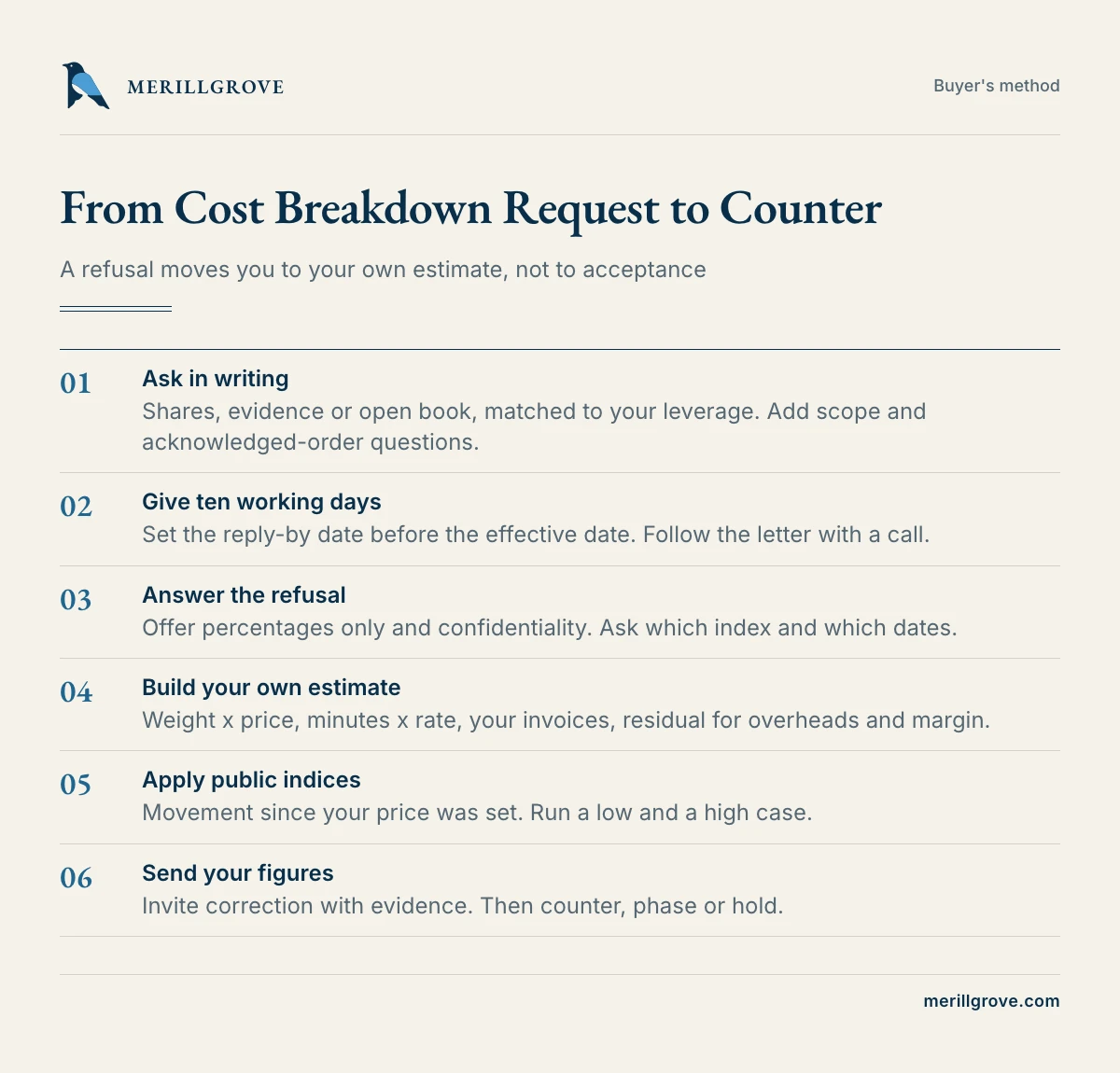 *From request to counter: a refusal moves you to your own estimate, not to acceptance.*
Build each line from what you already know:
- Materials: net weight per unit plus an offcut or scrap allowance, times a price per kg from your own recent quotes for the same material and form.
- Bought-in parts and finishing: prices from previous quotes or catalogues.
- Labour: minutes per unit, from a site visit, a time study or a reasonable estimate, times a loaded hourly rate for the supplier's location.
- Energy, packaging and delivery: from your own invoices where you pay them, or a small allowance where you do not.
- Overheads and margin: the residual, split on a stated assumption.
Then apply index movements from the date your current price was set. Where you are unsure, run a low and a high case. For a fuller method, see should-cost analysis and cost breakdown analysis.
Worked Example: An Australian Fabricator Refuses
The wage figure is a published ABS reading.
An Australian outdoor furniture maker buys powder-coated aluminium frames from a local fabricator at AUD 86.00 each, 5,000 a year. The fabricator gives notice of 11%, to AUD 95.46 (86.00 x 1.11), citing aluminium, energy and wages. It declines to give a breakdown, calling its costs confidential. The buyer sends a level 1 request, gets a second refusal, and builds its own estimate.
Aluminium: 3.2 kg of extrusion per frame plus an 8% offcut allowance is 3.456 kg. At AUD 7.80 per kg, taken from the buyer's own recent quotes for the same section, that is AUD 26.96. Labour: 24 minutes at a loaded AUD 55.00 an hour is AUD 22.00.
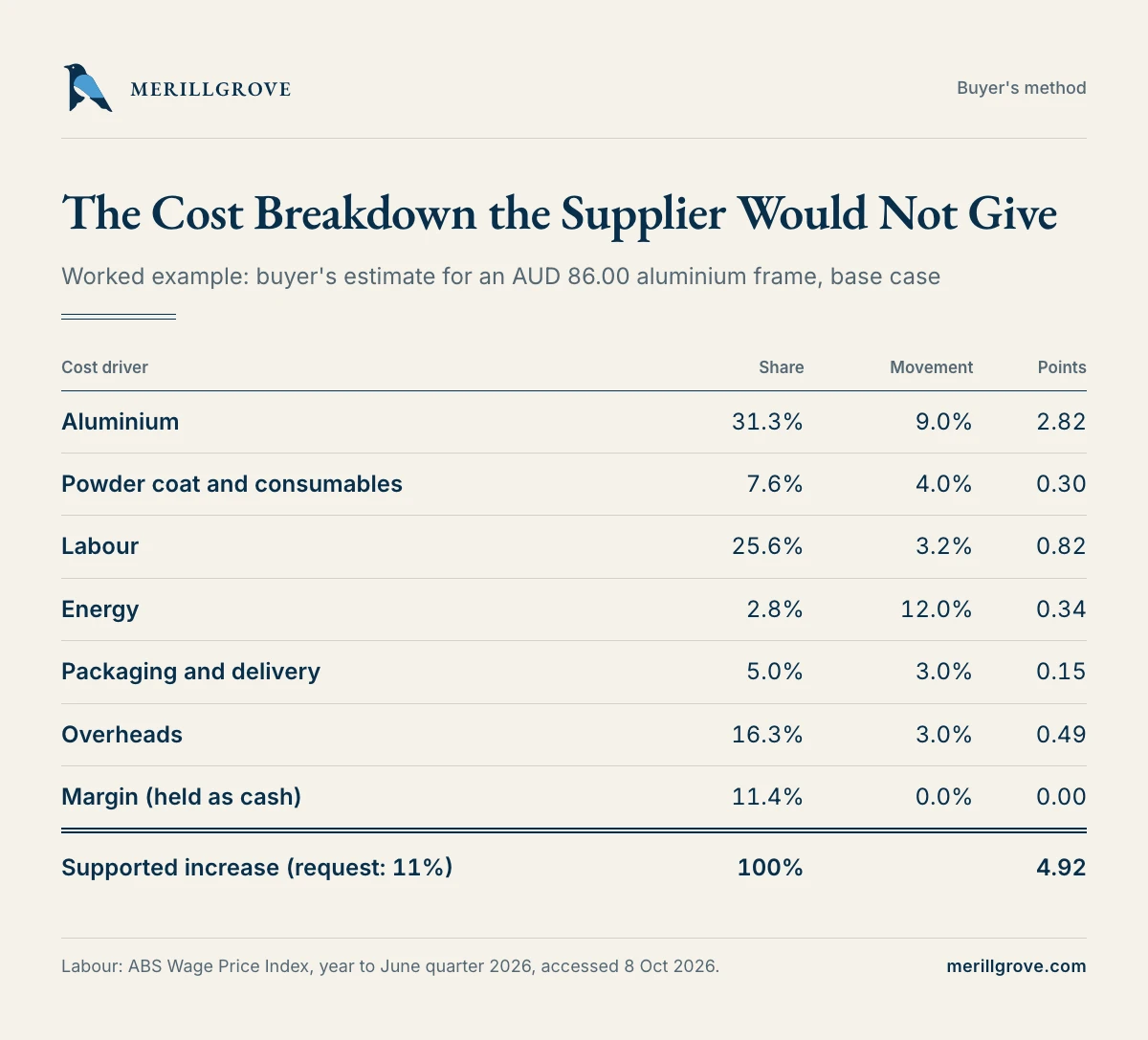 *The buyer's fallback estimate, base case.*
| Cost driver | AUD per frame | Share | Movement | Points |
|---|---|---|---|---|
| Aluminium | 26.96 | 31.3% | 9.0% | 2.82 |
| Powder coat and consumables | 6.50 | 7.6% | 4.0% | 0.30 |
| Labour | 22.00 | 25.6% | 3.2% | 0.82 |
| Energy | 2.40 | 2.8% | 12.0% | 0.34 |
| Packaging and delivery | 4.30 | 5.0% | 3.0% | 0.15 |
| Overheads | 14.00 | 16.3% | 3.0% | 0.49 |
| Margin (residual) | 9.84 | 11.4% | held as cash | 0.00 |
| Total | 86.00 | 100.0% | 4.92 |
The labour movement is the ABS Wage Price Index, up 3.2% over the twelve months to the June quarter 2026. The other movements are the buyer's example readings for its own inputs.
Base case: about 4.9%, a price of AUD 90.23 (86.00 x 1.0492). High case, with aluminium up 15% and energy up 20%: aluminium contributes 4.70 points and energy 0.56, the other lines 1.76, a total of 7.0%. Even the high case leaves a 4-point gap against 11%. At the base case the gap is AUD 5.23 a frame (95.46 minus 90.23), or AUD 26,150 a year.
The supplier may point to the ABS figure for input to manufacturing, up 10.7% over the year to the June quarter 2026. That is an index of inputs across all manufacturing. It is not this frame's cost, in which aluminium is about a third and wages a quarter.
The buyer sends its table with this paragraph, then moves to a counter using the counter with evidence wording:
As we have not received a breakdown, we have estimated one from our own data and public indices; it is attached. On these figures the evidence supports an increase of between 4.9% and 7.0%. If any share or movement is wrong, please show us where and we will correct it. Otherwise we will base our response on this range.
If the supplier is your only realistic source, the request still matters, but the reply changes. See a price increase from a sole supplier.
Want This Checked for You?
Send the notice, the quotes or the supplier details. We tell you what to question first, and the fee is agreed before any work starts.
More on Price Increases
 Price IncreasesHow to Ask a Supplier for a Price Reduction When Freight FallsFreight is in your CIF or DDP price and rates have dropped. Size the cut with freight share x lane movement, check the lag, then send the cost-down letter.
 Price IncreasesTariff Surcharges on Supplier Invoices: Who Should Pay?A tariff surcharge on a supplier invoice: who carries US duty under each Incoterm, five checks on the surcharge, and a worked example. Not customs advice.
 Price IncreasesHow to Pass a Supplier Price Increase to Customers Without Losing ThemHow much of a supplier price increase to pass on: cash margin vs percentage margin, break-even volume, timing, and a customer notice that holds.