

How to Reply to a Supplier Price Increase Letter: Seven Sample Replies
How to respond to a supplier price increase letter: seven reply types, when to use each, and sample paragraphs you can adapt, with a worked US example.
Contents
You have read the supplier's price increase letter, you know roughly how much of it the evidence supports, and now you need to write back. The reply has two jobs that pull against each other: hold your position on price, and keep the supplier shipping. This page gives seven types of response to a price increase letter, when each fits, and sample paragraphs to adapt.
To test whether the increase is justified, start with how to respond to a supplier price increase. And read the letter line by line first: its gaps become the questions in your reply.
In Short
- Write before you talk. A letter puts your numbers on the table before the sales manager calls.
- There are seven reply types: request the breakdown, counter with evidence, accept with conditions, phase, index-link, hold pending a market test, and decline.
- The gap between requested and justified, set against your leverage, picks the reply. Most first letters combine two types.
- Every reply carries the same four protections: acknowledged orders at the acknowledged price, other terms unchanged, a validity period and a reply-by date.
- Use "our figures show", never "you have inflated". An unsupported increase is usually a rounded-up headline, not a deliberate overcharge.
Pick the Reply Type First
The wording follows from the decision. The gap is the requested increase minus the supported increase, in percentage points; leverage is how credibly, and how soon, you could move the business.
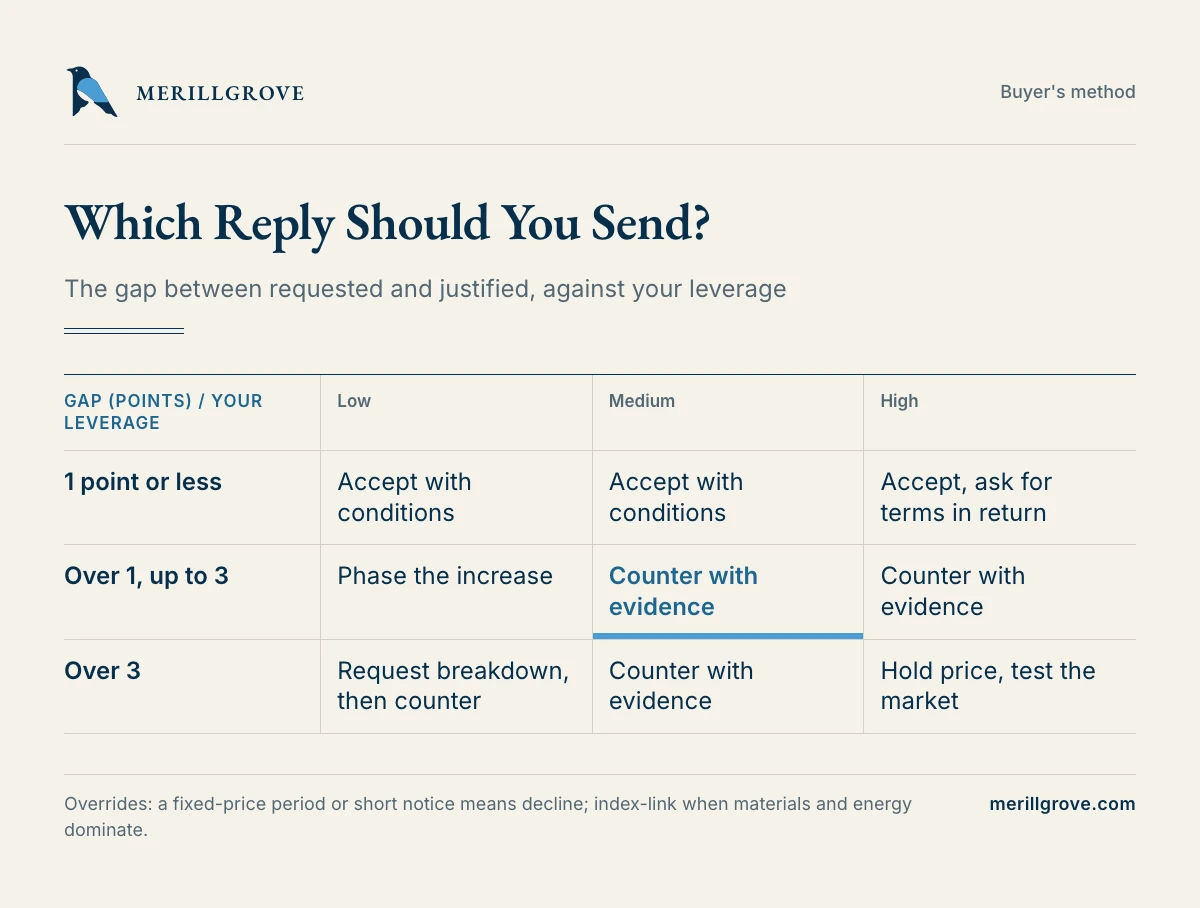 *Gap against leverage, with the reply each combination calls for. Override rules come first: a running fixed-price period means decline, whatever the grid says.*
| Reply type | Use when |
|---|---|
| 1. Request breakdown | No breakdown given and the gap looks larger than a point |
| 2. Counter with evidence | Part of the increase is supported; your leverage is medium or high |
| 3. Accept with conditions | Supported to within about a point |
| 4. Phase | Part is supported but your leverage is low |
| 5. Index-link | Materials and energy dominate the price; for the next change, not this one |
| 6. Hold pending market test | Largely unsupported and you have credible alternatives |
| 7. Decline | Fixed-price period running, notice short of your agreement, or no evidence after asking |
The full decision, including how to score leverage and the rules that override the grid, is in which answer to give.
What Every Reply Contains
Whatever the type, a good reply has the same skeleton. Six parts, in this order:
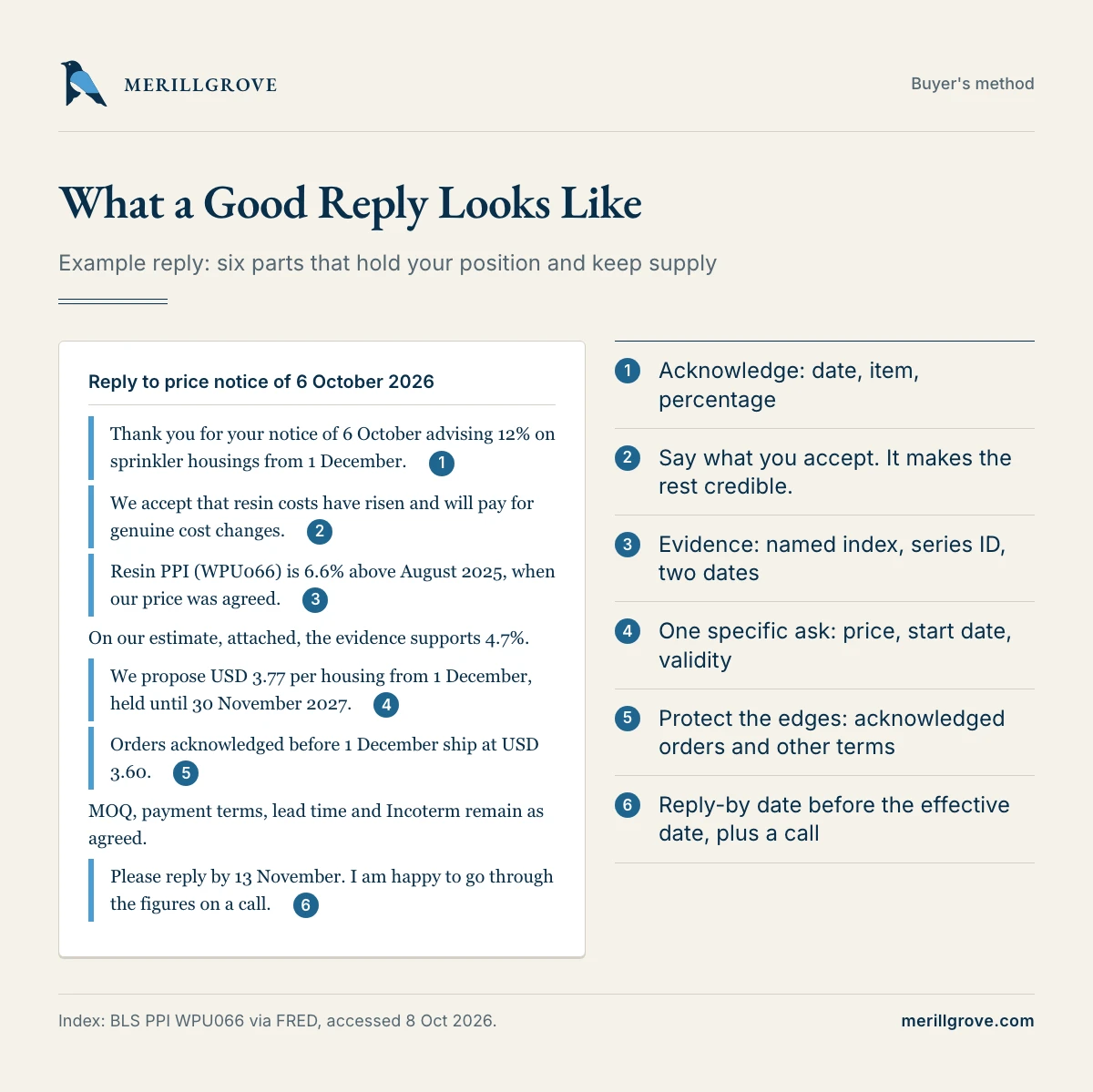 *The six parts of a reply that holds a position and keeps supply.*
- Acknowledge the notice by date, item and percentage. It shows you read it.
- Say what you accept. Costs have moved; you will pay for genuine changes. It makes the rest credible.
- Show your numbers, with the evidence attached: share of price, index, two dates, effect.
- Make one specific ask: a price, from a date, held for a period.
- Protect the edges: acknowledged orders at the acknowledged price, other terms unchanged, a review date.
- Set a reply-by date before the effective date, and offer a call.
Send it from the relationship owner and copy whoever approves prices.
Seven Sample Replies
Replace everything in square brackets. This is commercial guidance, not legal advice: where a paragraph relies on your agreement (replies 3 and 7 especially), check the clause, and take legal advice where the sums are significant.
1. Request the Cost Breakdown
Thank you for your notice of [date] advising an increase of [x]% on [items] from [effective date]. Before we can consider a change of this size, we need to understand how it is built. Please send us, by [date]: the share of our current price made up by each cost you cite, the change applied to each, and the index or invoices behind each change, with the two dates compared. Please also confirm whether the new price applies by order, shipment or invoice date, and that orders acknowledged before [date] will ship at the acknowledged price.
Often sent with reply 2, so the supplier responds to your figures. For wording at each level of leverage, see asking for a cost breakdown.
2. Counter with Evidence (the Counter Offer Letter)
We accept that [resin] costs have risen and we are prepared to pay for genuine cost changes. We have tested your increase against public indices for the period since our current price was agreed on [date]; our working is attached. It supports an increase of [4.7]%, which gives a price of [$3.77] per [housing] from [effective date], against [$4.03] in your notice. If your figures for any element differ from ours, please show us where, with the evidence, and we will review them.
3. Accept with Conditions
We have checked your breakdown against [indices] and accept that a price of [$x] reflects genuine cost changes. We accept it on these terms: it applies to orders placed on or after [date]; orders acknowledged before then ship at the current price; the new price is held until [date]; we review it together on [date] against the same indices, in either direction; and MOQ, payment terms, lead time and Incoterm remain as agreed.
Accepting is a legitimate answer. Accepting without conditions is the mistake.
4. Phase the Increase
Our analysis supports an increase of about [4.7]%. To share the pressure fairly, we propose two steps: [$3.69] from [1 December 2026], and [$3.77] from [1 March 2027], the second applying only if [the named index] is at or above [base reading] in the latest reading before that date. After step two, the price is held until [date].
Make the condition on step two objective: a named index and a reading, not "if costs remain high".
5. Propose an Index-Linked Mechanism for Next Time
For future cost changes, we propose linking [45]% of the price to [index name and series ID], reviewed [quarterly], with no change below a [2]% movement, a cap of [5]% per review, and the mechanism applying equally when the index falls.
The both-directions clause is the one to defend. Weights, thresholds and caps are covered in an index-linked price adjustment that moves both ways.
6. Hold the Price Pending a Market Test
Having reviewed your notice against public cost indices, we have not been able to reconcile an increase of [x]% with the movement in the costs you cite. We now need to confirm that our price remains in line with the market, and will obtain comparable quotations over the next [four to six] weeks. In the meantime, we ask that orders placed before [date] are supplied at the current price. This is not a decision to move the business, and we would like your offer to be part of the comparison.
Send this only if you can run the test, with stock to cover it. Never share other suppliers' prices.
7. Decline the Increase (the Rejection Letter)
We are not able to accept this change. Under our agreement dated [date], prices for these items are fixed until [date] [or: our agreement requires [x] days' written notice of a price change, and your notice does not meet that requirement]. We will continue to order at the current price of [$x] and to pay on the agreed terms. We are willing to discuss a review from [date], supported by evidence of cost changes since the current price was agreed.
The last sentence leaves a door open without conceding anything.
A Worked Example: A US Manufacturer Counters a 12% Resin Increase
The index readings are real.
A US maker of garden irrigation equipment buys injection-moulded sprinkler housings from a domestic moulder at $3.60 each, 150,000 a year. The price was agreed in August 2025. In October 2026 the moulder gives notice of 12% from 1 December, to $4.03 (3.60 x 1.12 = 4.032), citing "resin up more than 16%".
The buyer checks the Producer Price Index for plastic resins and materials (FRED series WPU066). It read 263.078 in August 2025, peaked at 306.623 in May 2026, and read 280.569 in August 2026. From the buyer's base to the May peak, resin rose 16.6%. To the latest reading, 6.65% (280.569 / 263.078 = 1.0665), which rounds to 6.6%. The notice was built on a reading that has since fallen back.
| Cost driver | Share of price | Movement | Points |
|---|---|---|---|
| Resin | 45% | 6.65% (WPU066, Aug 2025 to Aug 2026) | 2.99 |
| Labour | 15% | 3.6% (check against the BLS ECI) | 0.54 |
| Energy | 8% | 6.0% | 0.48 |
| Tooling upkeep and overheads | 17% | 3.0% | 0.51 |
| Packaging and freight | 7% | 2.0% | 0.14 |
| Margin | 8% | held as cash | 0.00 |
| Justified increase | 100% | 4.66 |
Justified price: $3.60 x 1.0466 = $3.77. Even at the May peak, resin would contribute 45% x 16.6% = 7.45 points and the total would be 9.1%, still short of 12%. The gap at the latest reading is 7.3 points, $0.26 a housing ($4.03 - $3.77), $39,000 a year.
With medium leverage (a second moulder that would need a tool transfer, ten weeks of stock), the buyer sends reply 2 with a sentence of reply 1, and adds reply 5: resin is 45% of the price and it is now falling.
| Answer | Price path | Extra cost over 12 months |
|---|---|---|
| Accept as notified | $4.03 from December | $0.43 x 150,000 = $64,500 |
| Counter (reply 2) | $3.77 from December | $0.17 x 150,000 = $25,500 |
| Phase (reply 4) | $3.69 for 3 months, then $3.77 | $0.09 x 37,500 + $0.17 x 112,500 = $22,500 |
The counter paragraph it sends:
Your notice cites resin up more than 16%. The PPI for plastic resins and materials (WPU066) rose 16.6% between August 2025, when our price was agreed, and May 2026, but the August 2026 reading is 6.6% above our base. On our estimate of the housing's cost, attached, the evidence supports 4.7%, or $3.77 per housing, held until 30 November 2027. We also propose linking the resin share to WPU066 from the next review, in both directions. If your figures differ from ours, please send them with the evidence.
No accusation, no threat, no mention of the other moulder. The index proposal is hard to refuse: the supplier asked for resin to count when it rose.
Want This Checked for You?
Send the notice, the quotes or the supplier details. We tell you what to question first, and the fee is agreed before any work starts.
More on Price Increases
 Price IncreasesHow to Ask a Supplier for a Price Reduction When Freight FallsFreight is in your CIF or DDP price and rates have dropped. Size the cut with freight share x lane movement, check the lag, then send the cost-down letter.
 Price IncreasesTariff Surcharges on Supplier Invoices: Who Should Pay?A tariff surcharge on a supplier invoice: who carries US duty under each Incoterm, five checks on the surcharge, and a worked example. Not customs advice.
 Price IncreasesHow to Pass a Supplier Price Increase to Customers Without Losing ThemHow much of a supplier price increase to pass on: cash margin vs percentage margin, break-even volume, timing, and a customer notice that holds.