
How to Pass a Supplier Price Increase to Customers Without Losing Them
How much of a supplier price increase to pass on: cash margin vs percentage margin, break-even volume, timing, and a customer notice that holds.
Contents
Your supplier has put its prices up, and some or all of the increase is real. Now you have to pass the supplier price increase to customers who did nothing to cause it and who are watching their own budgets. This guide is for distributors, wholesalers and resellers caught in that squeeze. It shows how much to pass on, when to do it, and how to word the notice so that customers accept it and you keep the account.
The arithmetic is simple, but the common mistake is to pass on the supplier's percentage instead of the supplier's money.
In Short
- Check the supplier's increase before you pass it on. Passing on an unjustified increase puts your name on it.
- Pass on cash, not the percentage. When cost is two thirds of your price, a 9% cost rise needs about 6% on your price to hold gross profit per unit.
- Holding your percentage margin asks customers for the full 9%. Know what that extra margin is worth in volume before you ask for it.
- Work out break-even volume for each option. Absorbing a 9% rise on a 33% margin line needs about 22% more volume just to stand still.
- Time the change to when the higher-cost stock reaches your shelf, and give the notice your own terms require.
- Write the notice like a supplier you would trust: what changes, by how much, from when, why in one line, and what stays the same.
Step 1: Check the Supplier's Increase Before You Pass It on
If the supplier asked for 9% and the evidence supports 5%, passing on 9% makes their weak case your problem. Your larger customers have buyers too, and some of them will test your notice with the same method you should have used on the supplier's.
So do that work first: read the supplier's notice for scope and dates, estimate each cost's share of the price, check the movement against public indices and counter where the gap is real. The full method is in the guide on how to respond to a supplier price increase, and the choice of answer is set out in accept, counter, phase or decline. Whatever you agree with the supplier becomes the cost figure you work with below.
Step 2: How Much of a Supplier Price Increase to Pass to Customers
Pass on the cash margin, not the percentage. The rule:
Price rise needed to hold gross profit per unit = supplier increase x (your cost / your selling price)
If the supplier's goods cost you two thirds of your selling price, a 9% supplier increase needs a 6% rise on your price. Not 9%.
An Australian distributor sells a 5 litre commercial floor cleaner to cafés and facility managers. It buys at AUD 18.00 and sells at AUD 27.00: gross profit AUD 9.00 a unit, a 33.3% margin. The manufacturer raises its price 9%, to AUD 19.62.
| Now | Absorb | Pass on the cash | Hold the % margin | |
|---|---|---|---|---|
| Cost (AUD) | 18.00 | 19.62 | 19.62 | 19.62 |
| Selling price (AUD) | 27.00 | 27.00 | 28.62 | 29.43 |
| Change in your price | 0.0% | +6.0% | +9.0% | |
| Gross profit per unit (AUD) | 9.00 | 7.38 | 9.00 | 9.81 |
| Gross margin | 33.3% | 27.3% | 31.4% | 33.3% |
| Volume change that keeps gross profit flat | +22.0% | 0.0% | -8.3% |
How the figures are built:
- Pass on the cash: 27.00 + 1.62 = 28.62. The rise is 1.62 / 27.00 = 6.0%, which is 9% x (18.00 / 27.00).
- Hold the percentage margin: 19.62 x (27.00 / 18.00) = 29.43, a 9.0% rise. Gross profit becomes 9.81.
- Break-even volume is old gross profit per unit divided by new: 9.00 / 7.38 = 1.220 (22.0% more units to stand still if you absorb), and 9.00 / 9.81 = 0.917 (you could lose 8.3% of volume at 29.43 and still earn the same cash).
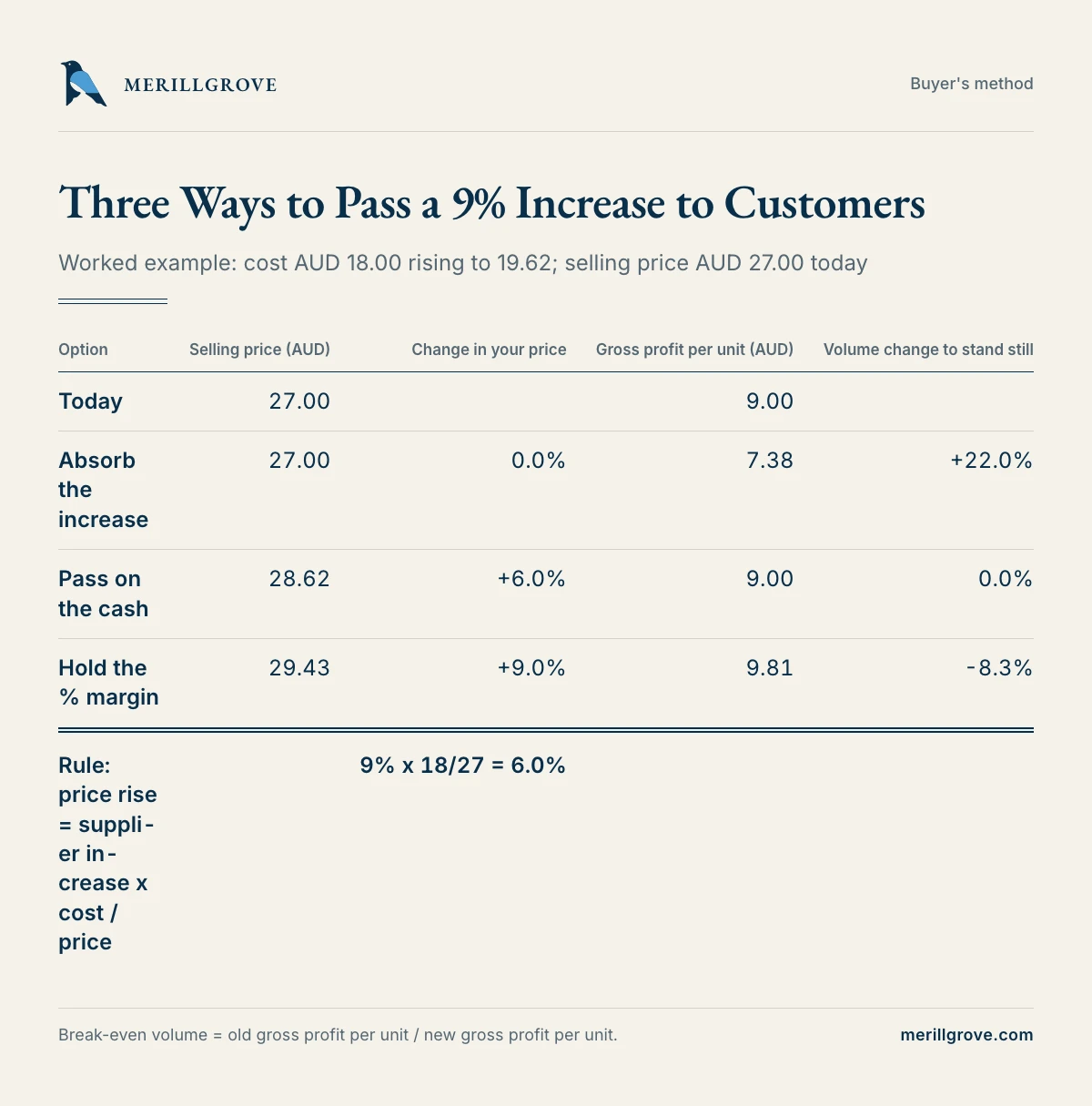 *Absorb, pass on the cash or hold the percentage: price, gross profit and the volume each option needs.*
Passing on the cash is the line you can defend in any conversation: the customer pays the supplier's increase in money, and you take nothing extra from it. Holding the percentage margin adds 0.81 a unit of profit you did not have before. That can be right if your own costs (wages, rent, delivery) have also risen, but that is a separate argument. Make it openly or not at all, and never hide it inside "our supplier has increased prices".
Absorbing can be right for a short period or a strategic account, but put a number on it first.
Step 3: Work Out the Change on the Customer's Basket, Not One Line
Customers buy a mix, and they judge your notice by what happens to their usual order. Give them that number.
A facilities customer spends AUD 12,000 a month with the distributor. AUD 4,800 of that (40%) is the manufacturer's range, all at the 33.3% margin above. Passing on the cash means 6.0% on those lines: 4,800 x 6.0% = AUD 288 a month, which is 288 / 12,000 = 2.4% of the account.
It is the figure the customer's buyer will calculate anyway, so lead with it and attach the line-by-line list.
Step 4: Choose the Date
Three things set the date, and none of them is the supplier's effective date on its own.
- Your stock cover. If you hold seven weeks of stock bought at the old cost and the supplier's increase starts on 1 December, your cost of sales rises from about 19 January, when that stock has sold through. Raising your prices on 1 December earns extra margin on old stock.
- Your own terms. Check the notice period in your terms of sale, any fixed prices in customer agreements or tenders, and the validity of quotes you have already issued. The guide on price increase notice periods covers what is usual. This is commercial guidance, not legal advice: check your own contracts.
- The basis. Say whether the new price applies by order date or delivery date. Order date is cleaner for the customer: orders placed before the date are invoiced at today's price.
Step 5: Separate Surcharge or Built into the Price
Next, decide whether the customer sees the increase as a separate surcharge line or inside your prices.
| Separate surcharge | Built into the price | |
|---|---|---|
| Visibility | The customer sees exactly what changed | One price, nothing to argue about line by line |
| When costs fall | Easy to reduce or remove | Harder to reverse; customers must ask |
| Customer reaction | Read as temporary; expect an end date | Read as permanent |
| Best for | Volatile, indexable drivers: freight, energy, tariffs | A permanent step in the supplier's list price |
If you use a surcharge, tie it to something you can show (an index, a supplier charge) and say when it will be reviewed.
If any of your customers are consumers, the rules are stricter. In the UK, traders must give consumers the total price, including mandatory charges, up front. Hiding unavoidable charges until later in the purchase (drip pricing) is illegal under the Digital Markets, Competition and Consumers Act 2024, and the CMA can fine up to 10% of turnover or GBP 300,000, whichever is greater. In the US, the FTC's Rule on Unfair or Deceptive Fees, in force since 12 May 2025, applies to live-event tickets and short-term lodging; other federal and state rules can still apply to how you show prices. In Australia, read the ACCC's guidance on displaying prices before you show a separate surcharge to consumers. Last checked: 8 October 2026. This is commercial guidance, not legal advice.
Step 6: Write the Notice
Write the notice you would want from your own supplier. The annotated example shows the structure.
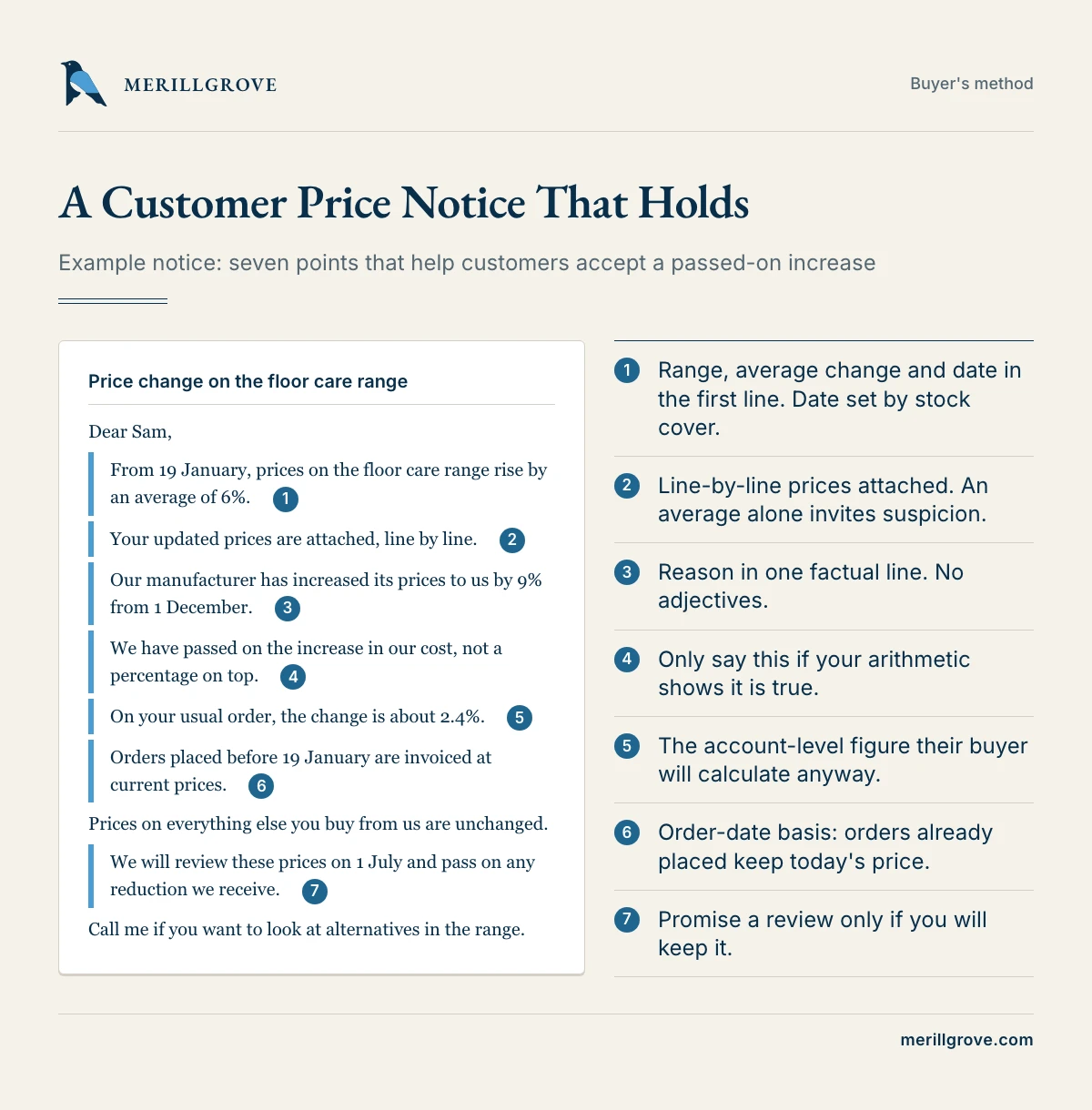 *A customer price notice with the seven points that make it hold.*
Template wording you can adapt:
Subject: Price change on the [brand] range from [date]
Dear [name],
From [date], prices on the [brand] range will rise by an average of [x]%. Your updated prices are attached, line by line.
[Supplier] has increased its prices to us by [y]% from [date]. We have passed on the increase in our cost, not a percentage on top. On your usual order, the change is about [z]%.
Orders placed before [date] will be invoiced at current prices. Prices on everything else you buy from us are unchanged.
We will review these prices on [date] and pass on any reduction we receive.
If you would like to talk it through, or look at alternatives in the range, call me on [number].
Three rules for the wording. Give the reason in one factual line: adjectives such as "unprecedented" invite challenge. Only write "passed on the increase in our cost" if Step 2 shows that is what you did. Only promise a review or a reduction if you will keep the promise; customers remember.
When Customers Push Back
Those who do are usually larger accounts, and they usually want one of four things.
- Evidence. Show your arithmetic for their basket. Share the supplier's notice only if you are free to; check for confidentiality terms first.
- Time. A phased change (half now, half in three months) costs you little if you timed the change to your stock cover.
- Choice. An alternative product, pack size or brand in your range can protect their budget and your margin.
- A two-way mechanism. For large, repeat accounts, offer the same thing you should ask your supplier for: an index-linked price adjustment that moves both ways.
Before you agree to absorb anything, go back to the break-even volume in Step 2.
Finally, once the new prices are live, check that the supplier invoices you at the price you agreed, from the date you agreed. Increases often creep in through invoices rather than notices: here is how to audit what you were actually invoiced.
Tools to Check the Supplier's Side First
Before you send a single customer notice, test the one you received. The free 12 checks before you accept a price increase, with the one-sheet justified increase quick calculator, is here: get the free checklist and calculator.
Sources (checked 8 October 2026): Competition and Markets Authority, Providing clear and accurate information about prices: summary (CMA209), https://www.gov.uk/government/publications/price-transparency-cma209/providing-clear-and-accurate-information-about-prices-summary; US Federal Trade Commission, Rule on Unfair or Deceptive Fees: Frequently Asked Questions, https://www.ftc.gov/business-guidance/resources/rule-unfair-or-deceptive-fees-frequently-asked-questions.
Want This Checked for You?
Send the notice, the quotes or the supplier details. We tell you what to question first, and the fee is agreed before any work starts.
More on Price Increases
 Price IncreasesHow to Ask a Supplier for a Price Reduction When Freight FallsFreight is in your CIF or DDP price and rates have dropped. Size the cut with freight share x lane movement, check the lag, then send the cost-down letter.
 Price IncreasesTariff Surcharges on Supplier Invoices: Who Should Pay?A tariff surcharge on a supplier invoice: who carries US duty under each Incoterm, five checks on the surcharge, and a worked example. Not customs advice.Price IncreasesHow to Check a Supplier's Steel SurchargeHow to check a supplier steel surcharge: steel weight x base price x index movement, with a worked US example on BLS steel indices and UK and AU sources.