

How to Check a Supplier's Steel Surcharge
How to check a supplier steel surcharge: steel weight x base price x index movement, with a worked US example on BLS steel indices and UK and AU sources.
Contents
A fabricator, stockholder or component supplier has added a steel surcharge to your quote or invoice: a line of its own, or a percentage on top, citing steel prices "up over 30%". Steel has risen sharply in 2026, so the claim may be broadly true. The question is whether this surcharge, on this part, matches what steel actually did to the supplier's cost of making it.
A steel surcharge from a supplier can be tested with three numbers: how much steel goes into the part, what that steel cost when your price was set, and how far a public index for that kind of steel has moved since. This guide sets out the calculation, the four places surcharges usually go wrong, and a worked example on real US index readings, with the UK and Australian sources to use instead.
In Short
- A fair steel surcharge is: gross steel weight x steel price at the time your price was set x the index movement since then.
- It applies to the steel in the part, not to the whole price or to all materials.
- Use an index for the product form the supplier buys (sheet, bar, plate, structural), not a broad steel average.
- Measure from the month your current price was set, not from a low point of the supplier's choosing.
- Allow for stock the supplier already holds, and make the surcharge fall when the index falls.
- In the worked example, three corrections take a USD 9.50 surcharge to USD 3.46, and a stock-lag test suggests USD 1.77 as a floor.
What a Steel Surcharge Should Be
A surcharge exists to pass on a change in one cost. So it should equal the change in that cost, per unit:
Surcharge per unit = gross steel weight (kg) x base steel price (per kg) x index movement
- Gross steel weight is the net weight in the finished part plus the offcuts and scrap the process creates. A laser-cut and folded sheet part might use 10% to 20% more steel than ends up in it. Ask the supplier for its figure; check it against the drawing.
- Base steel price is what the supplier paid per kg of that steel when your current price was agreed. If the supplier will not share it, estimate it from a stockholder quote for the same grade and form at that date, and say that you have.
- Index movement is the latest reading divided by the reading for the month your price was set, minus 1.
If the supplier sells its offcuts as scrap, a careful version deducts the scrap credit. Most buyers do not need that precision to find the big errors.
The calculation gives an amount per unit, not a percentage of the price. That alone catches any surcharge applied as a percentage of the whole price, because steel is only part of what you pay for: in the example below it is 22%. Our guide to estimating the material share of your price covers the build-up when you have no breakdown.
The Four Places Steel Surcharges Go Wrong
- The wrong cost base. The surcharge is applied to the whole price, or to "materials" that include coatings, fixings, gaskets and packaging, rather than to the steel alone.
- The wrong index. A broad "steel mill products" index, or a headline in the trade press, rather than the product form in your part. Different forms move differently.
- The wrong base month. The movement is measured from a low point before your current price was agreed. Any rise before that date is already in your price.
- No lag and no way down. The supplier is using steel bought months ago at lower prices, and the surcharge has no mechanism to fall when steel does.
Which Index to Use
Use the most specific public index you can find for the steel form in your part, in the market where the supplier buys. For the method across all cost drivers, see which public price index to use.
- US: the Bureau of Labor Statistics Producer Price Index, free on FRED. Useful series include steel mill products (WPU1017), cold rolled steel sheet and strip (WPU101707) and hot rolled steel bars, plates and structural shapes (WPU101704). Monthly, Index 1982=100, not seasonally adjusted.
- UK: the Department for Business, Innovation, Science and Trade's monthly construction material price indices, which break out steel items. In the 12 months to August 2026, fabricated structural steel rose 21.2% and concrete reinforcing bars 12.5%, against 6.4% for all construction work (published 7 October 2026). The ONS producer price indices cover manufactured metal products more widely.
- Australia: the ABS Producer Price Indexes, quarterly. In the June quarter 2026, input prices to house construction rose 2.1%, with other metal products the largest increase, reflecting higher aluminium and steel costs.
Record the date you read each value. Statistical offices revise recent months, and the supplier's figures may be from an earlier vintage.
A Worked Example (US)
Index readings are real BLS PPI values from FRED, read on 8 October 2026; everything else is an example to show the method.
A US equipment maker buys a powder-coated steel enclosure from a domestic fabricator at USD 84.00 a unit, about 3,000 units a year. The price was agreed in January 2026. In October the fabricator adds a steel surcharge of USD 9.50 a unit, "reflecting steel price increases of over 30%".
The buyer asks how it was built. The answer: material cost of USD 31.00 a unit, times 30.73%, the rise in the steel mill products index from November 2025 to August 2026. That is 31.00 x 30.73% = USD 9.53, rounded to 9.50.
The buyer's own inputs:
- Net steel in the enclosure: 14.0 kg of cold-rolled sheet. With a 15% allowance for offcuts, gross steel is 14.0 x 1.15 = 16.1 kg.
- Steel price in January 2026: USD 1.15 per kg, from the stockholder quote the fabricator used when pricing. Steel cost at base: 16.1 x 1.15 = USD 18.52, about 22% of the price.
- The other USD 12.48 of the supplier's "material cost" is powder coat, hinges, locks, gaskets and packaging. None of it is steel.
The index readings:
| Series (BLS PPI via FRED) | Nov 2025 | Jan 2026 | Jun 2026 | Aug 2026 |
|---|---|---|---|---|
| Steel mill products (WPU1017) | 291.556 | 315.369 | 381.162 | |
| Cold rolled steel sheet and strip (WPU101707) | 367.621 | 395.358 | 433.069 | 469.251 |
Now correct the surcharge one error at a time:
| Step | Calculation | USD per unit |
|---|---|---|
| Supplier's figure | 31.00 x 30.73% (steel mill products: 381.162 / 291.556 less 1) | 9.53 |
| 1. Steel only | 18.52 x 30.73% | 5.69 |
| 2. Right index: cold-rolled sheet, same months | 18.52 x 27.65% (469.251 / 367.621 less 1) | 5.12 |
| 3. Right base month: January 2026, when the price was set | 18.52 x 18.69% (469.251 / 395.358 less 1) | 3.46 |
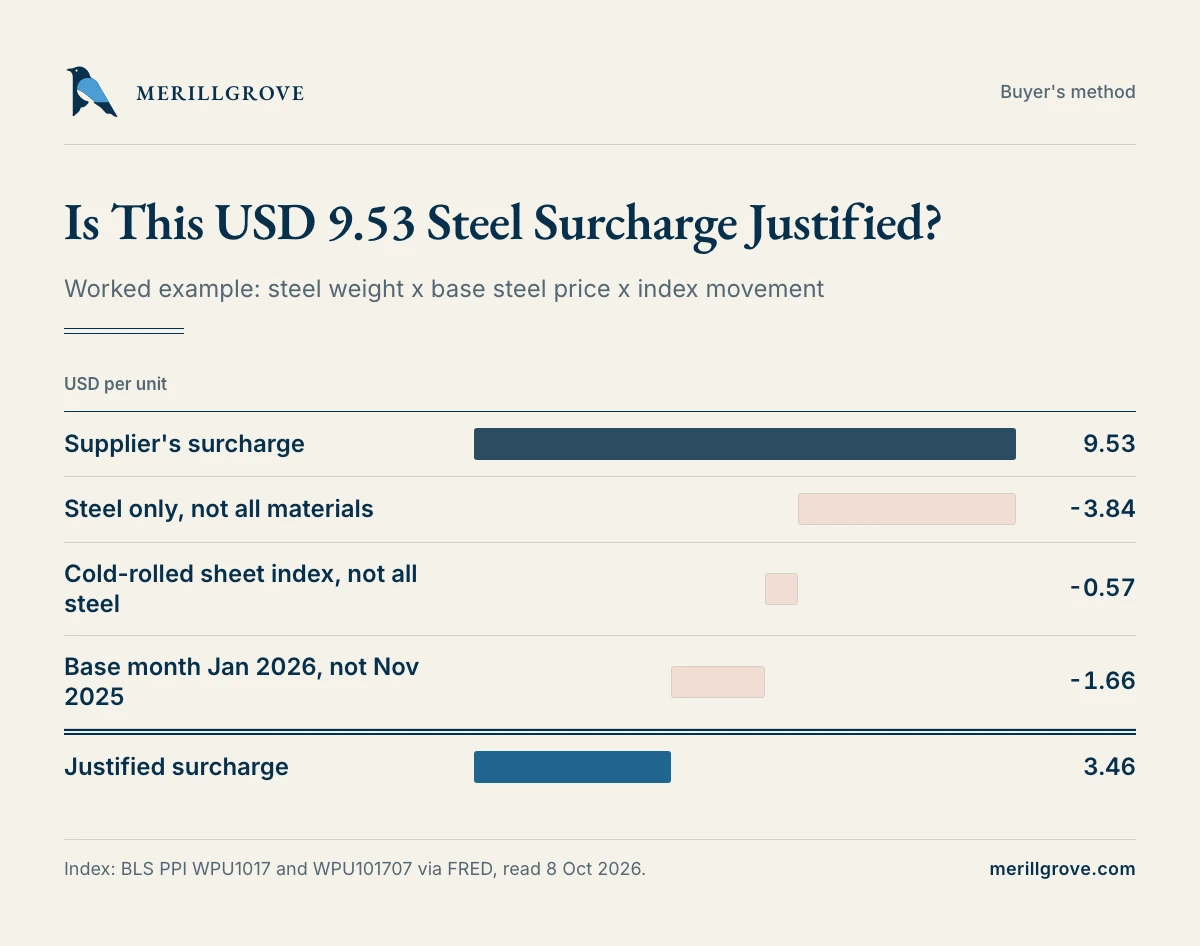 *Each correction, in dollars per unit.*
USD 3.46 is about 4.1% of the USD 84.00 price, against 11.3% for the surcharge as notified. At 3,000 units a year the difference is (9.50 less 3.46) x 3,000 = USD 18,120.
The lag test. If the fabricator holds about two months of sheet, the steel in October's enclosures was bought around June. On the June reading the movement is 433.069 / 395.358 less 1 = 9.54%, and the surcharge 18.52 x 9.54% = USD 1.77. That is a reasonable floor for a negotiation; USD 3.46 is a reasonable ceiling.
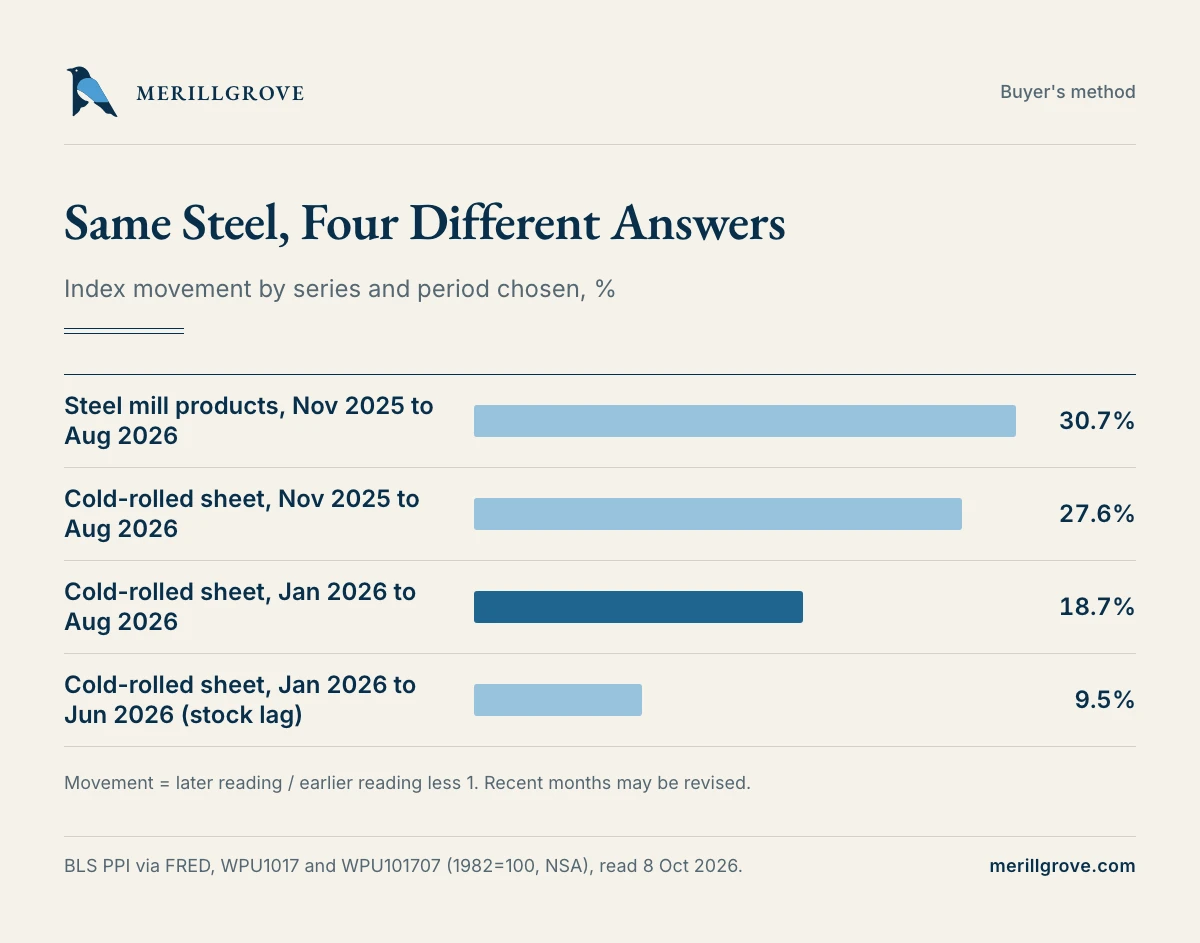 *The same steel, four answers: index choice and base month decide most of the surcharge. Readings: BLS PPI via FRED, read 8 Oct 2026.*
What to Send Back
Write before the call. Show the four-line table and ask the supplier which line it disagrees with: the weight, the base price, the index or the base month. Then propose:
- A surcharge of USD 3.46 a unit from the effective date, or a phased figure between the lag floor and that ceiling.
- A written mechanism for the future: the named index (WPU101707), the base reading (395.358, January 2026), the gross weight and base price, a quarterly recalculation, a threshold below which nothing changes, and movement in both directions.
- An end date. A surcharge with no review becomes part of the price.
Both directions matters. If the cold-rolled index fell back to 420, the same formula gives 18.52 x (420 / 395.358 less 1) = 18.52 x 6.23% = USD 1.15. Below 395.358 the surcharge is zero or a credit, depending on what you agree. A mechanism that only moves up is a price increase, not a surcharge. For drafting, see an index-linked price adjustment clause. Check any wording against your own contract; this is commercial guidance, not legal advice.
When the Surcharge Is Fair
Sometimes the calculation comes out close to what the supplier asked. If steel is a large share of the part, the index is the right one and the base month is when your price was set, accept it, ask for the mechanism and spend your effort elsewhere. The point of the test is to know, not to argue.
If the supplier also cites tariffs on imported steel, separate the two: a tariff is a different cost with a different test. See tariff surcharges on supplier invoices. If you are a contractor whose problem is steel moving between tender and order, rather than a surcharge on a price already agreed, see material price escalation clauses. For a price increase that covers several cost drivers at once, use the full method in how to respond to a supplier price increase.
Run It on Your Own Surcharge
Sources (checked 8 October 2026): BLS PPI Steel Mill Products (WPU1017) via FRED, https://fred.stlouisfed.org/series/WPU1017; BLS PPI Cold Rolled Steel Sheet and Strip (WPU101707) via FRED, https://fred.stlouisfed.org/series/WPU101707; BLS PPI Hot Rolled Steel Bars, Plates, and Structural Shapes (WPU101704) via FRED, https://fred.stlouisfed.org/series/WPU101704; Department for Business, Innovation, Science and Trade, Construction building materials: commentary September 2026, https://www.gov.uk/government/statistics/building-materials-and-components-statistics-september-2026/construction-building-materials-commentary-september-2026; ABS, Producer Price Indexes, Australia, June 2026, https://www.abs.gov.au/statistics/economy/price-indexes-and-inflation/producer-price-indexes-australia/latest-release.
Want This Checked for You?
Send the notice, the quotes or the supplier details. We tell you what to question first, and the fee is agreed before any work starts.
More on Price Increases
 Price IncreasesHow to Ask a Supplier for a Price Reduction When Freight FallsFreight is in your CIF or DDP price and rates have dropped. Size the cut with freight share x lane movement, check the lag, then send the cost-down letter.
 Price IncreasesTariff Surcharges on Supplier Invoices: Who Should Pay?A tariff surcharge on a supplier invoice: who carries US duty under each Incoterm, five checks on the surcharge, and a worked example. Not customs advice.
 Price IncreasesHow to Pass a Supplier Price Increase to Customers Without Losing ThemHow much of a supplier price increase to pass on: cash margin vs percentage margin, break-even volume, timing, and a customer notice that holds.