

Price Increase From a Sole Supplier: What You Can Still Do
No alternative supplier? You can still control timing, validity, terms and the next increase. A low-leverage playbook with a worked Australian example.
Contents
When the price increase comes from a sole supplier, the usual advice stops working. You cannot credibly test the market, threatening to move is a bluff the supplier can see through, and declining risks the one source you have. The supplier knows this, and the notice is usually written accordingly.
You still have more room than it feels like. A sole supplier controls the price; it does not control when the increase starts, how long it holds, what else changes with it, or whether the next one is negotiated on evidence. This guide sets out what you can still do, in order, with a worked example from an Australian manufacturer. It adapts the general method in how to respond to a supplier price increase to the case where walking away is not an option.
In Short
- Check how sole the supplier really is. Proprietary, specified, capacity-bound and habitual sole sources weaken at different speeds.
- Protect what is already agreed: acknowledged orders, any fixed-price period, the notice period.
- Buy ahead at the current price if the saving beats the holding cost.
- Get the evidence anyway. A shares-only breakdown request costs the supplier little to answer, and the answer anchors everything else.
- Trade what costs you little (forecasts, commitment, payment speed) for what matters: the supported part now, validity of 12 months or more, and unchanged terms.
- Propose an index link for the next change, and start reducing dependence now, even if a second source is a year away.
First: How Sole Is Your Sole Supplier?
"No alternative" means different things, and each changes on a different clock.
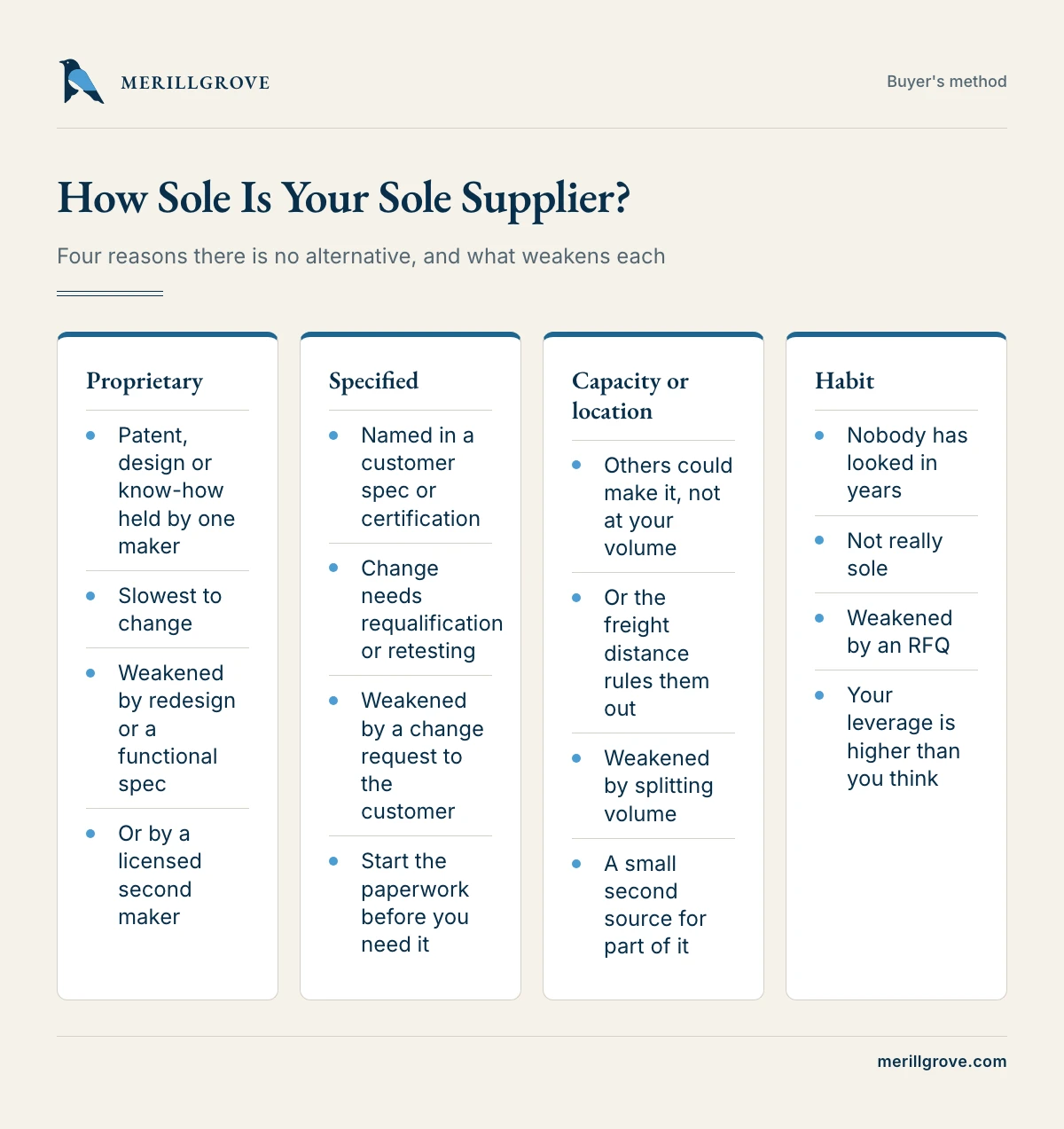 *Not every sole supplier is sole for the same reason. The reason tells you what to start working on.*
| Kind | Why there is no alternative | What weakens it |
|---|---|---|
| Proprietary | Patent, design or know-how only this supplier holds | Redesign, a functional specification, a licensed second maker |
| Specified | Your customer's approved specification or your product's certification names it | Requalification, a change request to your customer |
| Capacity or location | Others could make it but cannot take the volume or the freight distance | Splitting volume, a smaller second source for part of it |
| Habit | Nobody has looked for another source in years | An RFQ. This one is not really sole. |
If yours is habit, read choosing between accept, counter, phase and decline instead: your leverage is higher than you think. The rest of this guide is for the first three.
What a Sole Supplier Still Wants from You
Low leverage on price is not low leverage on everything. A sole supplier still values a customer who:
- forecasts accurately and orders to the forecast;
- commits to volume for longer than one order;
- pays on time, or earlier;
- orders in full, regular batches rather than urgent part-loads;
- does not ask for changes after the order is acknowledged.
Each of these has a cost to the supplier when it is missing. They are your currency. Spend them on validity and timing, not on headline percentage points the supplier will not give.
The Low-Leverage Playbook
Work down the ladder. Each yes is a move you can make.
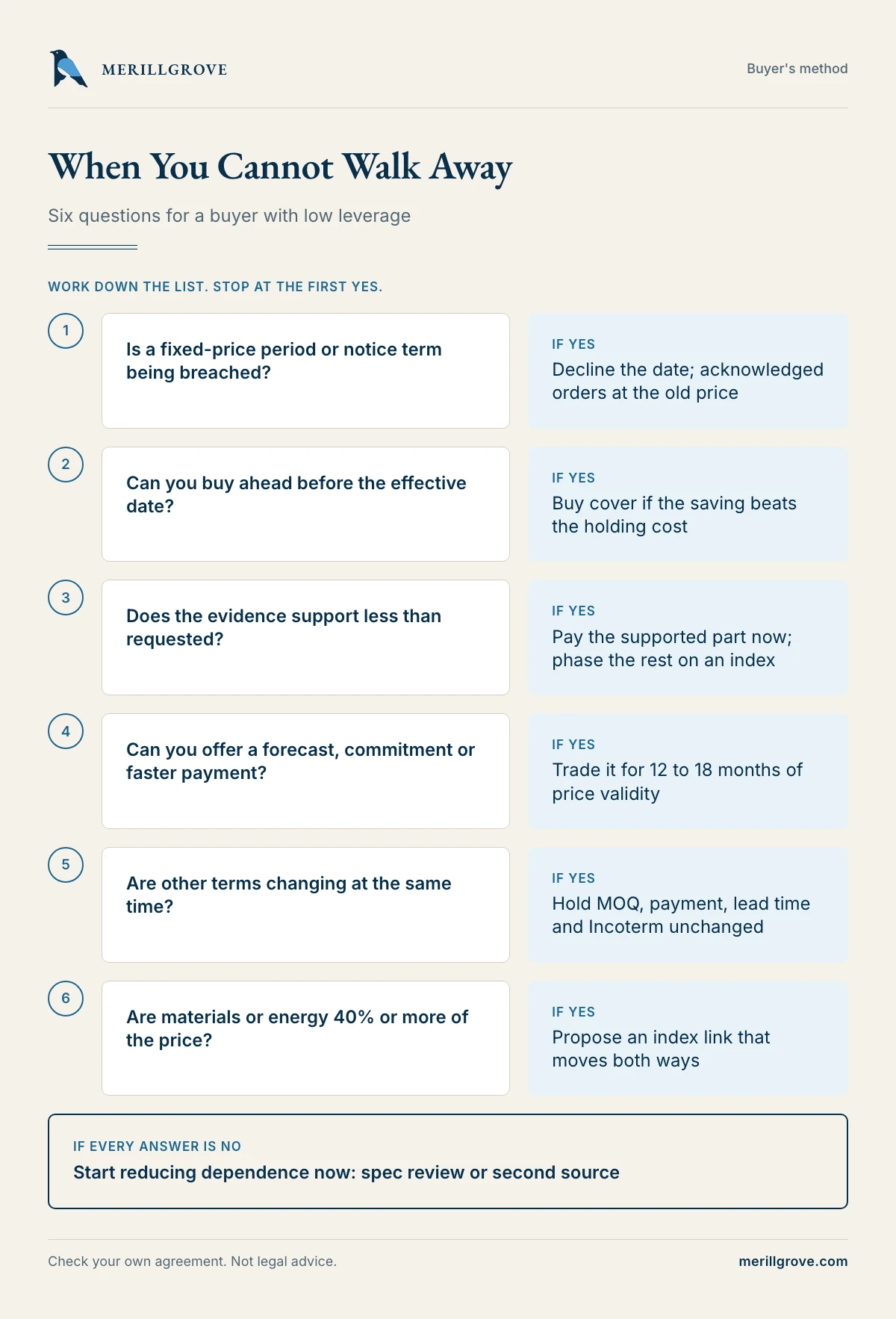 *Six questions for a low-leverage negotiation, in order.*
1. Protect what is already agreed. Confirm that orders the supplier has acknowledged ship at the acknowledged price. Check your agreement for a fixed-price period or a notice period: if either is being breached, the answer to the date is no, even from a sole supplier. Read the clause yourself; this is commercial guidance, not legal advice.
2. Buy ahead, if the numbers work. Before the effective date, order cover at the current price. Compare the saving (the increase times the units) with the holding cost (the cash tied up, at your cost of capital, plus storage), and check shelf life, obsolescence and whether the supplier will ship it. Expect a sole supplier to cap pre-increase orders; ask anyway, in writing, early.
3. Get the evidence anyway. Send a shares-only breakdown request: the share of your price for each cost cited and the change applied. Without a supported figure you have nothing to phase towards.
4. Offer the supported part now, the rest later. Pay the increase the evidence supports from the effective date. Put the remainder in a second step, triggered only by a named index at or above a stated reading. It is the offer a sole supplier finds hardest to refuse, because it gets money on day one.
5. Trade commitment for validity. A 12-month forecast, a volume commitment or faster payment, in return for the new price held for 12 to 18 months. The most expensive thing about a sole supplier is not one increase; it is the next one arriving in four months.
6. Fix the terms and the next change. Keep MOQ, payment terms, lead time and Incoterm unchanged, and no new surcharges on top. Where materials or energy dominate the price (as a rule of thumb, 40% or more), propose an index-linked adjustment for future changes, moving in both directions.
Then, whatever you agree, start reducing the dependence. A redesign, a requalification or a second source for part of the volume may take a year. Starting now is what gives you leverage at the next notice. See single-source risk for whether to accept the dependence, and how to find an alternative supplier without losing your current one.
Worked Example: A 15% Increase on a Proprietary Controller
The wage figure is a published ABS reading.
An Australian maker of commercial refrigeration buys an electronic controller from its only approved supplier. The controller is written into the product's certification, so changing it means retesting. Price AUD 142.00, 2,400 a year (200 a month). On 6 October 2026 the supplier gives notice of 15% from 1 December 2026, to AUD 163.30 (142.00 x 1.15), citing component and wage costs.
The supplier answers a shares-only request. The buyer applies movements since its price was set:
| Cost driver | Share | Movement | Points |
|---|---|---|---|
| Electronic components | 45% | 15.0% | 6.75 |
| Assembly labour | 20% | 3.2% (ABS Wage Price Index) | 0.64 |
| Engineering and firmware support | 10% | 3.0% | 0.30 |
| Freight and packaging | 5% | 4.0% | 0.20 |
| Overheads | 10% | 3.0% | 0.30 |
| Margin | 10% | held as cash | 0.00 |
| Supported | 100% | 8.19 |
The evidence supports 8.19%, a price of AUD 153.63 (142.00 x 1.0819). Leverage is low. Holding the price or testing the market are not real options.
The buyer proposes a package:
- Buy ahead: 600 controllers (three months) at AUD 142.00, delivered in November.
- Price: AUD 153.63 from 1 December, held until 31 May 2028.
- In return: a rolling 12-month forecast and payment at 14 days instead of 30.
- Terms: MOQ, lead time and Incoterm unchanged; no separate surcharges.
- Next change: the components share linked to a named index from June 2028, both directions.
- Fallback: if the supplier insists on more, a second step to 12% (AUD 159.04) from 1 June 2027, only if the component index is at or above its base reading.
The buy-ahead holding cost: the 600 units are worth AUD 85,200 and run down over three months, so on average AUD 42,600 is tied up. At 12% a year for cash and storage, that costs AUD 42,600 x 0.12 x 3/12 = AUD 1,278.
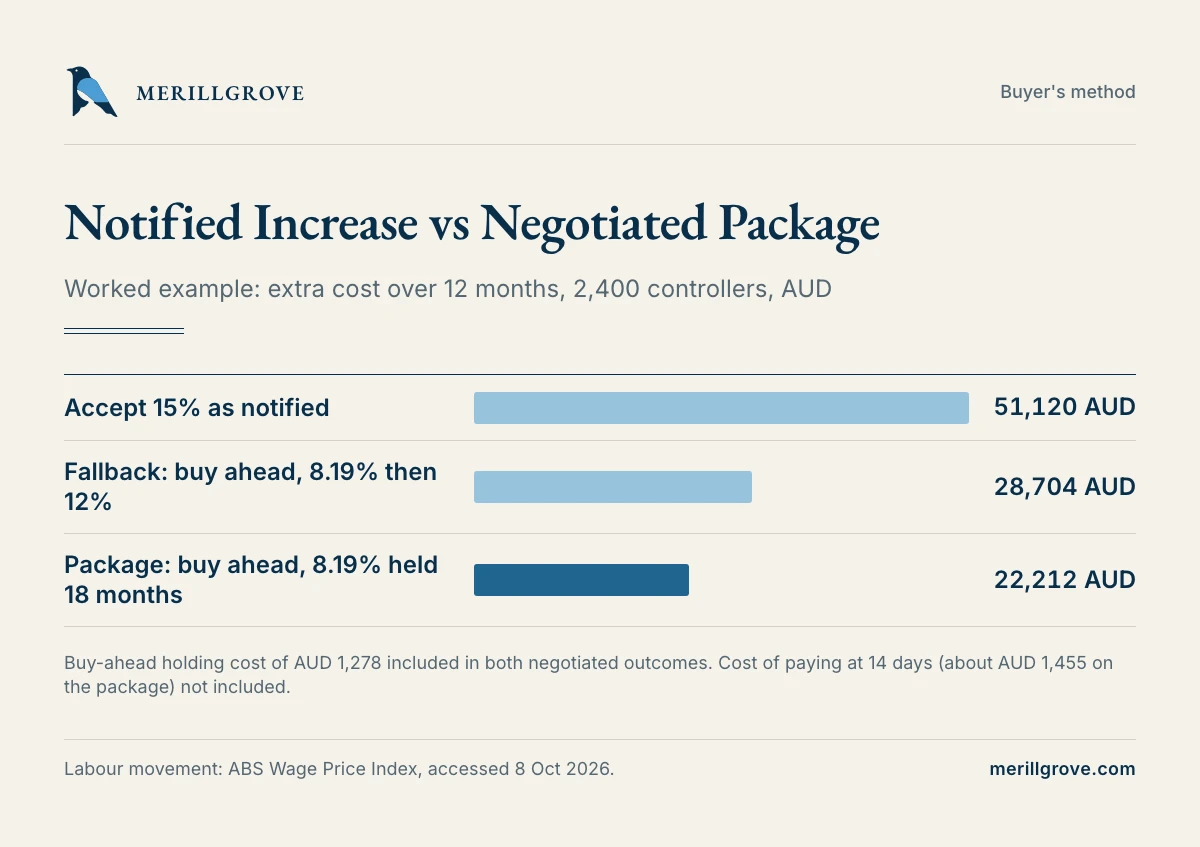 *Extra cost over 12 months (December 2026 to November 2027) against the current price, 2,400 controllers.*
| Outcome | Calculation | Extra cost over 12 months |
|---|---|---|
| Accept as notified | 21.30 x 2,400 | AUD 51,120 |
| Fallback: buy ahead, 8.19% then 12% | 1,278 + 11.63 x 600 + 17.04 x 1,200 | AUD 28,704 |
| Package: buy ahead, 8.19% held | 1,278 + 11.63 x 1,800 | AUD 22,212 |
The package costs AUD 28,908 less than accepting the notice as written, without the buyer ever claiming it could walk away. Even the fallback saves AUD 22,416. Paying at 14 days instead of 30 is not free either: 16 days earlier on AUD 276,534 of purchases (1,800 x 153.63), at the same 12% a year, is 276,534 x 0.12 x 16/365 = about AUD 1,455, which trims the package's saving to about AUD 27,450. It is still the cheapest outcome by a wide margin. And the 18-month validity means the next negotiation starts in 2028, on an index, rather than in 2027 on a fresh notice.
What Not to Do
- Do not bluff. A threat to move that the supplier knows you cannot carry out costs you credibility for the next notice too.
- Do not write "we have no choice". Even when true, it belongs in your internal notes, not in a letter.
- Do not hold back payment as a protest. It turns a price discussion into a supply risk, and it spends the one currency a sole supplier values most.
- Do not accept silently. Silence buys nothing; a conditional acceptance buys validity and terms.
Want This Checked for You?
Send the notice, the quotes or the supplier details. We tell you what to question first, and the fee is agreed before any work starts.
More on Price Increases
 Price IncreasesHow to Ask a Supplier for a Price Reduction When Freight FallsFreight is in your CIF or DDP price and rates have dropped. Size the cut with freight share x lane movement, check the lag, then send the cost-down letter.
 Price IncreasesTariff Surcharges on Supplier Invoices: Who Should Pay?A tariff surcharge on a supplier invoice: who carries US duty under each Incoterm, five checks on the surcharge, and a worked example. Not customs advice.
 Price IncreasesHow to Pass a Supplier Price Increase to Customers Without Losing ThemHow much of a supplier price increase to pass on: cash margin vs percentage margin, break-even volume, timing, and a customer notice that holds.