
CBAM Surcharges on Supplier Invoices: What to Ask Before You Pay
A CBAM surcharge should equal net embedded emissions times the certificate price for the quarter of import. The data to ask for, a worked test, and dates.
Contents
A "CBAM surcharge" has appeared on a steel or aluminium invoice, often as a flat amount per tonne. CBAM is a real cost for whoever imports the goods into the EU. But a figure built from gross embedded emissions times the latest certificate price overstates what the importer will pay for 2026 imports, and the free allocation adjustment alone can remove most of it.
This note gives you one screen, one test and one data request. Last checked: 8 October 2026. This is commercial guidance, not legal, customs or tax advice.
In Short
- CBAM is paid by the EU importer, the authorised CBAM declarant. A non-EU supplier selling to you as importer pays nothing to the EU.
- Importers below 50 tonnes a year of iron and steel, aluminium, fertiliser and cement goods have no CBAM obligation.
- For 2026 imports, the certificate price is set by quarter of import: EUR 75.36 for Q1, EUR 75.28 for Q2, EUR 82.32 for Q3.
- Certificates due are adjusted for EU ETS free allocation, which is still 97.5% of the usual level in 2026.
- Nothing is bought until February 2027 and nothing surrendered until 30 September 2027.
- So a fair CBAM line is net emissions per tonne times the price for the quarter of import, less any carbon price paid at origin.
The Screen: Who Is the Importer?
If you clear the goods into the EU yourself, a CBAM line from a non-EU supplier is not CBAM. It may reflect the supplier's cost of measuring and verifying emissions, which is worth discussing, but test it as a price increase. If your supplier is an EU stockholder or distributor that imported the goods, CBAM is its cost and some pass-through is reasonable. If that importer is below the 50-tonne threshold, it has no CBAM cost at all.
The Test: Embedded Emissions Times Certificate Price
Fair CBAM cost per tonne = (embedded emissions per tonne less the free allocation adjustment per tonne) x certificate price for the quarter of import, less any carbon price already paid where the goods were made.
Three common errors push a surcharge up. Using gross emissions with no free allocation adjustment. Using the latest quarter's price for goods imported earlier. Charging CBAM on goods outside Annex I, or on the whole invoice when only part of it is a CBAM good. Annex I is wider than raw steel: it includes structures (7308), screws and bolts (7318) and other articles of iron or steel (7326).
Worked Example
Emissions, adjustment and surcharge figures are examples; certificate prices are the published 2026 figures.
An EU fabricator buys 200 tonnes of steel sections from an EU stockholder that imported them in Q3 2026. The stockholder adds a CBAM surcharge of EUR 160 a tonne.
The fabricator asks for the data. The mill's verified emissions are 1.95 tCO2 a tonne. The stockholder's free allocation adjustment, worked out under the Commission's rules, is 1.40 tCO2 a tonne. No carbon price was paid at origin.
- Gross: 1.95 x 82.32 = EUR 160.52 a tonne. The surcharge is the gross figure.
- Net: (1.95 less 1.40) x 82.32 = 0.55 x 82.32 = EUR 45.28 a tonne.
- Overcharge: 160.00 less 45.28 = EUR 114.72 a tonne, or EUR 22,944 on 200 tonnes.
- Had the goods come in during Q2: 0.55 x 75.28 = EUR 41.40 a tonne.
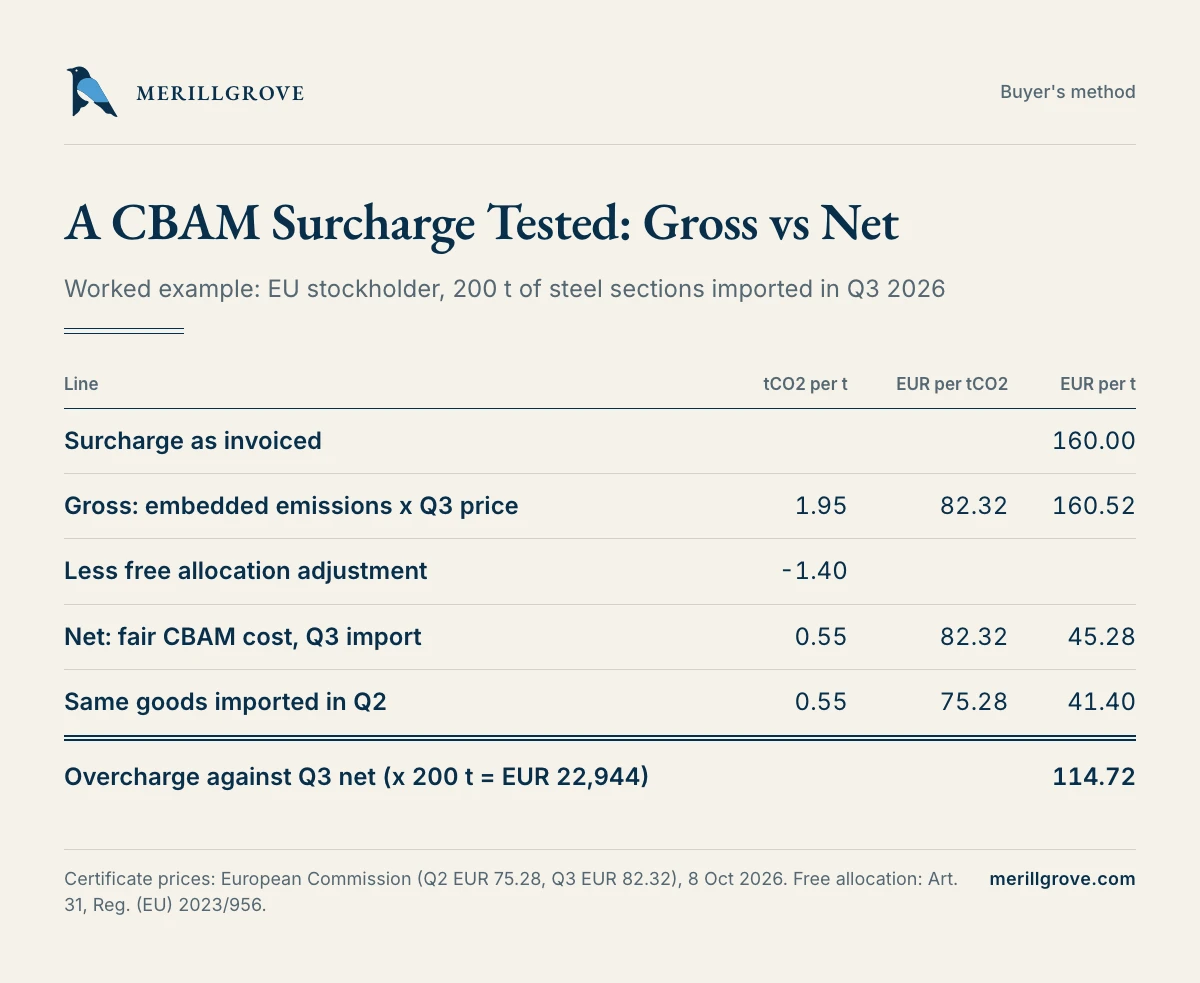 *Gross against net CBAM cost for the quarter of import.*
The fabricator counters at EUR 45.28 a tonne, as a separate line tied to the quarter of import, to be trued up when the stockholder surrenders certificates for 2026.
The Data Request: Six Items
- Who was the importer, and is it an authorised CBAM declarant?
- CN code and net mass of each CBAM good on the invoice.
- Embedded emissions per tonne, and whether they are verified actual values or default values.
- The free allocation adjustment per tonne, and how it was calculated.
- The quarter of import and the certificate price used.
- Any carbon price paid at origin and the evidence for it.
If a supplier will not give these, ask for its cost breakdown instead: see ask a supplier for a cost breakdown. A CBAM line often arrives with a steel price rise, and the two need separate tests: see the steel surcharge check and EU steel safeguard changes.
Action List, Dated
- By 23 October: list every invoice since January carrying a CBAM line. Note supplier, importer, tonnage, quarter of import and amount.
- By 6 November: send the six-item request to each supplier.
- By 30 November: agree a method in writing: net emissions, quarter-of-import price, true-up after surrender.
- 4 January 2027: the Commission publishes the Q4 2026 price. Check Q4 surcharges against it.
- February 2027: certificates go on sale. From 2027 declarants must hold certificates each quarter for at least 50% of emissions, net of the free allocation adjustment.
- 30 September 2027: 2026 declarations and surrender. Ask for the true-up.
UK buyers face their own scheme from January 2027: see UK CBAM from January 2027.
Next Step
Start with the free 12 checks and justified-increase quick calculator: get the checklist.
Sources (checked 8 October 2026): European Commission, CBAM definitive regime, https://taxation-customs.ec.europa.eu/carbon-border-adjustment-mechanism/cbam-definitive-regime_en; European Commission, Price of CBAM certificates, https://taxation-customs.ec.europa.eu/carbon-border-adjustment-mechanism/price-cbam-certificates_en; Regulation (EU) 2025/2083, http://data.europa.eu/eli/reg/2025/2083/oj; Regulation (EU) 2023/956, http://data.europa.eu/eli/reg/2023/956/oj; Directive (EU) 2023/959, http://data.europa.eu/eli/dir/2023/959/oj. Last checked: 8 October 2026. Commercial guidance, not legal, customs or tax advice.
Want This Checked for You?
Send the notice, the quotes or the supplier details. We tell you what to question first, and the fee is agreed before any work starts.
More on Trade Triggers
 Trade TriggersUS Wood Products Tariff Rises on 1 January 2027: Cabinets, Vanities and FurnitureSection 232 duty on kitchen cabinets and vanities rises from 25% to 50%, and on upholstered wooden furniture to 30%, on 1 January 2027. A dated plan.
 Trade TriggersIEEPA Tariff Refunds: What Importers Should CheckIEEPA tariff refunds go to the importer of record. What to check in ACE, what to ask vendors who charged you a tariff surcharge, and a worked example.
 Trade TriggersEU Steel Safeguard Changes in 2026: What Steel Buyers Should CheckThe EU's new steel regime: quotas from 1 July 2026, a 50% out-of-quota duty and melt and pour evidence from 1 October. How to test a steel surcharge.