
EU Steel Safeguard Changes in 2026: What Steel Buyers Should Check
The EU's new steel regime: quotas from 1 July 2026, a 50% out-of-quota duty and melt and pour evidence from 1 October. How to test a steel surcharge.
Contents
Since 1 July 2026 the EU has run a new import regime for steel. Suppliers are citing it in surcharges, often as "the 50% EU steel tariff". That 50% is real, but it applies only to imports outside quota. Whether your price should move, and by how much, depends on where your steel was made, whether it came in within quota, and what duty was actually paid.
This note sets out the regime from the regulation itself and a test for the surcharge. Last checked: 8 October 2026. This is commercial guidance, not legal or customs advice.
In Short
- Regulation (EU) 2026/1384 replaced the old steel safeguard, which expired on 30 June 2026. It applies from 1 July 2026.
- It opens annual tariff quotas per product category, 18,345,922 tonnes in total, managed by quarter. Within quota there is no extra duty.
- Imports outside quota, or once a quota is used up, pay a 50% ad valorem out-of-quota duty.
- Since 1 October 2026 importers must prove the country of melt and pour, for example with a mill test certificate.
- Steel made in the EU pays none of this. A surcharge on EU-melted steel is a market price move, not duty.
How the Regime Works
The quotas run from 1 July to 30 June, in quarters starting 1 July, 1 October, 1 January and 1 April. The Commission distributes them by country through implementing acts, so check the quota for your origin and product category, not just the headline. In the first year, unused volume in one quarter carries over to the next. The regime covers free trade partners too. Only Iceland, Liechtenstein and Norway are excluded outright, along with any country under a bilateral safeguard measure (Article 6). The out-of-quota duty is in addition to any other duty on the product.
The product list is broad: hot and cold rolled sheet, metallic and organic coated sheet, plate, stainless flat products, rebar, merchant bars, wire rod, sections, sheet piling, railway material, and several kinds of tube and pipe. By 31 December 2026 the Commission must assess adding further codes, and by 30 June 2027 whether to cover downstream products containing a significant amount of steel.
The Surcharge Test
Ask the supplier four questions, in writing:
- Which product category and CN code, and where was the steel melted and poured?
- Was your material imported within quota or out of quota, and when?
- What duty was actually paid per tonne, and on what customs value?
- What share of the supplier's stock of this product came in out of quota?
A stockholder that pays 50% on part of its intake and nothing on the rest can fairly pass on a blended figure, not the full rate.
A contractor buys 500 tonnes of coated sheet a year from an EU stockholder. The stockholder adds EUR 120 a tonne, citing the 50% duty. It confirms a customs value of EUR 600 a tonne and that 30% of its intake this quarter came in out of quota.
- Out-of-quota duty per tonne: 600 x 50% = EUR 300.
- Blended across its intake: 300 x 30% = EUR 90 a tonne.
- Gap: 120 less 90 = EUR 30 a tonne, or EUR 15,000 a year on 500 tonnes.
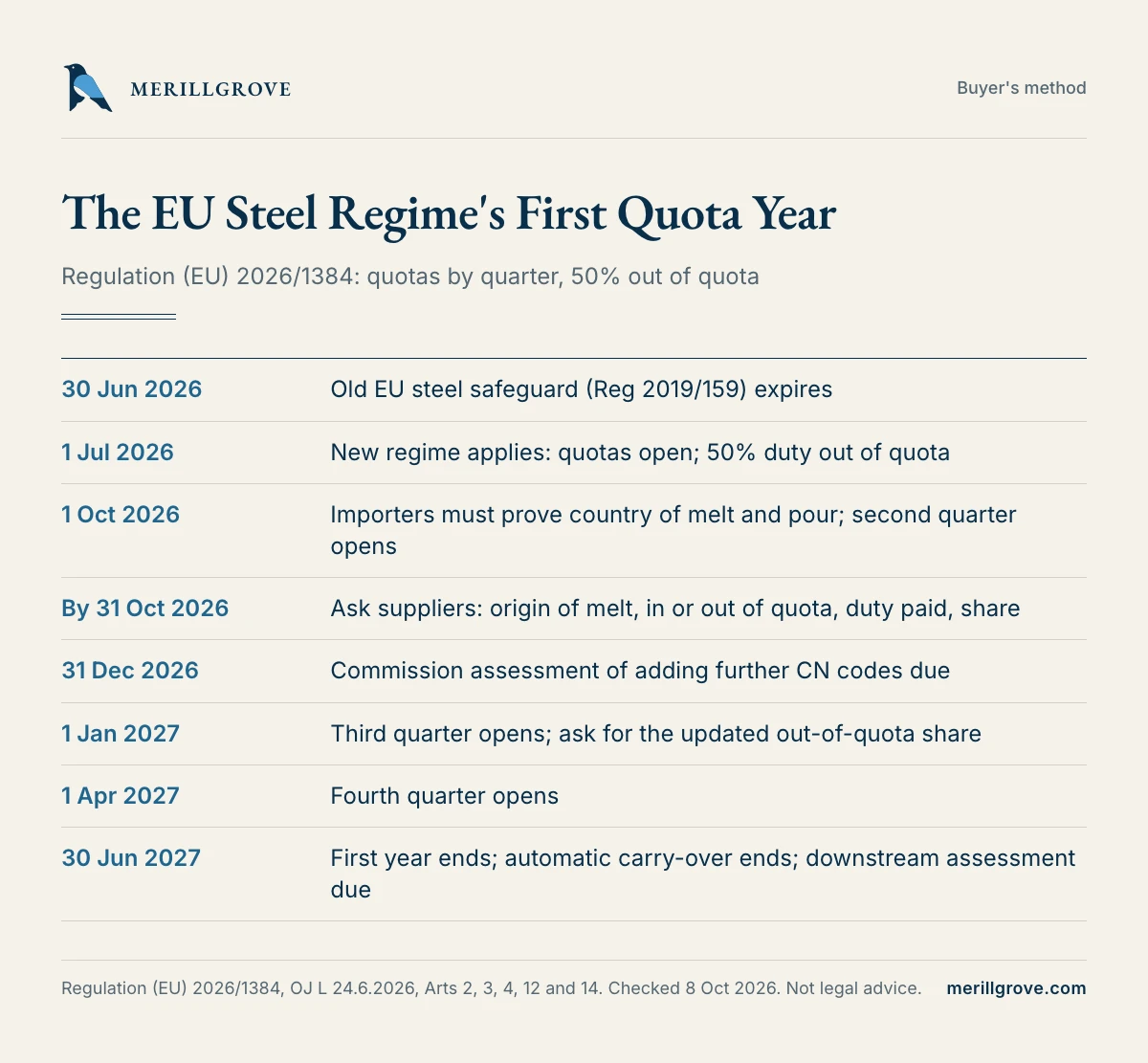 *The dates in the first quota year that change the surcharge conversation.*
The contractor counters at EUR 90, reviewed each quarter against the out-of-quota share. If the stockholder's material was EU-melted, it asks for the surcharge to be tested against a steel price index instead: see the steel surcharge check. If the same invoice carries a CBAM line, test it separately: see CBAM surcharges on supplier invoices.
UK Buyers
The EU regime applies to imports into the EU. A UK buyer of steel made or stocked in the EU pays no EU import duty, but EU prices can rise where quotas bind, and a supplier may cite the regime. Apply the same test: whose import, what duty, on what share.
Action List, Dated
- By 16 October: list steel products bought, with supplier, category and origin of melt where known.
- By 31 October: send the four questions to each supplier that cited the regime or a 50% tariff.
- By 30 November: agree surcharges as separate lines with a quarterly review, not as permanent price increases. For contracts, see material price escalation clauses.
- 31 December 2026: Commission scope assessment due. Check whether your codes are added.
- 1 January and 1 April 2027: new quarters. Ask for the updated out-of-quota share.
- 30 June 2027: end of the first quota year and of automatic carry-over; downstream assessment due.
Merchants are passing these costs down too: see builders merchant price increases.
Next Step
Start with the free 12 checks and justified-increase quick calculator: get the checklist.
Sources (checked 8 October 2026): Regulation (EU) 2026/1384 of the European Parliament and of the Council of 17 June 2026, OJ L, 2026/1384, 24.6.2026, http://data.europa.eu/eli/reg/2026/1384/oj. Last checked: 8 October 2026. Commercial guidance, not legal, customs or tax advice.
Want This Checked for You?
Send the notice, the quotes or the supplier details. We tell you what to question first, and the fee is agreed before any work starts.
More on Trade Triggers
 Trade TriggersUS Wood Products Tariff Rises on 1 January 2027: Cabinets, Vanities and FurnitureSection 232 duty on kitchen cabinets and vanities rises from 25% to 50%, and on upholstered wooden furniture to 30%, on 1 January 2027. A dated plan.
 Trade TriggersIEEPA Tariff Refunds: What Importers Should CheckIEEPA tariff refunds go to the importer of record. What to check in ACE, what to ask vendors who charged you a tariff surcharge, and a worked example.
 Trade TriggersAnti-Dumping Duties in Australia: Check Your Supplier ListAustralian dumping duty is set by goods, country and exporter. A six-step exposure check for your supplier list, a landed cost example and dates to watch.