
Anti-Dumping Duties in Australia: Check Your Supplier List
Australian dumping duty is set by goods, country and exporter. A six-step exposure check for your supplier list, a landed cost example and dates to watch.
Contents
Australian dumping duty is not set by country alone. A measure names the goods, the countries and, usually, the exporters, with different rates for each. Two suppliers in the same city can carry very different duty. Your supplier list is therefore the right place to start an exposure check, and the cheapest quote is not always the cheapest landed.
This note gives a six-step check, a worked comparison and the dates to watch. Last checked: 8 October 2026. This is commercial guidance, not legal or customs advice. Merillgrove does not classify goods; your customs broker confirms the classification and any duty.
In Short
- Dumping duty is imposed on goods covered by a published notice where the export price is below normal value. It is collected from the importer at entry, on top of ordinary customs duty.
- Interim dumping duty is payable pending final assessment, worked out by a method set in a signed ministerial notice.
- Notices normally expire five years after publication unless revoked or continued, so your exposure changes over time.
- The agency's name is changing. Legislation compiled on 29 September 2026 refers to the Australian Trade Remedies Commission; older texts and pages say Anti-Dumping Commission.
- Separately, the Productivity Commission reports to Government in November 2026 on safeguards for fabricated structural steel.
The Six-Step Exposure Check
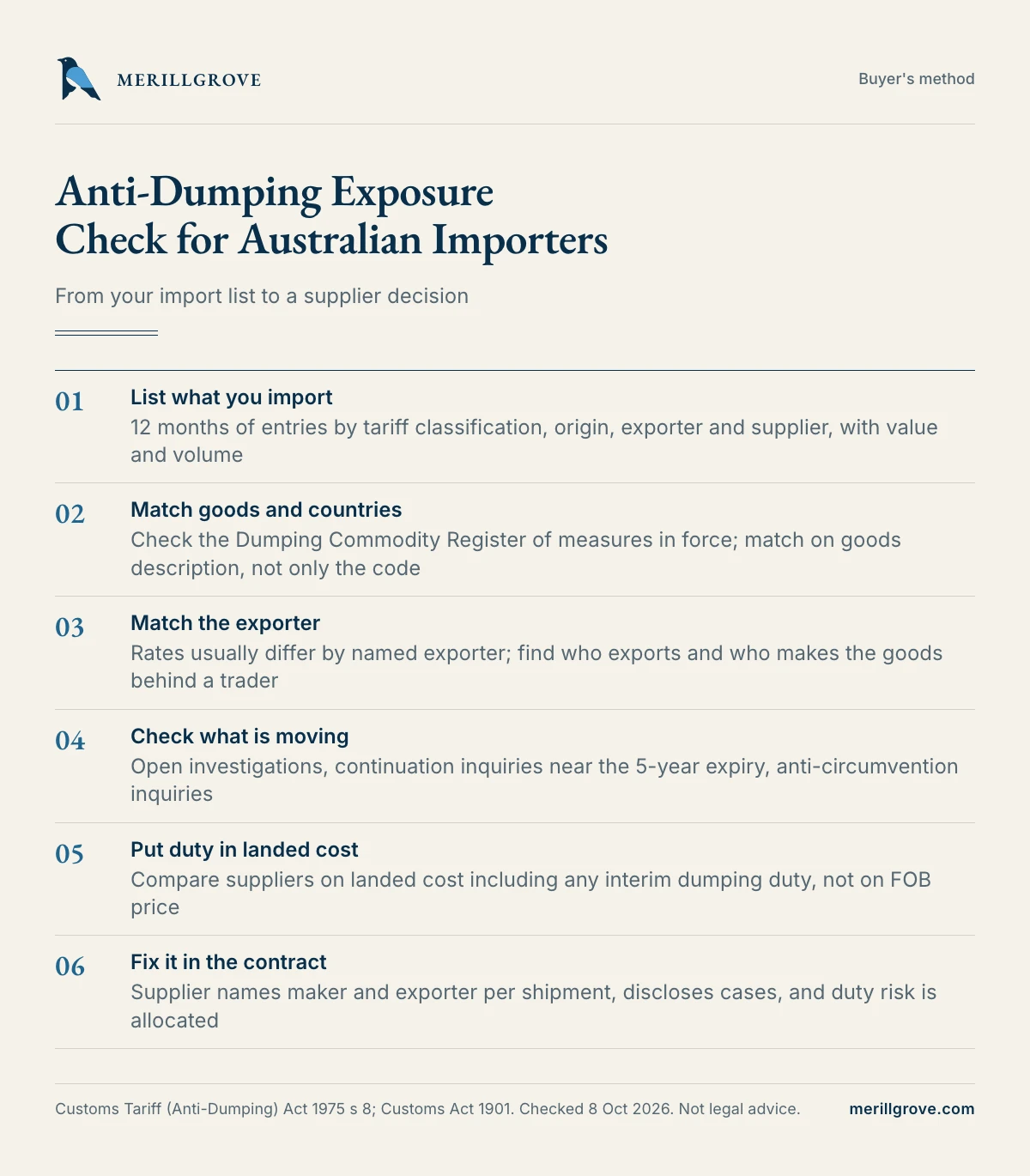 *From tariff line to exporter to contract: the exposure check sequence.*
- List what you import. Twelve months of entries by tariff classification, country of origin, exporter and supplier, with value and volume.
- Match goods and countries to the register. The Commission keeps a Dumping Commodity Register of measures in force. Match on the goods description, not only the tariff code.
- Match the exporter. Rates usually differ by named exporter, with a residual rate for others. If you buy through a trading company, find out who exports and who makes the goods.
- Check what is moving. Open investigations, continuation inquiries for measures near their five-year expiry, and anti-circumvention inquiries can all change the answer.
- Put duty into landed cost. Compare suppliers on landed cost including any interim duty, using the landed cost formula. For ordinary duty, see estimate import duty before you buy.
- Fix it in the contract. Require the supplier to name the manufacturer and exporter on every shipment, tell you of any case involving them, and agree who bears duty if a measure applies after you order.
Evidence note: the Commission's website did not respond on 8 October 2026, so we could not re-check the register's current format. Search for it under both agency names.
Worked Example
The duty rate is an example and is not the rate in any measure.
An Australian fabricator buys 500 tonnes a year of a steel product. Two quotes:
- Exporter A, named in a measure at an interim rate of 15% of the export price: AUD 1,000 a tonne FOB, plus AUD 80 freight and insurance, plus 1,000 x 15% = AUD 150 duty. Total AUD 1,230 a tonne.
- Exporter B, in a country not covered by the measure: AUD 1,080 a tonne FOB, plus AUD 80. Total AUD 1,160 a tonne.
Both totals are before ordinary customs duty and GST, which apply to both. The quote that looked AUD 80 cheaper is AUD 70 a tonne more expensive landed: AUD 35,000 a year on 500 tonnes. If you need another source, see find alternative suppliers.
Action List, Dated
- By 23 October 2026: build the import list in step 1 with your broker's entry data.
- By 6 November: match goods, countries and exporters against the register.
- By 20 November: ask suppliers in writing to name the manufacturer and exporter, and whether either is party to any Australian case.
- November 2026: the Productivity Commission's final report on fabricated structural steel safeguards goes to Government. If you buy goods in heading 7308, read it when tabled; the Government must table it within 25 sitting days of receipt.
- Every quarter: re-check the register and new cases for your lines; note expiry dates five years from publication.
For wider support in Australia, see procurement support in Australia.
Next Step
Start with the free 12 checks and justified-increase quick calculator, which also tests duty-driven price notices from local distributors: get the checklist.
If the check shows your main source carries a measure, a Sourcing Feasibility Brief tells you which origins are realistic for that product family, with landed-cost ranges and a go or no-go, in 7 to 10 working days. AUD 2,800. Merillgrove is paid only by the buyer and takes no supplier commissions. Ask for a brief.
Sources (checked 8 October 2026): Customs Tariff (Anti-Dumping) Act 1975, compilation of 29 September 2026, https://www.legislation.gov.au/C2004A00298/latest/text; Customs Act 1901, Part XVB, compilation of 19 September 2026, https://www.legislation.gov.au/C1901A00006/latest/text; Customs Amendment (Safeguard Inquiries) Act 2026, https://www.legislation.gov.au/C2026A00092/asmade/text; Productivity Commission, Fabricated structural steel safeguards, https://www.pc.gov.au/inquiries-and-research/steel-safeguards/ and terms of reference, https://www.pc.gov.au/inquiries-and-research/steel-safeguards/terms-of-reference. Last checked: 8 October 2026. Commercial guidance, not legal, customs or tax advice.
Want This Checked for You?
Send the notice, the quotes or the supplier details. We tell you what to question first, and the fee is agreed before any work starts.
More on Trade Triggers
 Trade TriggersUS Wood Products Tariff Rises on 1 January 2027: Cabinets, Vanities and FurnitureSection 232 duty on kitchen cabinets and vanities rises from 25% to 50%, and on upholstered wooden furniture to 30%, on 1 January 2027. A dated plan.
 Trade TriggersIEEPA Tariff Refunds: What Importers Should CheckIEEPA tariff refunds go to the importer of record. What to check in ACE, what to ask vendors who charged you a tariff surcharge, and a worked example.
 Trade TriggersEU Steel Safeguard Changes in 2026: What Steel Buyers Should CheckThe EU's new steel regime: quotas from 1 July 2026, a 50% out-of-quota duty and melt and pour evidence from 1 October. How to test a steel surcharge.