
US Wood Products Tariff Rises on 1 January 2027: Cabinets, Vanities and Furniture
Section 232 duty on kitchen cabinets and vanities rises from 25% to 50%, and on upholstered wooden furniture to 30%, on 1 January 2027. A dated plan.
Contents
If you import kitchen cabinets, vanities or upholstered wooden furniture, the Section 232 wood tariff on them is due to rise on 1 January 2027. Cabinets and vanities go from 25% to 50%. Upholstered wooden products go from 25% to 30%. The increase was first due on 1 January 2026 and was pushed back a year; nothing published so far moves it again. That leaves about twelve weeks to re-run landed cost, decide what to bring in early, and re-quote.
Last checked: 8 October 2026. This is commercial guidance, not legal or customs advice. Merillgrove does not classify goods; your licensed customs broker confirms whether a product is in scope.
In Short
- Section 232 duties on wood products have applied since 14 October 2025: 10% on certain softwood timber and lumber, 25% on certain upholstered wooden products, 25% on kitchen cabinets and vanities.
- The cabinet and vanity duty covers parts imported for use in them, not only finished units.
- From 1 January 2027 the rates become 30% (upholstered) and 50% (cabinets and vanities), except for countries with an agreement.
- Caps exist for the UK (10%) and for the EU, Japan, Korea and Taiwan (Section 232 duty plus the normal rate capped at 15%).
- Section 232 goods are outside the forced labour Section 301 tariffs. These duties add to other duties.
What the Proclamations Say
Proclamation 10976 of 29 September 2025 set the 10% and 25% rates for goods entered from 12:01 a.m. on 14 October 2025, with increases on 1 January 2026. Proclamation 11000 of 31 December 2025 rewrote that clause: "Effective January 1, 2027, the duty rate in clause 2 shall increase to 30 percent and the duty rate in clause 3 shall increase to 50 percent", except for countries that reach an agreement. The rate follows the date of entry, not the date of order or shipment.
Two things could still change the picture before January. Commerce was due to update the President on hardwood timber and lumber by 1 October 2026, which could lead to further action. And agreements can cap rates by origin, as they already do for the UK, EU, Japan, Korea and Taiwan. As of 8 October we found no new proclamation in the Federal Register.
What the Step-up Does to Landed Cost
The MFN rate is assumed to be zero; values and volumes are examples.
A US distributor imports a vanity from Vietnam at a customs value of USD 180. Freight, insurance and fees add USD 22.
- Today: duty 180 x 25% = USD 45. Landed USD 247.
- From 1 January 2027: duty 180 x 50% = USD 90. Landed USD 292.
- Increase: USD 45 a unit, 18.2% on landed cost. At 4,000 units a year, USD 180,000.
An upholstered sofa at a customs value of USD 400 moves from 400 x 25% = USD 100 to 400 x 30% = USD 120: USD 20 a unit.
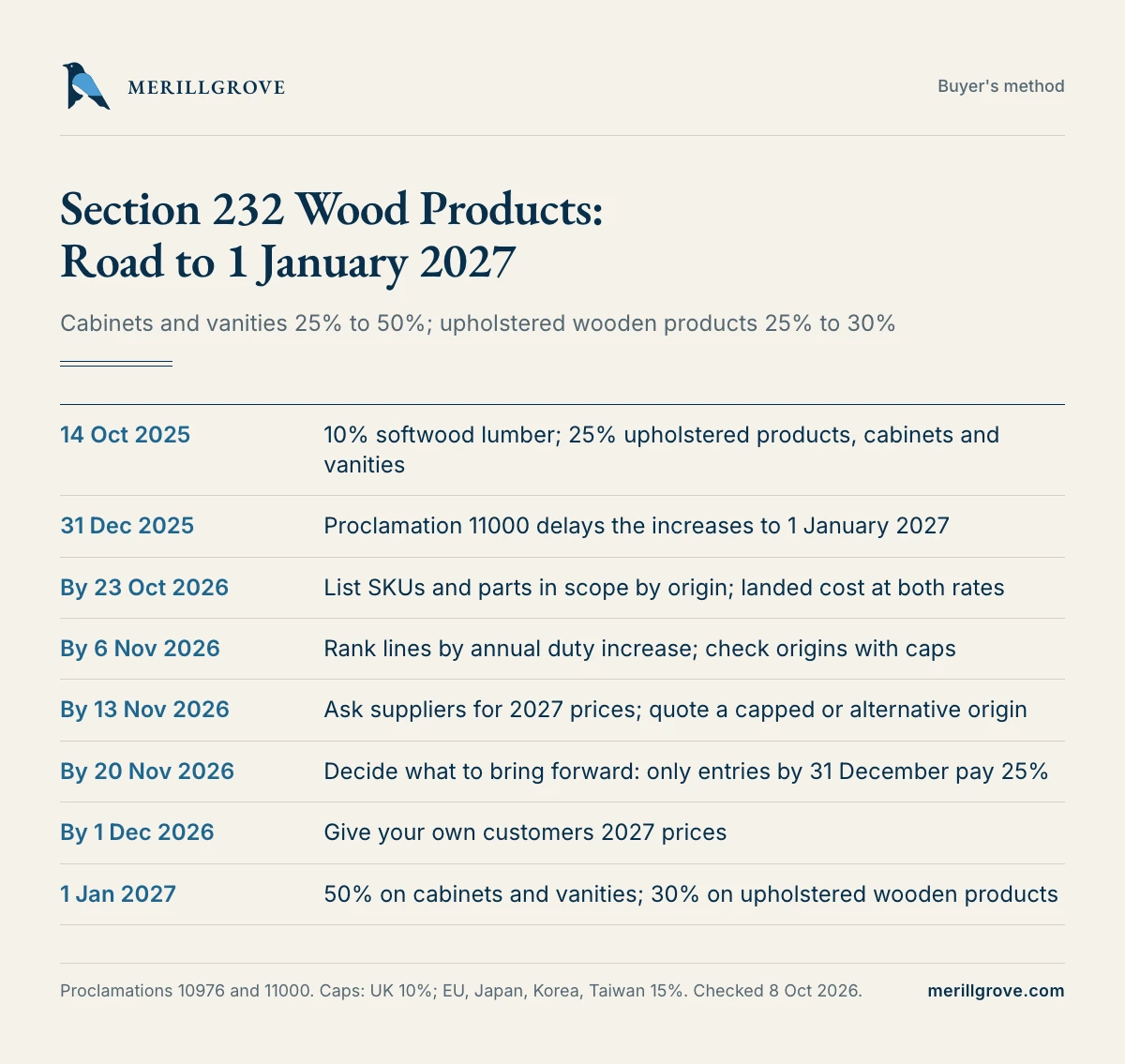 *Rates, dates and the decisions due before the step-up.*
Run your own lines through the landed cost formula; for the normal duty rate, see estimate import duty before you buy.
Exposure and Re-Quote Plan
- By 23 October: list every SKU and part entered under the wood products headings in the last 12 months, by origin, with landed cost at today's and 2027 rates. Ask your broker to confirm scope for parts.
- By 6 November: rank lines by the duty increase over a year. Check whether any origin you use, or could use, has a cap.
- By 13 November: ask suppliers for 2027 prices showing their contribution to the increase, and quote at least one capped or alternative origin for your top lines. China plus one sets out how to compare a second origin fairly.
- By 20 November: decide what to bring forward. Only goods entered by 31 December pay 25%. Weigh the duty saved against the cash, storage and markdown risk of early stock.
- By 1 December: notify your own customers of 2027 prices: see pass a supplier price increase to customers.
- 1 January 2027: step-up applies to goods entered from that date.
Next Step
Start with the free 12 checks and justified-increase quick calculator, useful on the duty change and on the vendor notices that follow: get the checklist.
If 50% makes a line unworkable from its current origin, a Sourcing Feasibility Brief tells you which origins are realistic for that product family, with landed-cost ranges and a go or no-go, in 7 to 10 working days. USD 2,900. Merillgrove is paid only by the buyer and takes no supplier commissions. Ask for a brief.
Want This Checked for You?
Send the notice, the quotes or the supplier details. We tell you what to question first, and the fee is agreed before any work starts.
More on Trade Triggers
 Trade TriggersIEEPA Tariff Refunds: What Importers Should CheckIEEPA tariff refunds go to the importer of record. What to check in ACE, what to ask vendors who charged you a tariff surcharge, and a worked example.
 Trade TriggersEU Steel Safeguard Changes in 2026: What Steel Buyers Should CheckThe EU's new steel regime: quotas from 1 July 2026, a 50% out-of-quota duty and melt and pour evidence from 1 October. How to test a steel surcharge.
 Trade TriggersAnti-Dumping Duties in Australia: Check Your Supplier ListAustralian dumping duty is set by goods, country and exporter. A six-step exposure check for your supplier list, a landed cost example and dates to watch.