China Plus One: Is Moving a Product Out of China Worth It?
A China plus one test for importers: switching cost against duty and cost saving, a landed-cost break-even, three duty scenarios and a decision ladder.
Contents
You buy a product line from China, the duty on it has changed several times since early 2025, and someone (a board member, a customer, a private equity owner) is asking for a China plus one strategy. The pressure is real. The answer still has to come from the product, not the headline. For each product, the question is whether the annual landed-cost saving from a new origin pays back the one-off cost of moving, within the time you are prepared to trust the duty gap that creates most of the saving.
This guide gives you that test, a break-even you can calculate on one page, three duty scenarios to run it against, and a decision ladder that includes the answer many guides leave out: sometimes the right move is to stay in China and use the analysis to negotiate.
By Duncan Cassar, Merillgrove. Last checked: 8 October 2026.
In Short
- Decide product by product. A China plus one strategy is a set of product decisions, not a country preference.
- The test: annual landed saving times the years you trust it, against the one-off switching cost plus a risk allowance.
- The duty gap is the least reliable number in the model. In the US it has changed repeatedly since early 2025. Run three duty scenarios, not one.
- Calculate the break-even duty rate: the China rate at which the move stops paying. If today's gap sits only just above it, you are betting on policy.
- Staying is often right when the running saving is thin, the new origin still depends on Chinese inputs, or the payback is longer than your confidence in the tariff gap.
- If the answer is move, move in stages: pilot, then a share of volume, with the China supplier kept qualified for at least a year.
Three Versions of China Plus One, and Which One You Are Deciding
The phrase covers three different decisions, and the economics differ for each:
- A second source for the same product. China keeps most of the volume; a supplier elsewhere takes a share. This buys resilience and a negotiating position, at a cost. See dual sourcing for that calculation.
- A full move of one product. The China supplier is replaced for that product. This is where switching cost bites hardest, and it is the case this guide's test is built for.
- Final assembly moved, inputs still from China. The factory address changes; the supply chain may not. The Vietnam route guide explains why a new address does not automatically mean a new risk profile. It also matters for duty: US non-preferential origin rules use a "substantial transformation" test applied case by case, so assembling Chinese parts elsewhere does not guarantee a non-China origin.
Write down which of the three you are deciding before you build any numbers. Most muddled China plus one business cases mix all three.
The Test: Switching Cost Against Duty and Cost Saving
The decision rests on four numbers.
1. Landed cost per unit, both origins, on the same basis. Not the FOB quote. Landed cost here means the price plus freight and destination charges, duty, inspection, a defect allowance and the cost of carrying the extra stock a longer or less predictable lead time forces on you. Build it the same way for both origins, or the comparison is meaningless. The cluster article on sourcing from Vietnam vs China sets out the ledger line by line.
2. Annual running saving. Landed cost difference per unit times annual volume. It can be negative.
3. One-off switching cost. Everything you spend once to make the move: new tooling, samples and testing, supplier qualification and a visit, your team's time, overlap stock while both suppliers run, an allowance for a failed first production run, and exit costs at the current supplier. Switching suppliers: the real cost of changing, line by line covers each line in depth.
4. Your trust horizon. The number of months you are prepared to rely on today's duty gap. This is a judgement, and it should be explicit.
Then:
- Payback (months) = one-off switching cost ÷ (annual running saving ÷ 12).
- The move passes the test only if payback is shorter than your trust horizon in the scenario you think most likely, and the running saving is not negative in your middle scenario.
A useful by-product is the break-even duty rate: the China duty rate (holding the new origin's rate fixed) at which the running saving just covers the switching cost within your trust horizon. Compare it with today's rate. A large margin means the decision survives a policy change. A thin margin means you are making a bet on tariffs, and should size it like one.
Why the Duty Gap Is the Weakest Number in the Model
For US importers, the duty difference between a China origin and an alternative is usually the biggest line in the business case, and the one most likely to change. Dated facts, as at 8 October 2026:
- On 20 February 2026 the US Supreme Court held that the International Emergency Economic Powers Act does not authorise tariffs. The 2025 IEEPA tariffs that drove many China plus one decisions fell away, and CBP is now processing refunds of IEEPA duties through its CAPE function in ACE.
- The older China Section 301 duties remain, and 178 product exclusions from them run until 10 November 2026.
- USTR opened a separate Section 301 investigation into Vietnam's intellectual property practices on 29 May 2026. Its page lists no action as at 8 October 2026. It is open, and it could narrow the gap.
The direction of trade has already moved: China's share of US goods imports fell from 22% before 2018 to 9% by the end of 2025, according to PIIE's analysis of US import data. That tells you many importers have moved. It does not tell you whether your product should.
So do not put one duty number into the model. Run three scenarios: the gap holds, the gap narrows, the gap closes. Get the actual rates for your HTS line from a licensed customs broker and the USITC tariff schedule, and record the date you checked. Merillgrove does not classify goods, give customs advice or certify origin; this is commercial guidance, not customs or legal advice.
UK and Australian importers run the same test with a different duty line. The US China-specific Section 301 duties do not apply to your imports, so the duty side is normally the gap between the standard rate and any preferential rate the new origin qualifies for under a trade agreement, such as the UK-Vietnam Free Trade Agreement, provided the goods meet its rules of origin. Check the UK Trade Tariff or the Australian Border Force's guidance and your broker. For many UK and Australian buyers the duty gap is small, which means a move has to pay on price, risk or a customer requirement rather than tariffs.
Worked Example: A Storage Box, China or Vietnam
Duty rates are scenarios, not current rates.
A US home-goods importer buys an injection-moulded storage box with lid from a supplier in China at USD 8.00 FOB, 40,000 units a year. A Vietnamese supplier quotes USD 8.60 FOB for the same specification. To keep the arithmetic visible, duty is applied to the FOB value as a simplification.
Under Scenario A (the gap holds: China 35% all-in, Vietnam 15%), the landed cost per unit looks like this:
| Cost line (USD per unit) | China | Vietnam |
|---|---|---|
| FOB price | 8.00 | 8.60 |
| Ocean freight and destination charges | 0.55 | 0.60 |
| Duty, Scenario A (35% / 15% of FOB) | 2.80 | 1.29 |
| QC and inspection | 0.10 | 0.15 |
| Defect allowance (1% / 2% of FOB) | 0.08 | 0.17 |
| Extra inventory carrying (lead time) | 0.12 | 0.16 |
| Landed cost | 11.65 | 10.97 |
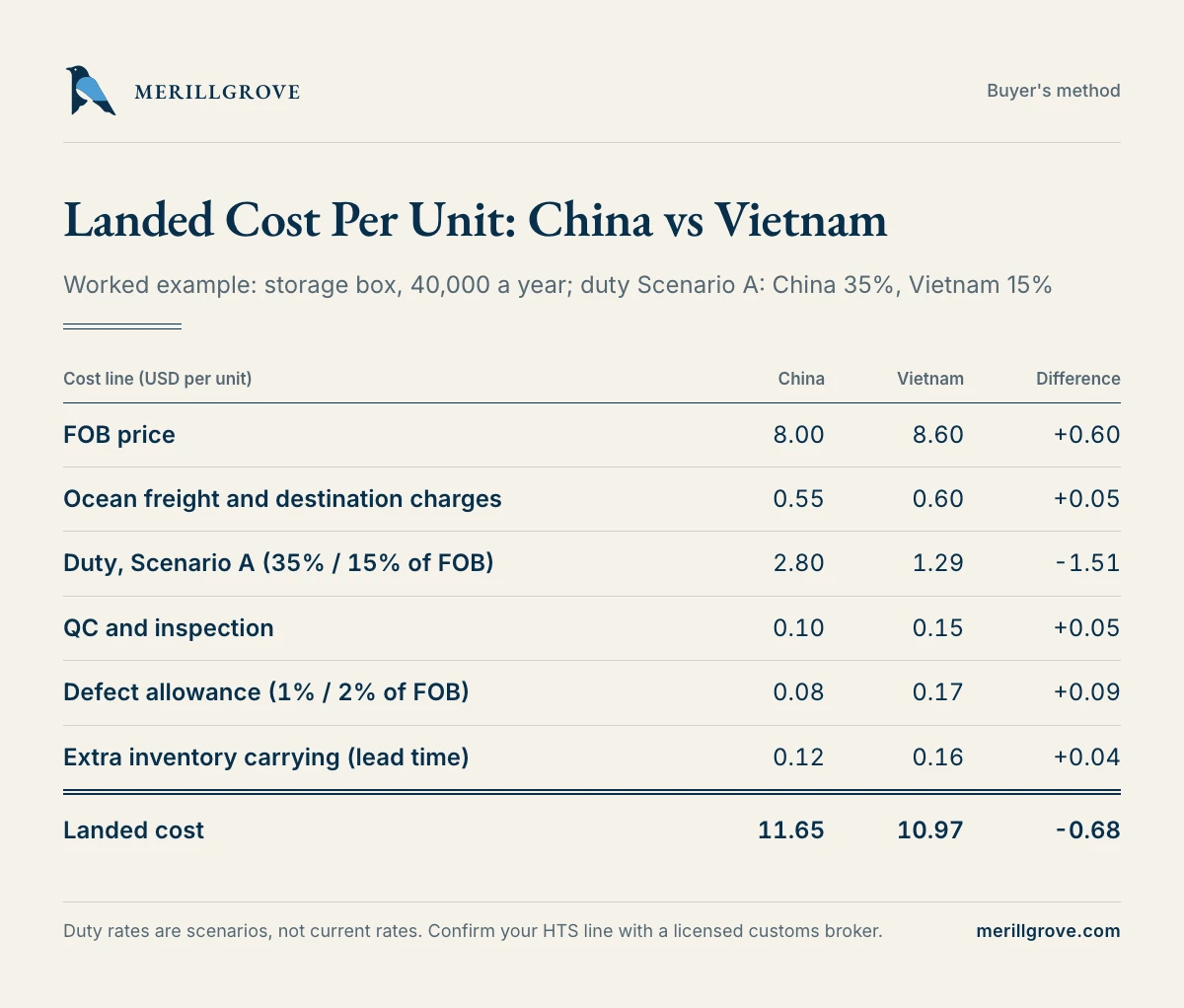 *Landed cost per unit for the storage box under Scenario A.*
Leave duty out and Vietnam costs more: 9.68 against 8.85, a penalty of 0.83 a unit before tariffs. Duty turns that into a saving of 0.68 a unit (11.65 − 10.97), or USD 27,200 a year (0.68 × 40,000).
Now the other two scenarios. Only the duty lines change.
- Scenario B, gap narrows (China 30%, Vietnam 15%). China duty 2.40, China landed 11.25. Saving 0.28 a unit, USD 11,200 a year.
- Scenario C, gap closes (both 25%). China duty 2.00, China landed 10.85; Vietnam duty 2.15, Vietnam landed 11.83. Vietnam costs 0.98 a unit more: a loss of USD 39,200 a year.
The one-off switching cost is USD 47,800:
| One-off cost | USD |
|---|---|
| New moulds | 18,000 |
| Samples, testing and certification | 4,500 |
| Supplier qualification, audit and one visit | 6,000 |
| Team time: 120 hours at 60 an hour | 7,200 |
| Overlap stock: 6,000 units (about eight weeks) at 11.00, financed six months at 20% a year | 6,600 |
| Failed first run allowance: 10% chance of a 30,000 loss | 3,000 |
| Exit costs at the China supplier (committed materials) | 2,500 |
| Total | 47,800 |
Payback. Scenario A: 47,800 ÷ 27,200 = 1.76 years, about 21 months. Scenario B: 47,800 ÷ 11,200 = 4.27 years, about 51 months. Scenario C: never.
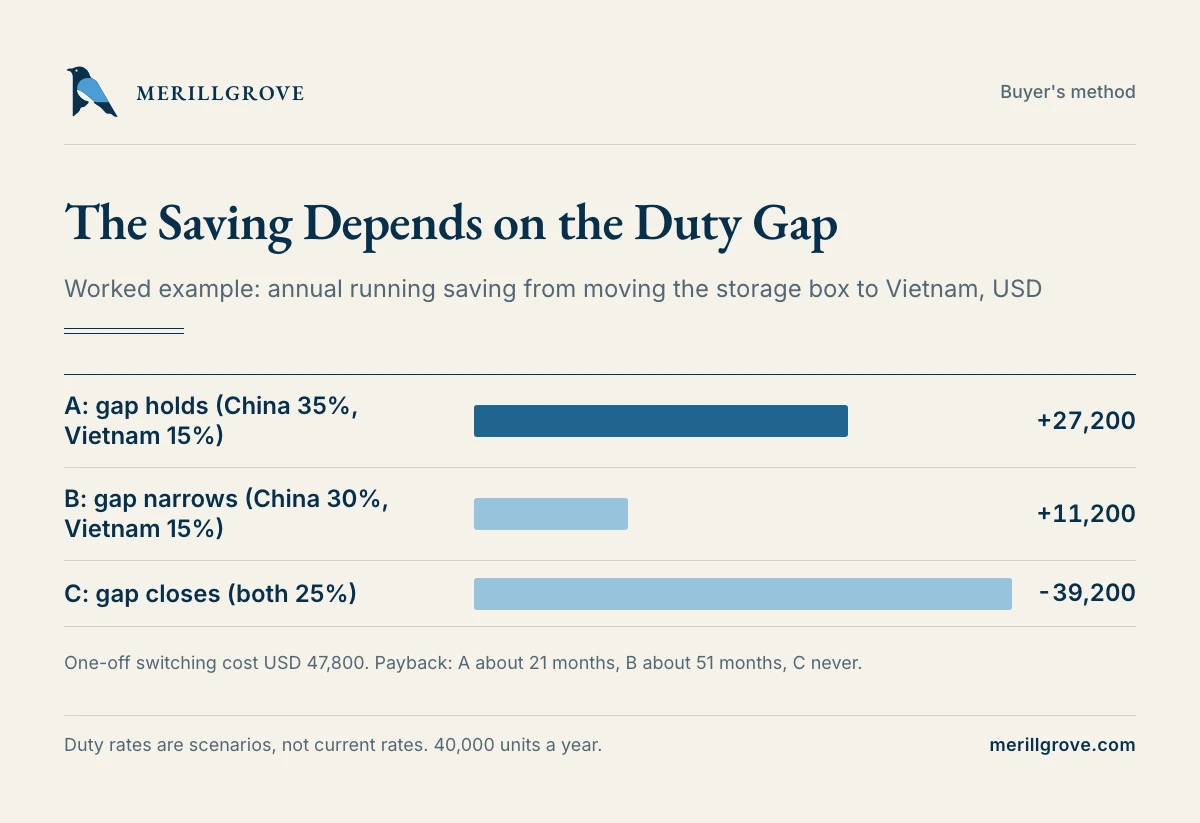 *Annual running saving by duty scenario, against a one-off switching cost of USD 47,800.*
Weighting the scenarios. If the buyer judges A and B equally likely at 40% each and C at 20%, the expected annual saving is (0.4 × 27,200) + (0.4 × 11,200) + (0.2 × −39,200) = 10,880 + 4,480 − 7,840 = USD 7,520. Expected payback: 47,800 ÷ 7,520 = 6.4 years. The weights are a judgement, not a forecast; the point is to make the judgement visible.
Break-even duty rate. With Vietnam held at 15%, the running saving is zero when China's duty per unit equals the non-duty penalty plus Vietnam's duty: 0.83 + 1.29 = 2.12, a China rate of 26.5% (2.12 ÷ 8.00). To also pay back the 47,800 within a 24-month trust horizon, the move needs 0.5975 a unit more (47,800 ÷ (40,000 × 2)), so China's duty must reach 2.7175 a unit, a rate of about 34.0%. Scenario A's 35% clears that by one point.
What the buyer does. The move only works if a gap of about 19 points holds for two years, after a period in which the US duty stack changed repeatedly. That is a policy bet, not a sourcing decision. The buyer keeps China as the main source, qualifies the Vietnamese supplier on one colour variant at about 20% of volume (which costs the samples, qualification and part of the tooling, not the full 47,800), and takes the analysis to the China supplier. A 4% price cut from the incumbent (0.32 a unit) would be worth more than the whole Vietnam saving under Scenario B (0.28). The test is re-run each quarter and on every tariff announcement.
When Staying in China Is the Right Answer
Staying is not failure. It is the right call when:
- The running saving is thin or negative in the middle scenario. A move that only pays if the widest gap holds is a speculation on tariffs.
- The new origin still depends on Chinese inputs. If the moulds, resin, fabric or electronics still come from China, you have changed the label on the carton, not the risk. You may also not have changed the origin.
- Supplier depth matters more than labour cost. For multi-component products, a deep supplier base gives you options and second sources without changing country.
- The payback is longer than the product's life. A product in its last two seasons rarely justifies new moulds.
- Your volume is too small for the new market's capable factories. A supplier that accepts your volume is not the same as a supplier that prioritises it.
- The incumbent will move on price. A credible, costed alternative is often worth more as a negotiating position than as a move.
The Decision Ladder
Work down the ladder for each product. Stop at the first "yes".
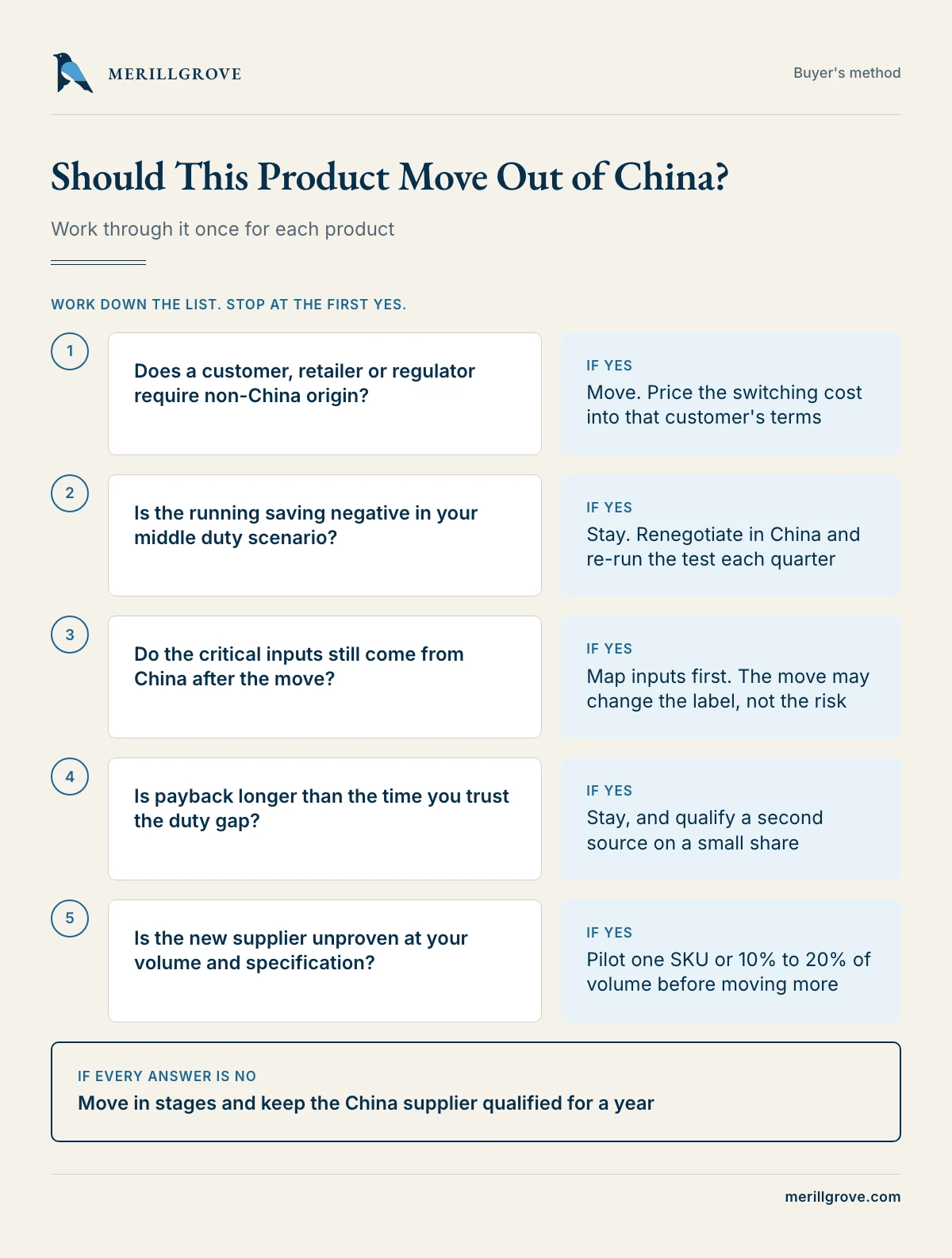 *Six questions to decide whether a product moves out of China, stays, or gets a second source. Merillgrove method.*
- Does a customer, retailer or regulator require non-China origin? If yes, move, and price the switching cost into that customer's terms. The test then tells you what the requirement costs you.
- Is the running saving negative in your middle duty scenario? If yes, stay. Renegotiate in China and re-run the test each quarter.
- Do the critical inputs still come from China after the move? If yes, map the inputs before going further. The move may change the label, not the risk.
- Is payback longer than the time you trust the duty gap? If yes, stay, and qualify a second source on a small share instead.
- Is the new supplier unproven at your volume and specification? If yes, pilot one SKU or 10% to 20% of volume before moving more.
- Otherwise, move in stages and keep the China supplier qualified for a year.
If the Answer Is Move: Do It in Stages
A staged move protects you against the two things the model cannot price well: a supplier that performs worse at volume than in samples, and a tariff change mid-transition.
- Search quietly. Approach new suppliers without unsettling the current one. Find alternative suppliers without losing your current one sets out a discreet sequence and the qualification gates.
- Search where the evidence is. For Vietnam, start with how to find a manufacturer in Vietnam: which search routes reveal what, and the first screening questions.
- Compare on one basis. Rebuild both quotes as landed cost, with the same Incoterm, payment terms, MOQ and tooling treatment, before the price conversation starts.
- Pilot, then share, then move. One SKU, then 20% to 40% of volume, then the rest, each step gated on measured quality, lead time and landed cost.
- Keep the exit open. Keep the China supplier qualified, keep ownership of your tooling and drawings documented, and do not let the last order lapse until the new supplier has run at volume.
Get an Outside Read Before You Commit
If you want the test run on your own product before you spend on tooling, Merillgrove's Sourcing Feasibility Brief compares your current China landed cost with one or two alternative origins, maps input dependence, sets out the switching cost, and gives a move, stay or second-source recommendation, with the duty lines left for your broker to confirm. USD 2,900 / GBP 1,300 / AUD 2,800: request a Sourcing Feasibility Brief. Merillgrove is paid by the buyer only, with no supplier commissions and no percentage of order value.
Sources (checked 8 October 2026): Supreme Court of the United States, Learning Resources, Inc. v. Trump, No. 24-1287, https://www.supremecourt.gov/opinions/25pdf/24-1287_4gcj.pdf; Federal Register, Initiation of Section 301 Investigations (forced labor import prohibitions, Annex A), https://www.federalregister.gov/documents/2026/03/17/2026-05151/initiation-of-section-301-investigations-of-acts-policies-and-practices-of-various-economies-related; CBP, IEEPA Duty Refunds, https://www.cbp.gov/trade/programs-administration/trade-remedies/ieepa-duty-refunds; USTR, USTR Takes Action in Forced Labor Section 301 Investigations, https://ustr.gov/about/policy-offices/press-office/press-releases/2026/july/ustr-takes-action-forced-labor-section-301-investigations; USTR, Fact Sheet on the Section 301 action on 60 economies, https://ustr.gov/about/policy-offices/press-office/fact-sheets/2026/july/fact-sheet-ustr-section-301-action-response-failure-60-economies-ban-imports-produced-forced-labor; USTR, Section 301 Investigation of Vietnam's intellectual property practices, https://ustr.gov/trade-topics/enforcement/section-301-investigations/section-301-investigation-vietnams-acts-policies-and-practices-related-intellectual-property; USTR, extension of China Section 301 exclusions, https://ustr.gov/about/policy-offices/press-office/press-releases/2025/november/ustr-extends-exclusions-china-section-301-tariffs-related-forced-technology-transfer-investigation; PIIE, The Trump-China trade wars: Five takeaways from US imports in 2025, https://www.piie.com/blogs/realtime-economics/2026/trump-china-trade-wars-five-takeaways-us-imports-2025; USITC, Harmonized Tariff Schedule, https://hts.usitc.gov/; CBP, U.S. Rules of Origin, https://www.cbp.gov/document/publications/rules-origin; Department for Business and Trade, UK-Vietnam Free Trade Agreement, https://www.gov.uk/government/collections/uk-vietnam-free-trade-agreement; UK Integrated Online Tariff, https://www.trade-tariff.service.gov.uk/find_commodity; Australian Border Force, Cost of importing goods, https://www.abf.gov.au/importing-exporting-and-manufacturing/importing/cost-of-importing-goods. Incoterms is a trademark of the International Chamber of Commerce.
This is commercial guidance, not customs or legal advice.
Want This Checked for You?
Send the notice, the quotes or the supplier details. We tell you what to question first, and the fee is agreed before any work starts.