
Sourcing From Vietnam vs China: Compare the Landed Cost
Sourcing from Vietnam vs China, compared as landed cost per unit: price, freight, duty scenarios, deposit, defects and MOQ, with the break-even duty gap.
Contents
You have two quotes for the same product: one from China, one from Vietnam. The Vietnam quote is higher on unit price and someone has already said it will be cheaper "because of tariffs". Sourcing from Vietnam vs China is a fair question; that answer is a slogan. This guide shows how to lay both quotes out as landed cost per unit, which lines usually decide it, and how to find the duty gap at which Vietnam stops winning for your product.
Whether to move at all is a separate decision with its own switching cost, covered in the China plus one decision test.
By Duncan Cassar, Merillgrove. Last checked: 8 October 2026.
In Short
- Compare landed cost per unit, not FOB. Seven lines: price, freight, duty, deposit financing, inspection, defect allowance and the stock a higher MOQ forces you to carry.
- In the worked example, a 15-point duty advantage worth 0.86 a unit shrinks to a 0.10 saving once the other six lines are in.
- Find the break-even duty gap for your product. If today's gap is only just above it, the comparison is a tariff bet.
- Inputs that still come from China affect Vietnam's price, lead time and possibly origin.
- UK and Australian buyers face no US China-specific duties, so for them the non-duty lines usually decide.
Put Both Quotes on One Basis First
Two quotes rarely arrive comparable. Before any arithmetic, align:
- Incoterm and named place. FOB Ningbo and FOB Ho Chi Minh City are comparable; FOB against DDP is not. See how to compare quotes on different Incoterms.
- Specification and revision. Same drawing, same materials, same packaging, same labelling.
- Payment terms. Deposit percentage and how long before shipment it is paid.
- MOQ and tooling. Who pays for moulds or patterns, who owns them, and whether the MOQ matches your normal order.
- Validity and currency. Same currency, both valid on the comparison date.
The Landed-Cost Ledger: One Product, Two Origins
Duty rates are scenarios, not current rates.
A US brand buys a polyester backpack, 24,000 units a year. China quotes USD 6.40 FOB with a 30% deposit paid 60 days before shipment and an MOQ of 3,000. Vietnam quotes USD 6.90 FOB with a 50% deposit paid 75 days before shipment and an MOQ of 5,000. Duty is applied to FOB value as a simplification, at an assumed 35% for China and 20% for Vietnam.
| Cost line (USD per unit) | China | Vietnam | How it is calculated |
|---|---|---|---|
| FOB price | 6.40 | 6.90 | Quote |
| Freight and destination charges | 0.48 | 0.52 | Forwarder quotes to the warehouse, per unit |
| Duty (scenario: 35% / 20% of FOB) | 2.24 | 1.38 | 6.40 x 35%; 6.90 x 20% |
| Deposit financing | 0.03 | 0.06 | Deposit x 8% a year x days early ÷ 365 |
| Inspection | 0.08 | 0.12 | Inspection fees ÷ units |
| Defect allowance | 0.10 | 0.17 | 1.5% / 2.5% of FOB |
| Extra stock from higher MOQ | 0.00 | 0.08 | See below |
| Landed cost | 9.33 | 9.23 |
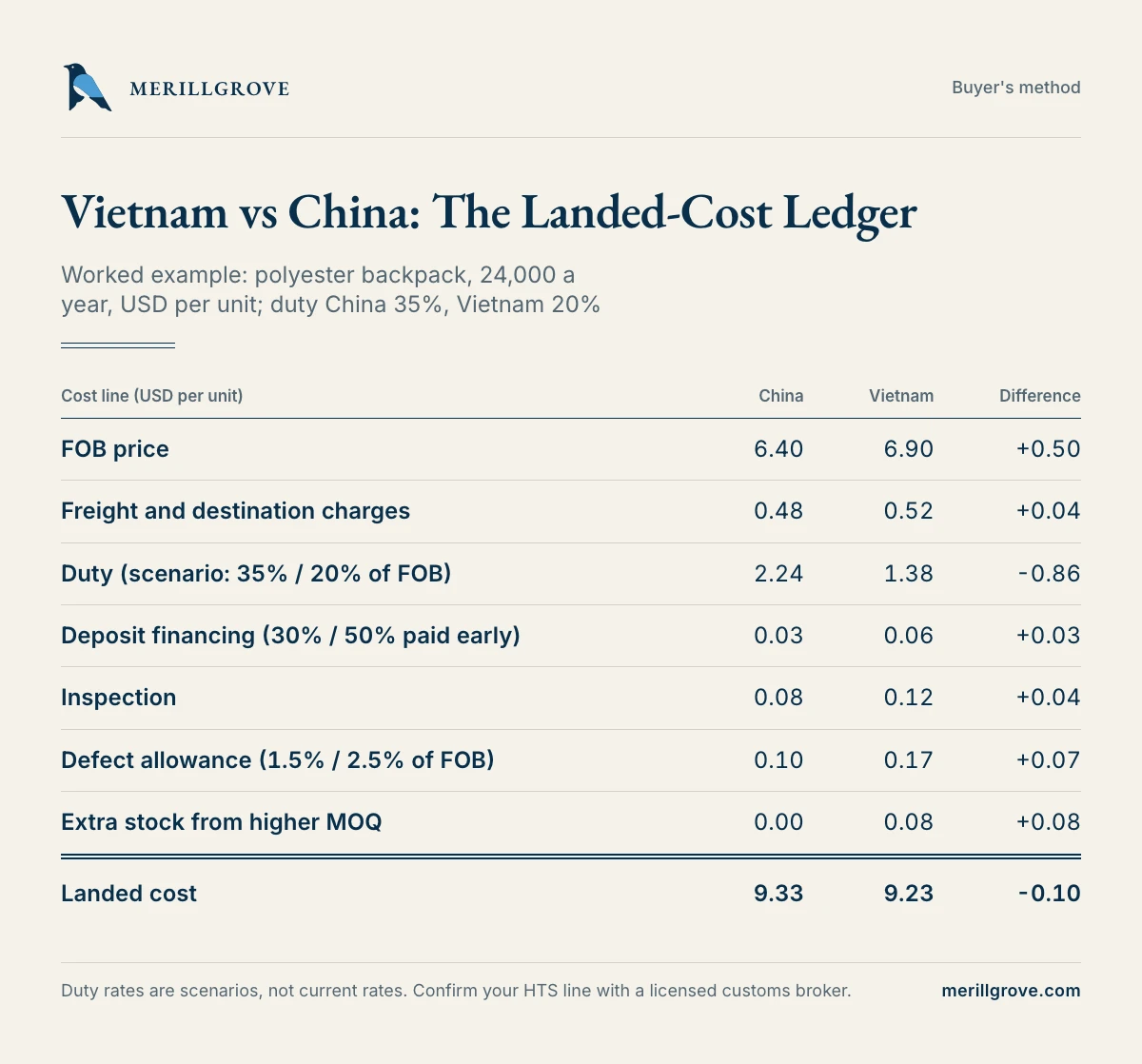 *Seven lines decide the comparison, not the unit price.*
Three lines need explaining:
- Deposit financing. China: 30% of 6.40 is 1.92, paid 60 days early at 8% a year: 1.92 x 0.08 x 60 ÷ 365 = 0.025, rounded to 0.03. Vietnam: 50% of 6.90 is 3.45, paid 75 days early: 3.45 x 0.08 x 75 ÷ 365 = 0.057, rounded to 0.06.
- Defect allowance. 1.5% of 6.40 is 0.096 (0.10); 2.5% of 6.90 is 0.1725 (0.17). A new supplier carries a higher allowance until pilot results say otherwise.
- Extra stock from MOQ. The brand would order 3,000 at a time. Vietnam's MOQ of 5,000 adds an average of 1,000 units of stock ((5,000 − 3,000) ÷ 2). At about 9.20 landed and 20% a year to carry, that is 1,840 a year, or 0.08 a unit across 24,000.
The result: the 15-point duty difference is worth 0.86 a unit (2.24 − 1.38). Price, freight, deposit, inspection, defects and MOQ take back 0.76 of it. Vietnam ends up 0.10 a unit cheaper, USD 2,400 a year. That is real, but it is not the story the slogan told.
Find the Break-Even Duty Gap
Hold Vietnam's rate fixed and ask what China's rate must be for the two to cost the same. China's landed cost without duty is 7.09 (9.33 − 2.24). Vietnam's landed cost is 9.23. China's duty would need to be 2.14 a unit (9.23 − 7.09), a rate of 33.4% (2.14 ÷ 6.40). With Vietnam at 20%, the break-even gap is about 13.4 points. The scenario gap of 15 points clears it by less than two.
| China duty scenario (Vietnam 20%) | China landed | Vietnam saving per unit | Per year |
|---|---|---|---|
| 30% (gap 10 points) | 9.01 | −0.22 | −5,280 |
| 35% (gap 15 points) | 9.33 | 0.10 | 2,400 |
| 40% (gap 20 points) | 9.65 | 0.42 | 10,080 |
| 45% (gap 25 points) | 9.97 | 0.74 | 17,760 |
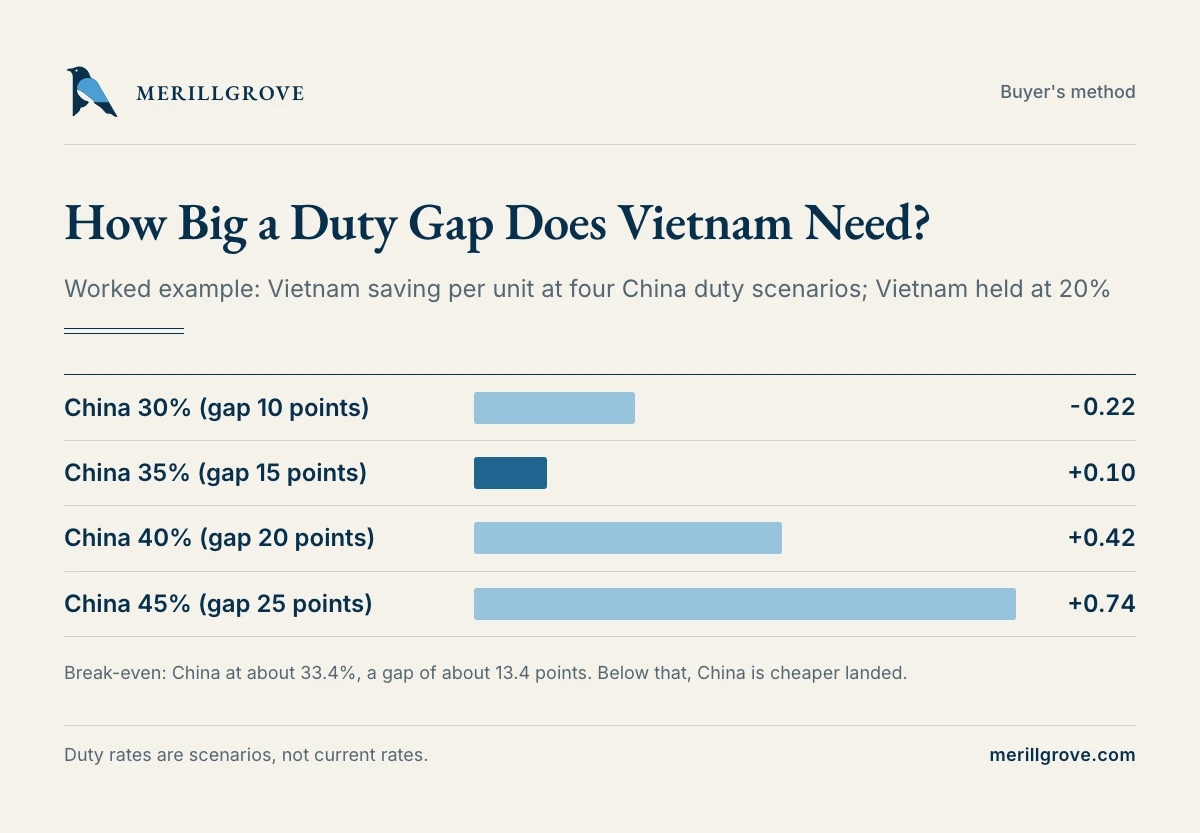 *Vietnam's saving per unit at four example duty gaps. Break-even is about 13.4 points.*
Why this matters now: as at 8 October 2026, USTR's July 2026 forced labour Section 301 action applies 12.5% to products of both China and Vietnam (subject to the exemptions listed in its Federal Register notice), so that action does not open a gap between them. Any US duty gap for your product is likely to come from measures aimed at one origin, chiefly the China-specific Section 301 duties in place since 2018 where your HTS line is covered. A separate Section 301 investigation into Vietnam's intellectual property practices, opened on 29 May 2026, has no action listed yet. Either could move the gap. Get the actual rates for your HTS line from a licensed customs broker and the USITC tariff schedule, and date them. Merillgrove does not classify goods, give customs advice or certify origin; this is commercial guidance, not customs advice.
What Moves Which Line
Each factor below enters the ledger through one line. The Vietnam route guide and China route guide cover the market background; this table turns it into numbers.
| Factor | Ledger line it moves | How to get your number |
|---|---|---|
| Inputs imported from China | FOB price, lead time carrying, origin risk | Bill of materials with country of origin for the top five inputs |
| Supplier depth in your category | FOB price (competition), defect allowance | Count evidence-supported suppliers, not search results |
| Payment terms | Deposit financing | Deposit %, days before shipment, your cost of money |
| MOQ | Extra stock carrying | MOQ against your normal order size |
| Process maturity and yield | Defect allowance, inspection | Pilot-run results, not sample results |
| Port, route and sailing frequency | Freight, lead time carrying | Forwarder quotes from both origins to your door |
| Origin evidence | Duty line, compliance risk | Where the product is substantially transformed; broker's view |
Vietnam has real depth in some categories: it nearly tripled its share of US furniture imports between June 2018 and 2025, according to PIIE's analysis of US import data. That is a category signal, not evidence about your supplier.
Origin: The Line That Can Wipe Out the Saving
The duty line only holds if the goods are of Vietnamese origin. For US non-preferential purposes, CBP applies a substantial transformation test case by case: the product must become a new and different article, with a distinct name, character and use, in the country claimed. A Vietnamese factory that packs or lightly assembles Chinese kits may not meet it.
CBP enforces this. Its Enforce and Protect Act page sets out how evasion of antidumping and countervailing duties is investigated, and features a USD 300 million evasion scheme involving imported Chinese mattresses. Get the in-house processes and input origins in writing, and ask your broker whether a binding ruling is worth requesting before you place volume.
UK and Australian Buyers
The US China-specific Section 301 duties do not apply to your imports, so the duty line is usually the gap between the standard rate and any preference the new origin earns. UK importers can claim preference under the UK-Vietnam Free Trade Agreement only if the goods meet its rules of origin; check the line on the UK Trade Tariff. Australian importers should check preference eligibility with their broker. In both cases the comparison usually turns on the six non-duty lines, so build them with the same care.
Next Steps
If Vietnam still wins at a narrower gap, the next step is finding and qualifying the supplier: see how to find a manufacturer in Vietnam. The general method behind the ledger is in landed cost vs unit price.
If you want the comparison done for you, Merillgrove's Sourcing Feasibility Brief covers one product family: which origins are realistic, landed-cost ranges, capability, risks and a go or no-go, in 7 to 10 working days (USD 2,900 / GBP 1,300 / AUD 2,800): see the brief. Merillgrove is paid only by the buyer and takes no supplier commissions.
Sources (checked 8 October 2026): USTR, USTR Takes Action in Forced Labor Section 301 Investigations, https://ustr.gov/about/policy-offices/press-office/press-releases/2026/july/ustr-takes-action-forced-labor-section-301-investigations; USTR, Federal Register notice of action (pre-publication, 23 July 2026), https://ustr.gov/sites/default/files/files/Press/Releases/2026/FLIP%20301%20Investigation%20Final%20Action%20FRN%207-23-26%20FINAL.pdf; USTR, Section 301 Investigation of Vietnam's intellectual property practices, https://ustr.gov/trade-topics/enforcement/section-301-investigations/section-301-investigation-vietnams-acts-policies-and-practices-related-intellectual-property; PIIE, The Trump-China trade wars: Five takeaways from US imports in 2025, https://www.piie.com/blogs/realtime-economics/2026/trump-china-trade-wars-five-takeaways-us-imports-2025; CBP, U.S. Rules of Origin, https://www.cbp.gov/document/publications/rules-origin; CBP, Enforce and Protect Act (EAPA), https://www.cbp.gov/trade/trade-enforcement/tftea/eapa; Department for Business and Trade, UK-Vietnam Free Trade Agreement, https://www.gov.uk/government/collections/uk-vietnam-free-trade-agreement; USITC, Harmonized Tariff Schedule, https://hts.usitc.gov/; UK Integrated Online Tariff, https://www.trade-tariff.service.gov.uk/find_commodity. Incoterms is a trademark of the International Chamber of Commerce.
Want This Checked for You?
Send the notice, the quotes or the supplier details. We tell you what to question first, and the fee is agreed before any work starts.