
UK CBAM From January 2027: What to Ask Suppliers Now
UK CBAM starts on 1 January 2027. Who pays, the GBP 50,000 threshold, the emissions data to request from overseas suppliers now, and the dates to 2028.
Contents
UK CBAM applies to iron and steel, aluminium, cement, fertiliser and hydrogen goods imported on or after 1 January 2027. The tax falls on you as the importer, but the number that drives it, the verified emissions intensity of the goods, sits with your overseas supplier. Requests sent in January will be competing with every other UK and EU importer. This note tells you who is caught, what to ask for now, and when it falls due.
Last checked: 8 October 2026. This is commercial guidance, not legal or tax advice.
In Short
- From 1 January 2027 for goods imported into the UK in the five sectors, identified by commodity code. Scrap is excluded. Glass and ceramics are not on the government's list, whatever some summaries say.
- The liable person is the importer: the person in whose name the customs declaration is made.
- You must register once CBAM goods you import reach GBP 50,000, on a 30-day forward test or a 12-month backward test.
- The first accounting period is calendar 2027. Return and payment are due on 31 May 2028.
- You report either verified actual emissions from your supplier or a government default value.
Are You Caught?
Value is the customs value. On any day, if you expect CBAM goods worth GBP 50,000 or more to pass the tax point in the next 30 days, you are liable to register from that day. On the first of each month, look back 12 months; in 2027 you only look back to 1 January 2027. For 2027 imports you have until 31 January 2028 to register.
If you buy from a UK distributor that imports, the distributor is liable and will price it in. Expect CBAM lines on its invoices from January, and test them as you would an EU one: see CBAM surcharges on supplier invoices.
Why the Supplier Data Matters
Liability is embodied emissions (emissions intensity in tCO2e per tonne x net weight) times the CBAM rate for the sector, less any Carbon Price Relief for carbon prices paid abroad. The government will publish the rate quarterly from January 2027 and an illustrative example rate this autumn. Without verified supplier data you must use the default value.
The rate, intensities and default value are examples; they are not forecasts.
A UK fabricator imports 400 tonnes of steel fixings in 2027. Its supplier can provide a verified intensity of 2.10 tCO2e a tonne. Take a rate of GBP 40 a tonne of CO2e.
- With verified data: 400 x 2.10 x 40 = GBP 33,600.
- If the default were 2.60: 400 x 2.60 x 40 = GBP 41,600.
- The cost of not having the data: GBP 8,000 a year on one product line.
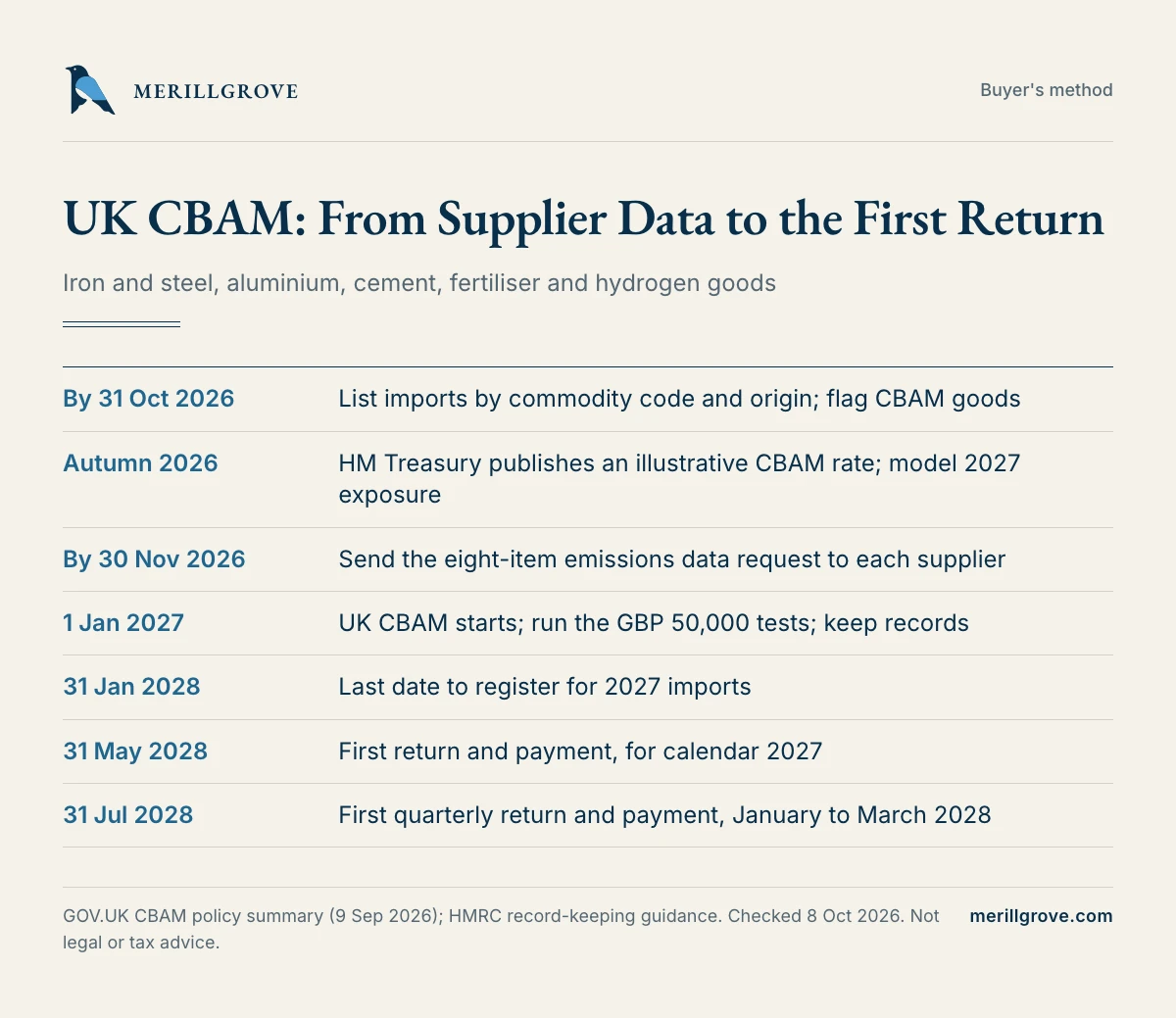 *UK CBAM dates for an importer of covered goods.*
The Data Request: Eight Items
Send this to each overseas supplier of CBAM goods, in writing:
- The producing installation: name, address and operator.
- The UK 8-digit commodity code for each product you buy, agreed between you.
- Net weight per unit or per shipment, excluding packaging, in kilograms.
- Emissions intensity in tCO2e per tonne for calendar 2026, and when 2027 data will be available.
- The verifier's name and its accreditation, against ISO 14065 and ISO/IEC 17029.
- The verification report, or a good-specific verification summary.
- Emissions for precursor goods, such as the steel used in a fabricated part, actual or default.
- Any carbon price paid where the goods were made, with the evidence needed for Carbon Price Relief.
Ask whether the supplier already prepares EU CBAM data: the UK methods are designed to work with the EU's. Then put it in the contract: who supplies what, by when, and who bears the extra cost if verified data is late and defaults apply. See supply agreement commercial terms. For new suppliers, add the questions to your supplier qualification questionnaire.
Records from Day One
Keep records for six years: commodity code and description, tax point date, value, net weight, any exemption evidence, and the verification document behind any actual emissions you report. HMRC can charge a fixed GBP 500 penalty for failing to keep CBAM records.
Action List, Dated
- By 31 October 2026: list your imports by commodity code and origin; flag CBAM goods; total their value for 2026.
- Autumn 2026: read HM Treasury's illustrative rate when published, and model your 2027 exposure.
- By 30 November 2026: send the eight-item request to every supplier of CBAM goods.
- 1 January 2027: UK CBAM starts. Start the forward and backward tests and the records.
- 31 January 2028: last date to register for 2027 imports.
- 31 May 2028: first return and payment, for calendar 2027.
- 31 July 2028: first quarterly return and payment, for January to March 2028.
Next Step
Start with the free 12 checks and justified-increase quick calculator for the CBAM lines that will follow: get the checklist.
Sources (checked 8 October 2026): GOV.UK, CBAM policy summary, https://www.gov.uk/government/publications/carbon-border-adjustment-mechanism-cbam-policy-summary/carbon-border-adjustment-mechanism-cbam-policy-summary; HMRC, Keeping records for CBAM, https://www.gov.uk/guidance/keeping-records-for-carbon-border-adjustment-mechanism-cbam; GOV.UK, Prepare for CBAM, https://www.gov.uk/government/collections/carbon-border-adjustment-mechanism. Last checked: 8 October 2026. Commercial guidance, not legal, customs or tax advice.
Want This Checked for You?
Send the notice, the quotes or the supplier details. We tell you what to question first, and the fee is agreed before any work starts.
More on Trade Triggers
 Trade TriggersUS Wood Products Tariff Rises on 1 January 2027: Cabinets, Vanities and FurnitureSection 232 duty on kitchen cabinets and vanities rises from 25% to 50%, and on upholstered wooden furniture to 30%, on 1 January 2027. A dated plan.
 Trade TriggersIEEPA Tariff Refunds: What Importers Should CheckIEEPA tariff refunds go to the importer of record. What to check in ACE, what to ask vendors who charged you a tariff surcharge, and a worked example.
 Trade TriggersEU Steel Safeguard Changes in 2026: What Steel Buyers Should CheckThe EU's new steel regime: quotas from 1 July 2026, a 50% out-of-quota duty and melt and pour evidence from 1 October. How to test a steel surcharge.